p.44 抽出テキスト
According to current guidelines, an immediate invasive strategy (within 2 h from admission) should be applied to very high-risk patients, mostly with electrical or haemodynamic instability.426 These patients were excluded from all major randomized ACS trials. In addition, patients with severe symptoms, refractory to medical therapy, or those with electrocardiogram (ECG) signs suggesting the left main stem as a culprit vessel should be promptly referred for coronary angiography. An early invasive strategy (within 24 h) should be applied to high-risk patients, especially those with markedly elevated troponins, dynamic ST/T-segment changes, transient ST-segment elevation, or a GRACE risk score >140.

6.3 Ischaemia with no obstructive

coronary artery disease in diabetes Details on the role of ischaemia with no obstructive CAD are outlined in the Supplementary data online, Section 3.2.

7 Heart failure and diabetes

7.1 Definition and pathophysiology

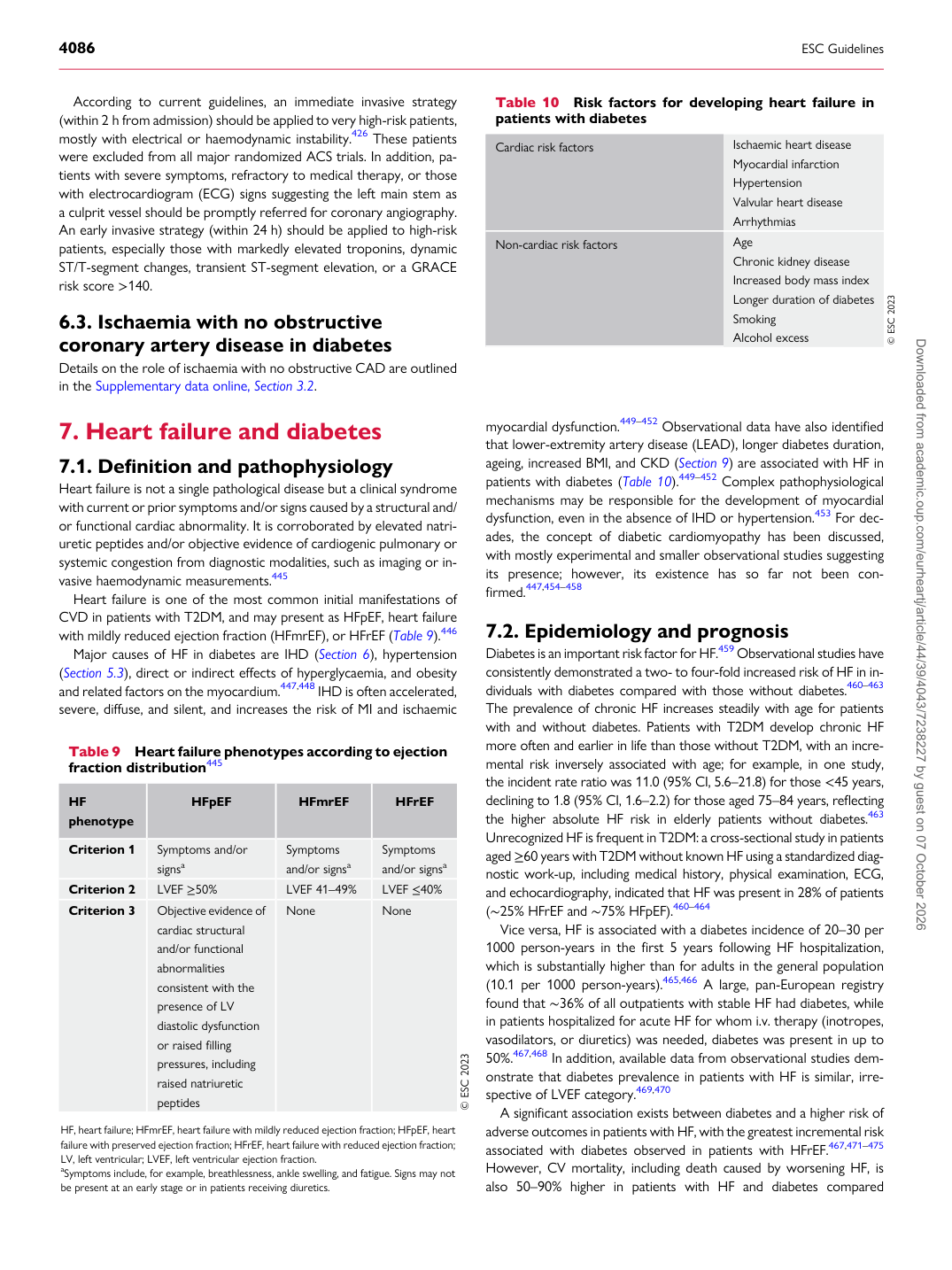
Heart failure is not a single pathological disease but a clinical syndrome with current or prior symptoms and/or signs caused by a structural and/ or functional cardiac abnormality. It is corroborated by elevated natriuretic peptides and/or objective evidence of cardiogenic pulmonary or systemic congestion from diagnostic modalities, such as imaging or invasive haemodynamic measurements.445 Heart failure is one of the most common initial manifestations of CVD in patients with T2DM, and may present as HFpEF, heart failure with mildly reduced ejection fraction (HFmrEF), or HFrEF (Table 9).446 Major causes of HF in diabetes are IHD (Section 6), hypertension (Section 5.3), direct or indirect effects of hyperglycaemia, and obesity and related factors on the myocardium.447,448 IHD is often accelerated, severe, diffuse, and silent, and increases the risk of MI and ischaemic myocardial dysfunction.449–452 Observational data have also identified that lower-extremity artery disease (LEAD), longer diabetes duration, ageing, increased BMI, and CKD (Section 9) are associated with HF in patients with diabetes (Table 10).449–452 Complex pathophysiological mechanisms may be responsible for the development of myocardial dysfunction, even in the absence of IHD or hypertension.453 For decades, the concept of diabetic cardiomyopathy has been discussed, with mostly experimental and smaller observational studies suggesting its presence; however, its existence has so far not been confirmed.447,454–458

7.2 Epidemiology and prognosis

Diabetes is an important risk factor for HF.459 Observational studies have consistently demonstrated a two- to four-fold increased risk of HF in individuals with diabetes compared with those without diabetes.460–463 The prevalence of chronic HF increases steadily with age for patients with and without diabetes. Patients with T2DM develop chronic HF more often and earlier in life than those without T2DM, with an incremental risk inversely associated with age; for example, in one study, the incident rate ratio was 11.0 (95% CI, 5.6–21.8) for those <45 years, declining to 1.8 (95% CI, 1.6–2.2) for those aged 75–84 years, reflecting the higher absolute HF risk in elderly patients without diabetes.463 Unrecognized HF is frequent in T2DM: a cross-sectional study in patients aged ≥60 years with T2DM without known HF using a standardized diagnostic work-up, including medical history, physical examination, ECG, and echocardiography, indicated that HF was present in 28% of patients (∼25% HFrEF and ∼75% HFpEF).460–464 Vice versa, HF is associated with a diabetes incidence of 20–30 per 1000 person-years in the first 5 years following HF hospitalization, which is substantially higher than for adults in the general population (10.1 per 1000 person-years).465,466 A large, pan-European registry found that ∼36% of all outpatients with stable HF had diabetes, while in patients hospitalized for acute HF for whom i.v. therapy (inotropes, vasodilators, or diuretics) was needed, diabetes was present in up to 50%.467,468 In addition, available data from observational studies demonstrate that diabetes prevalence in patients with HF is similar, irrespective of LVEF category.469,470 A significant association exists between diabetes and a higher risk of adverse outcomes in patients with HF, with the greatest incremental risk associated with diabetes observed in patients with HFrEF.467,471–475 However, CV mortality, including death caused by worsening HF, is also 50–90% higher in patients with HF and diabetes compared

Table 9 Heart failure phenotypes according to ejection fraction distribution445

HF phenotype HFpEF HFmrEF HFrEF

Criterion 1 Symptoms and/or

signsa Symptoms

and/or signsa Symptoms

and/or signsa

Criterion 2 LVEF ≥50% LVEF 41–49% LVEF ≤40% Criterion 3 Objective evidence of

cardiac structural and/or functional abnormalities consistent with the presence of LV diastolic dysfunction or raised filling pressures, including raised natriuretic peptides None None © ESC 2023

HF, heart failure; HFmrEF, heart failure with mildly reduced ejection fraction; HFpEF, heart failure with preserved ejection fraction; HFrEF, heart failure with reduced ejection fraction; LV, left ventricular; LVEF, left ventricular ejection fraction. aSymptoms include, for example, breathlessness, ankle swelling, and fatigue. Signs may not be present at an early stage or in patients receiving diuretics. Table 10 Risk factors for developing heart failure in patients with diabetes

Cardiac risk factors Ischaemic heart disease

Myocardial infarction Hypertension Valvular heart disease Arrhythmias

Non-cardiac risk factors Age

Chronic kidney disease Increased body mass index Longer duration of diabetes Smoking Alcohol excess © ESC 2023 Downloaded from academic.oup.com/eurheartj/article/44/39/4043/7238227 by guest on 07 October 2026