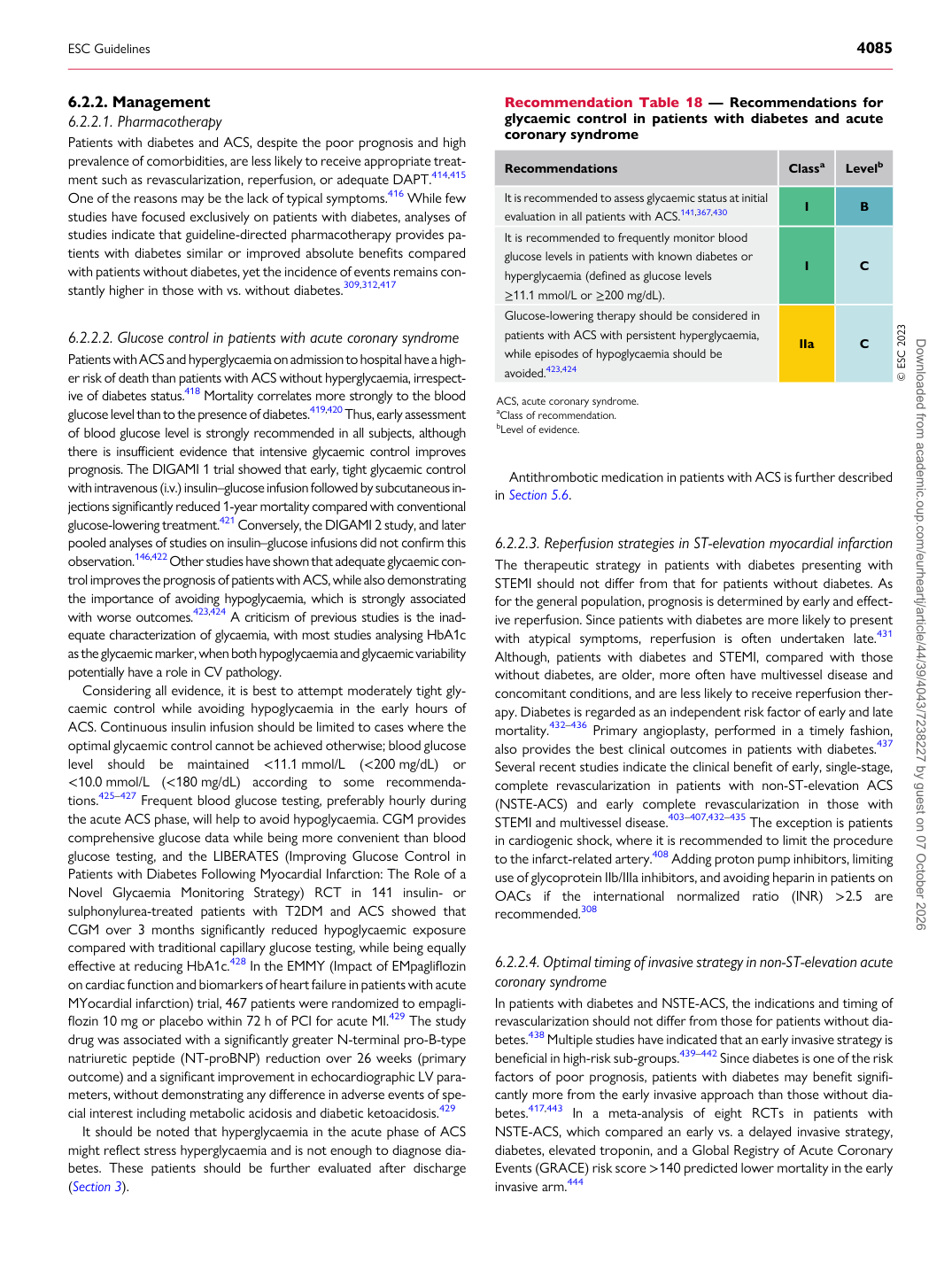
p.43 抽出テキスト
6.2.2 Management

6.2.2.1. Pharmacotherapy Patients with diabetes and ACS, despite the poor prognosis and high prevalence of comorbidities, are less likely to receive appropriate treatment such as revascularization, reperfusion, or adequate DAPT.414,415 One of the reasons may be the lack of typical symptoms.416 While few studies have focused exclusively on patients with diabetes, analyses of studies indicate that guideline-directed pharmacotherapy provides patients with diabetes similar or improved absolute benefits compared with patients without diabetes, yet the incidence of events remains constantly higher in those with vs. without diabetes.309,312,417

6.2.2.2 Glucose control in patients with acute coronary syndrome

Patients with ACS and hyperglycaemia on admission to hospital have a higher risk of death than patients with ACS without hyperglycaemia, irrespective of diabetes status.418 Mortality correlates more strongly to the blood glucose level than to the presence of diabetes.419,420 Thus, early assessment of blood glucose level is strongly recommended in all subjects, although there is insufficient evidence that intensive glycaemic control improves prognosis. The DIGAMI 1 trial showed that early, tight glycaemic control with intravenous (i.v.) insulin–glucose infusion followed by subcutaneous injections significantly reduced 1-year mortality compared with conventional glucose-lowering treatment.421 Conversely, the DIGAMI 2 study, and later pooled analyses of studies on insulin–glucose infusions did not confirm this observation.146,422 Other studies have shown that adequate glycaemic control improves the prognosis of patients with ACS, while also demonstrating the importance of avoiding hypoglycaemia, which is strongly associated with worse outcomes.423,424 A criticism of previous studies is the inadequate characterization of glycaemia, with most studies analysing HbA1c as the glycaemic marker, when both hypoglycaemia and glycaemic variability potentially have a role in CV pathology. Considering all evidence, it is best to attempt moderately tight glycaemic control while avoiding hypoglycaemia in the early hours of ACS. Continuous insulin infusion should be limited to cases where the optimal glycaemic control cannot be achieved otherwise; blood glucose level should be maintained <11.1 mmol/L (<200 mg/dL) or <10.0 mmol/L (<180 mg/dL) according to some recommendations.425–427 Frequent blood glucose testing, preferably hourly during the acute ACS phase, will help to avoid hypoglycaemia. CGM provides comprehensive glucose data while being more convenient than blood glucose testing, and the LIBERATES (Improving Glucose Control in Patients with Diabetes Following Myocardial Infarction: The Role of a Novel Glycaemia Monitoring Strategy) RCT in 141 insulin- or sulphonylurea-treated patients with T2DM and ACS showed that CGM over 3 months significantly reduced hypoglycaemic exposure compared with traditional capillary glucose testing, while being equally effective at reducing HbA1c.428 In the EMMY (Impact of EMpagliflozin on cardiac function and biomarkers of heart failure in patients with acute MYocardial infarction) trial, 467 patients were randomized to empagliflozin 10 mg or placebo within 72 h of PCI for acute MI.429 The study drug was associated with a significantly greater N-terminal pro-B-type natriuretic peptide (NT-proBNP) reduction over 26 weeks (primary outcome) and a significant improvement in echocardiographic LV parameters, without demonstrating any difference in adverse events of special interest including metabolic acidosis and diabetic ketoacidosis.429 It should be noted that hyperglycaemia in the acute phase of ACS might reflect stress hyperglycaemia and is not enough to diagnose diabetes. These patients should be further evaluated after discharge (Section 3). Antithrombotic medication in patients with ACS is further described in Section 5.6.

6.2.2.3 Reperfusion strategies in ST-elevation myocardial infarction

The therapeutic strategy in patients with diabetes presenting with STEMI should not differ from that for patients without diabetes. As for the general population, prognosis is determined by early and effective reperfusion. Since patients with diabetes are more likely to present with atypical symptoms, reperfusion is often undertaken late.431 Although, patients with diabetes and STEMI, compared with those without diabetes, are older, more often have multivessel disease and concomitant conditions, and are less likely to receive reperfusion therapy. Diabetes is regarded as an independent risk factor of early and late mortality.432–436 Primary angioplasty, performed in a timely fashion, also provides the best clinical outcomes in patients with diabetes.437 Several recent studies indicate the clinical benefit of early, single-stage, complete revascularization in patients with non-ST-elevation ACS (NSTE-ACS) and early complete revascularization in those with STEMI and multivessel disease.403–407,432–435 The exception is patients in cardiogenic shock, where it is recommended to limit the procedure to the infarct-related artery.408 Adding proton pump inhibitors, limiting use of glycoprotein IIb/IIIa inhibitors, and avoiding heparin in patients on OACs if the international normalized ratio (INR) >2.5 are recommended.308

6.2.2.4 Optimal timing of invasive strategy in non-ST-elevation acute

coronary syndrome In patients with diabetes and NSTE-ACS, the indications and timing of revascularization should not differ from those for patients without diabetes.438 Multiple studies have indicated that an early invasive strategy is beneficial in high-risk sub-groups.439–442 Since diabetes is one of the risk factors of poor prognosis, patients with diabetes may benefit significantly more from the early invasive approach than those without diabetes.417,443 In a meta-analysis of eight RCTs in patients with NSTE-ACS, which compared an early vs. a delayed invasive strategy, diabetes, elevated troponin, and a Global Registry of Acute Coronary Events (GRACE) risk score >140 predicted lower mortality in the early invasive arm.444

Recommendation Table 18 — Recommendations for glycaemic control in patients with diabetes and acute coronary syndrome

Recommendations Classa Levelb

It is recommended to assess glycaemic status at initial evaluation in all patients with ACS.141,367,430 I B It is recommended to frequently monitor blood glucose levels in patients with known diabetes or hyperglycaemia (defined as glucose levels ≥11.1 mmol/L or ≥200 mg/dL). I C Glucose-lowering therapy should be considered in patients with ACS with persistent hyperglycaemia, while episodes of hypoglycaemia should be avoided.423,424 IIa C © ESC 2023

ACS, acute coronary syndrome. aClass of recommendation. bLevel of evidence.

ESC Guidelines                                                                                                                                                                                          4085

Downloaded from academic.oup.com/eurheartj/article/44/39/4043/7238227 by guest on 07 October 2026