p.42 抽出テキスト
no differences in CV outcomes at follow-up in those who underwent routine screening compared with standard recommendations.386–388 Data from a meta-analysis of five RCTs with 3299 asymptomatic patients with diabetes showed non-invasive CAD screening significantly reduced the rate of any cardiac event by 27% (RR 0.73; 95% CI, 0.55–0.97; P = 0.028), driven by a non-significant reduction in non-fatal MI (RR 0.65; P = 0.062) and hospitalization for HF (RR 0.61; P = 0.1). Still, given the limitations of this analysis (e.g. different screening modalities, heterogenous patient populations), non-invasive, routine screening for CAD in asymptomatic patients is not recommended.389 Moreover, in a recently published RCT involving men aged 65–74 years, routine CVD screening did not significantly reduce the incidence of death from any cause after a median follow-up of 5.6 years, also in a pre-specified diabetes sub-group.296

6.1.3 Management

The comprehensive management of patients with diabetes and established CAD should start with a healthy lifestyle and reducing or eliminating modifiable risk factors such as obesity, hypertension, or dyslipidaemia. The goal of pharmacotherapy should be to substantially reduce serious CV events. Targets and pharmacotherapy for glycaemia, BP, and LDL-C levels are addressed in the respective sections (Section 5.2, 5.4, and 5.5).

6.1.3.1 Pharmacotherapy

6.1.3.1.1. Glucose-lowering medication. Based on the results of various CVOTs, SGLT2 inhibitors and/or GLP-1 RAs are recommended in patients with T2DM and CAD to reduce CV events (Section 5.3).

6.1.3.1.2. Other medications. Due to the diffuse nature of CAD, some patients with diabetes are not amenable to revascularization. Symptom relief might then be achieved by increasing myocardial oxygen supply with long-acting nitrates or CCBs, or by decreasing oxygen demand with the help of beta-blockers, non-dihydropyridine CCBs, ranolazine, or ivabradine. Note that none of these medications improves mortality or the rate of ischaemic events. Beta-blockers with a simultaneous vasodilatory effect (e.g. carvedilol, nebivolol, labetalol) may be preferred due to their neutral or positive metabolic impact.390–392 Ranolazine, a drug that reduces myocardial ischaemia at the cellular level, also has the unique effect of reducing HbA1c, especially in patients with poor metabolic control.393,394 In normotensive patients with diabetes and CAD, ACE-Is or ARBs are also recommended to reduce the risk of CV events, especially in patients with HF or CKD.395–397

6.1.3.2 Revascularization

In patients with diabetes, the indications for myocardial revascularization are the same as those in patients without diabetes, the essential aspects of which are reported in the 2018 ESC/EACTS Guidelines on myocardial revascularization and 2019 ESC Guideline on chronic coronary syndromes.299,308 A detailed description of the evidence from outcome trials on revascularization in patients with diabetes can be found in Supplementary data online, Section 3.1.1. In brief, given the current knowledge, in patients with diabetes and multivessel disease, CABG with arterial grafts is preferred over complex PCI, providing that patient characteristics (e.g. frailty, cerebrovascular disease) are considered.398 PCI with newer-generation drug-eluting stents (DES), whenever possible, is acceptable for patients with less-extensive disease (i.e. single-vessel disease or two-vessel disease not involving the left anterior descending, and those with SYNTAX Score ≤22). Thus, the extent of CAD, lesion complexity, and the risk of major surgery are key points in the decision-making process. Because most of the trials on revascularization contained patients with T2DM, current Guidelines cannot easily be applied to patients with T1DM. It has now been demonstrated that CABG is also superior to PCI in patients with T1DM and multivessel CAD.399

For recommendations for revascularization according to the extent of CAD, see the 2018 ESC/EACTS Guidelines on myocardial revascularization and the 2019 ESC Guideline on chronic coronary syndromes.299,308

6.2 Acute coronary syndromes and

diabetes 6.2.1. Clinical presentation and diagnosis Diabetes is a frequent comorbidity in patients hospitalized for ACS, with an increasing prevalence over the last decade and a high mortality rate.409 Among patients presenting with ST-elevation myocardial infarction (STEMI), ∼25% have a history of diabetes and more than 40% show a previously undiagnosed T2DM or pre-diabetes.410 Patients with diabetes more often present with non-typical symptoms compared with those without diabetes, and this impacts prompt diagnosis and treatment.411 Moreover, patients with diabetes frequently have multivessel disease and multiple coronary lesions, with a higher percentage of highly vulnerable atherosclerotic plaques associated with impaired microvasculature vasodilation.412,413

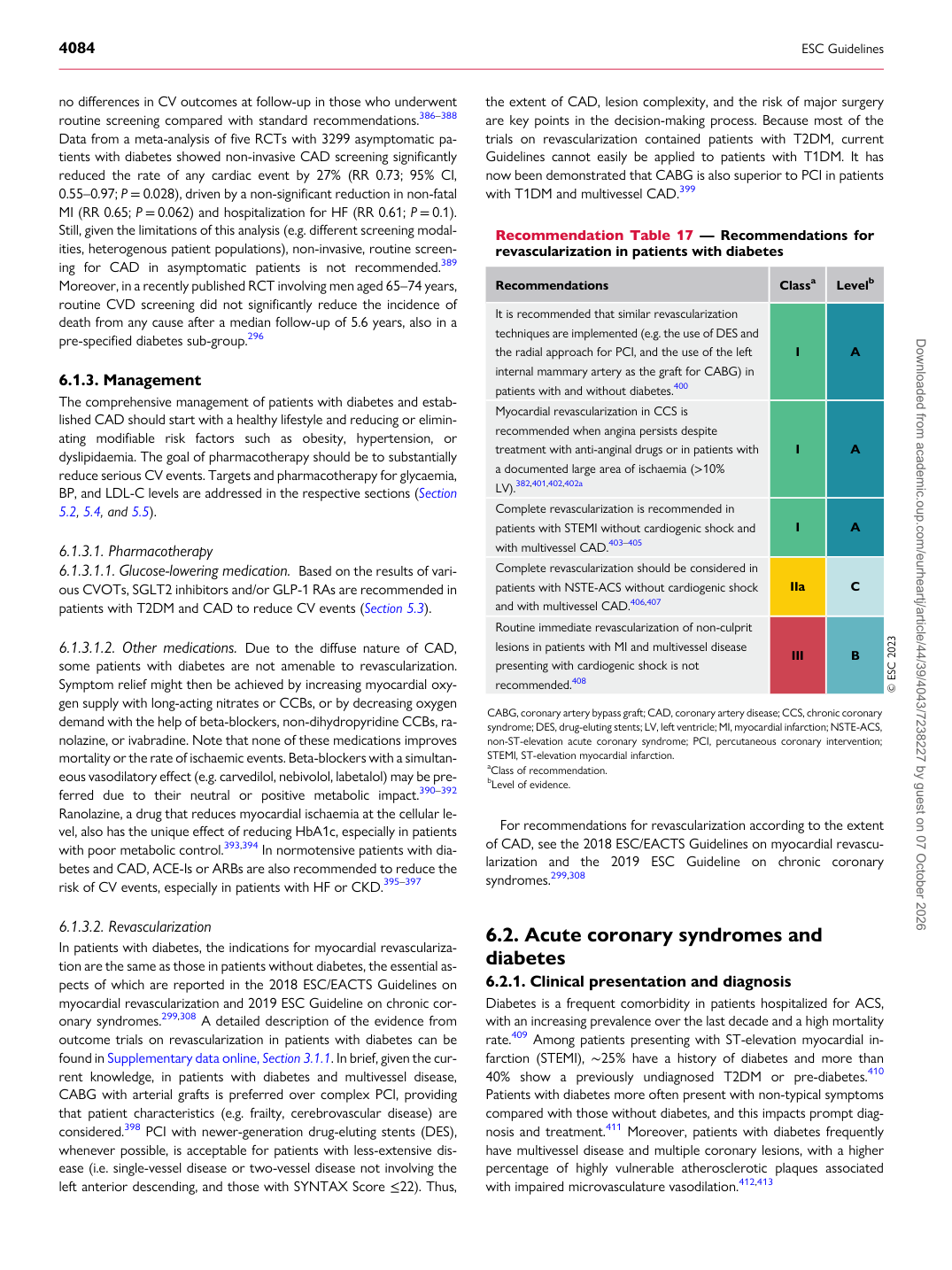
Recommendation Table 17 — Recommendations for revascularization in patients with diabetes

Recommendations Classa Levelb

It is recommended that similar revascularization techniques are implemented (e.g. the use of DES and the radial approach for PCI, and the use of the left internal mammary artery as the graft for CABG) in patients with and without diabetes.400 I A Myocardial revascularization in CCS is recommended when angina persists despite treatment with anti-anginal drugs or in patients with a documented large area of ischaemia (>10% LV).382,401,402,402a I A Complete revascularization is recommended in patients with STEMI without cardiogenic shock and with multivessel CAD.403–405 I A Complete revascularization should be considered in patients with NSTE-ACS without cardiogenic shock and with multivessel CAD.406,407 IIa C Routine immediate revascularization of non-culprit lesions in patients with MI and multivessel disease presenting with cardiogenic shock is not recommended.408 III B © ESC 2023

CABG, coronary artery bypass graft; CAD, coronary artery disease; CCS, chronic coronary syndrome; DES, drug-eluting stents; LV, left ventricle; MI, myocardial infarction; NSTE-ACS, non-ST-elevation acute coronary syndrome; PCI, percutaneous coronary intervention; STEMI, ST-elevation myocardial infarction. aClass of recommendation. bLevel of evidence. Downloaded from academic.oup.com/eurheartj/article/44/39/4043/7238227 by guest on 07 October 2026