p.40 抽出テキスト
5.7 Multifactorial approach to risk-factor

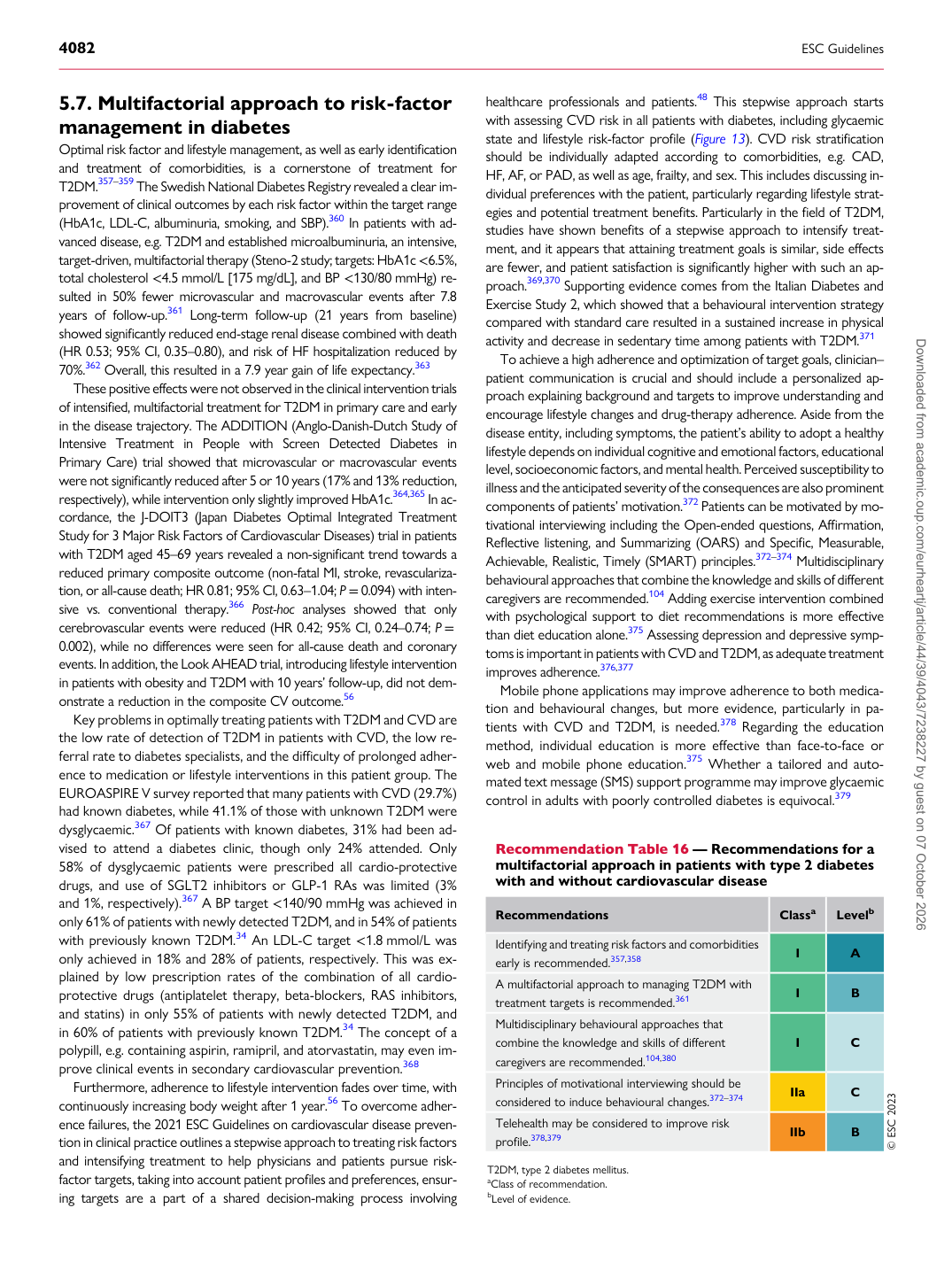
management in diabetes Optimal risk factor and lifestyle management, as well as early identification and treatment of comorbidities, is a cornerstone of treatment for T2DM.357–359 The Swedish National Diabetes Registry revealed a clear improvement of clinical outcomes by each risk factor within the target range (HbA1c, LDL-C, albuminuria, smoking, and SBP).360 In patients with advanced disease, e.g. T2DM and established microalbuminuria, an intensive, target-driven, multifactorial therapy (Steno-2 study; targets: HbA1c <6.5%, total cholesterol <4.5 mmol/L [175 mg/dL], and BP <130/80 mmHg) resulted in 50% fewer microvascular and macrovascular events after 7.8 years of follow-up.361 Long-term follow-up (21 years from baseline) showed significantly reduced end-stage renal disease combined with death (HR 0.53; 95% CI, 0.35–0.80), and risk of HF hospitalization reduced by 70%.362 Overall, this resulted in a 7.9 year gain of life expectancy.363 These positive effects were not observed in the clinical intervention trials of intensified, multifactorial treatment for T2DM in primary care and early in the disease trajectory. The ADDITION (Anglo-Danish-Dutch Study of Intensive Treatment in People with Screen Detected Diabetes in Primary Care) trial showed that microvascular or macrovascular events were not significantly reduced after 5 or 10 years (17% and 13% reduction, respectively), while intervention only slightly improved HbA1c.364,365 In accordance, the J-DOIT3 (Japan Diabetes Optimal Integrated Treatment Study for 3 Major Risk Factors of Cardiovascular Diseases) trial in patients with T2DM aged 45–69 years revealed a non-significant trend towards a reduced primary composite outcome (non-fatal MI, stroke, revascularization, or all-cause death; HR 0.81; 95% CI, 0.63–1.04; P = 0.094) with intensive vs. conventional therapy.366 Post-hoc analyses showed that only cerebrovascular events were reduced (HR 0.42; 95% CI, 0.24–0.74; P = 0.002), while no differences were seen for all-cause death and coronary events. In addition, the Look AHEAD trial, introducing lifestyle intervention in patients with obesity and T2DM with 10 years’ follow-up, did not demonstrate a reduction in the composite CV outcome.56 Key problems in optimally treating patients with T2DM and CVD are the low rate of detection of T2DM in patients with CVD, the low referral rate to diabetes specialists, and the difficulty of prolonged adherence to medication or lifestyle interventions in this patient group. The EUROASPIRE V survey reported that many patients with CVD (29.7%) had known diabetes, while 41.1% of those with unknown T2DM were dysglycaemic.367 Of patients with known diabetes, 31% had been advised to attend a diabetes clinic, though only 24% attended. Only 58% of dysglycaemic patients were prescribed all cardio-protective drugs, and use of SGLT2 inhibitors or GLP-1 RAs was limited (3% and 1%, respectively).367 A BP target <140/90 mmHg was achieved in only 61% of patients with newly detected T2DM, and in 54% of patients with previously known T2DM.34 An LDL-C target <1.8 mmol/L was only achieved in 18% and 28% of patients, respectively. This was explained by low prescription rates of the combination of all cardioprotective drugs (antiplatelet therapy, beta-blockers, RAS inhibitors, and statins) in only 55% of patients with newly detected T2DM, and in 60% of patients with previously known T2DM.34 The concept of a polypill, e.g. containing aspirin, ramipril, and atorvastatin, may even improve clinical events in secondary cardiovascular prevention.368 Furthermore, adherence to lifestyle intervention fades over time, with continuously increasing body weight after 1 year.56 To overcome adherence failures, the 2021 ESC Guidelines on cardiovascular disease prevention in clinical practice outlines a stepwise approach to treating risk factors and intensifying treatment to help physicians and patients pursue riskfactor targets, taking into account patient profiles and preferences, ensuring targets are a part of a shared decision-making process involving healthcare professionals and patients.48 This stepwise approach starts with assessing CVD risk in all patients with diabetes, including glycaemic state and lifestyle risk-factor profile (Figure 13). CVD risk stratification should be individually adapted according to comorbidities, e.g. CAD, HF, AF, or PAD, as well as age, frailty, and sex. This includes discussing individual preferences with the patient, particularly regarding lifestyle strategies and potential treatment benefits. Particularly in the field of T2DM, studies have shown benefits of a stepwise approach to intensify treatment, and it appears that attaining treatment goals is similar, side effects are fewer, and patient satisfaction is significantly higher with such an approach.369,370 Supporting evidence comes from the Italian Diabetes and Exercise Study 2, which showed that a behavioural intervention strategy compared with standard care resulted in a sustained increase in physical activity and decrease in sedentary time among patients with T2DM.371

To achieve a high adherence and optimization of target goals, clinician– patient communication is crucial and should include a personalized approach explaining background and targets to improve understanding and encourage lifestyle changes and drug-therapy adherence. Aside from the disease entity, including symptoms, the patient’s ability to adopt a healthy lifestyle depends on individual cognitive and emotional factors, educational level, socioeconomic factors, and mental health. Perceived susceptibility to illness and the anticipated severity of the consequences are also prominent components of patients’ motivation.372 Patients can be motivated by motivational interviewing including the Open-ended questions, Affirmation, Reflective listening, and Summarizing (OARS) and Specific, Measurable, Achievable, Realistic, Timely (SMART) principles.372–374 Multidisciplinary behavioural approaches that combine the knowledge and skills of different caregivers are recommended.104 Adding exercise intervention combined with psychological support to diet recommendations is more effective than diet education alone.375 Assessing depression and depressive symptoms is important in patients with CVD and T2DM, as adequate treatment improves adherence.376,377 Mobile phone applications may improve adherence to both medication and behavioural changes, but more evidence, particularly in patients with CVD and T2DM, is needed.378 Regarding the education method, individual education is more effective than face-to-face or web and mobile phone education.375 Whether a tailored and automated text message (SMS) support programme may improve glycaemic control in adults with poorly controlled diabetes is equivocal.379

Recommendation Table 16 — Recommendations for a multifactorial approach in patients with type 2 diabetes with and without cardiovascular disease

Recommendations Classa Levelb

Identifying and treating risk factors and comorbidities early is recommended.357,358 I A A multifactorial approach to managing T2DM with treatment targets is recommended.361 I B Multidisciplinary behavioural approaches that combine the knowledge and skills of different caregivers are recommended.104,380 I C Principles of motivational interviewing should be considered to induce behavioural changes.372–374 IIa C Telehealth may be considered to improve risk profile.378,379 IIb B © ESC 2023

T2DM, type 2 diabetes mellitus. aClass of recommendation. bLevel of evidence. Downloaded from academic.oup.com/eurheartj/article/44/39/4043/7238227 by guest on 07 October 2026