p.39 抽出テキスト
5.6.3 Patients with atherosclerotic cardiovascular

disease and/or revascularization requiring long-term oral anticoagulation In patients requiring long-term oral anticoagulants (OACs; e.g. those with AF) undergoing PCI for ACS or CCS, DAPT with clopidogrel is combined with full-dose OACs (triple antithrombotic therapy [TAT]). Combined antithrombotic drugs, while effective, increase major bleeding risk.337,338 RCTs have compared TAT with dual antithrombotic therapy (DAT) combining an OAC mostly with clopidogrel, in patients with AF and ACS or post-PCI (Supplementary data online, Table S14). These RCTs have some common features: a primary outcome of safety comprising moderate-to-major, often BARC-defined, bleeding (Supplementary data online, Figure S7); efficacy (including CV death, MI, stroke, as well as revascularization, and/ or stent thrombosis) as a secondary endpoint, often with a noninferiority comparison; relatively short follow-up (6–14 months); and limited sample size with few patients with diabetes (28–37% across RCTs; Supplementary data online, Table S14).339–342 Thus, these RCTs are underpowered to assess both the efficacy of DAT and the safety of major bleeding of TAT in patients with diabetes. Moreover, two meta-analyses suggest significantly higher MI and stent thrombosis rates with DAT vs. TAT (Supplementary data online, Table S14).343,344 The lack of high-quality evidence on efficacy, meta-analyses suggesting some harm, and the underlying high CV and stent thrombosis risk in patients with diabetes, indicate that TAT duration should be cautiously and systematically evaluated for both thrombotic and bleeding risks in the individual patient with diabetes. 5.6.4 Preventing gastrointestinal bleeding

Large observational studies or head-to-head RCTs show similar rates of gastrointestinal and non-gastrointestinal major bleeding for single antiplatelet therapy (SAPT) with low-dose ASA or a P2Y12 inhibitor (clopidogrel or ticagrelor).337,338,346–350 Thus, gastrointestinal mucosal bleeding appears to be due to pre-existing mucosal lesions associated with defective primary haemostasis secondary to platelet inhibition, rather than with a specific antiplatelet drug. A meta-analysis showed that gastroprotectant drugs significantly reduce the risk of gastrointestinal bleeding in patients on single or combined antithrombotic drugs.351 This benefit was also observed in the pre-specified subgroup of 6732 patients with diabetes in the COMPASS trial, consistent with large population studies on proton pump inhibitors and OACs (either vitamin K antagonist [VKA] or non-vitamin K antagonist oral anticoagulant [NOACs]).352 Regarding CV safety, the composite of MI, stroke, CV death, CHD, and acute limb ischaemia was similar between pantoprazole and placebo, as was the rate of new-onset diabetes.337,351–355

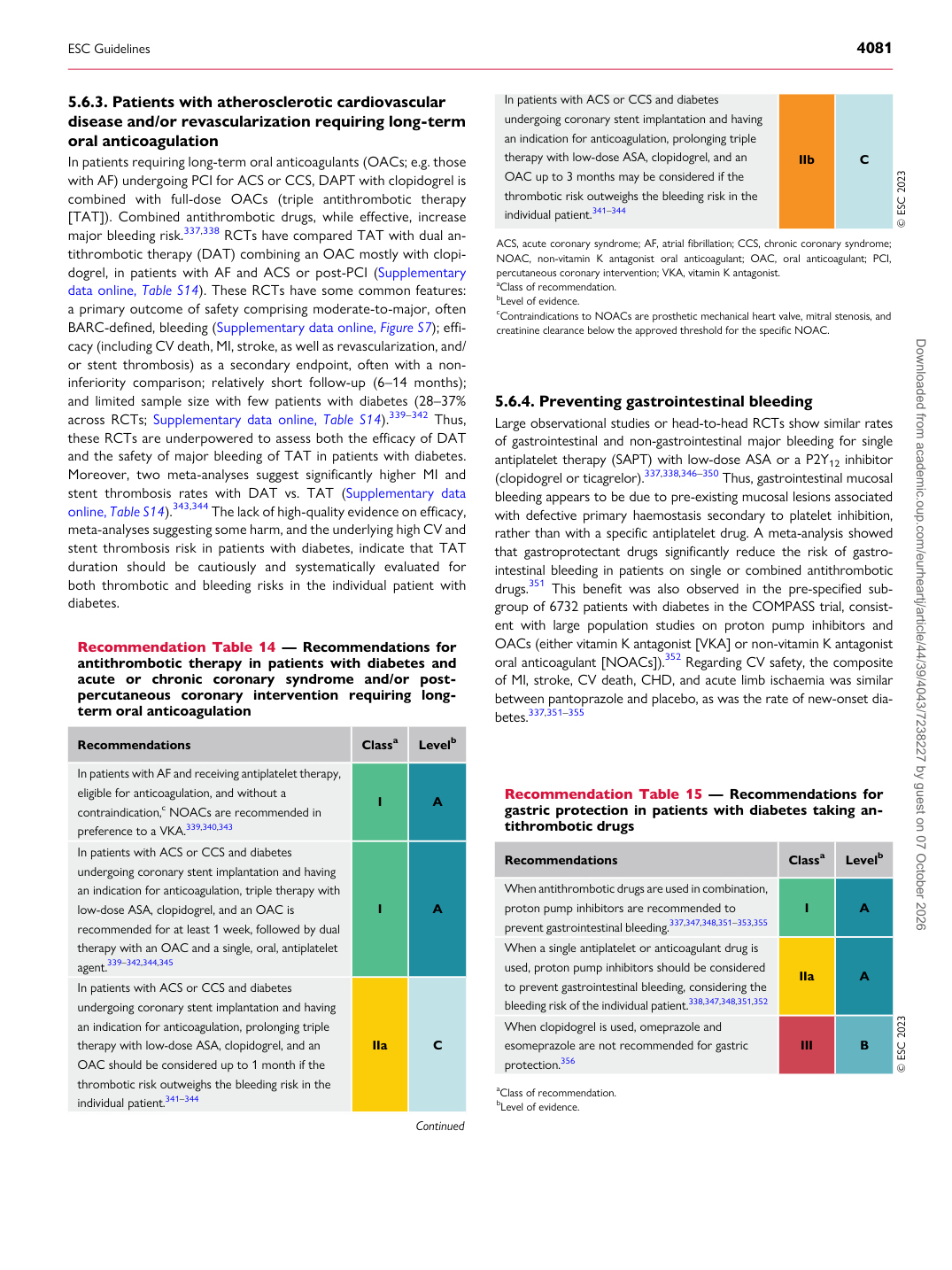
Recommendation Table 14 — Recommendations for antithrombotic therapy in patients with diabetes and acute or chronic coronary syndrome and/or postpercutaneous coronary intervention requiring longterm oral anticoagulation

Recommendations Classa Levelb

In patients with AF and receiving antiplatelet therapy, eligible for anticoagulation, and without a contraindication,c NOACs are recommended in preference to a VKA.339,340,343 I A In patients with ACS or CCS and diabetes undergoing coronary stent implantation and having an indication for anticoagulation, triple therapy with low-dose ASA, clopidogrel, and an OAC is recommended for at least 1 week, followed by dual therapy with an OAC and a single, oral, antiplatelet agent.339–342,344,345 I A In patients with ACS or CCS and diabetes undergoing coronary stent implantation and having an indication for anticoagulation, prolonging triple therapy with low-dose ASA, clopidogrel, and an OAC should be considered up to 1 month if the thrombotic risk outweighs the bleeding risk in the individual patient.341–344 IIa C

Continued In patients with ACS or CCS and diabetes undergoing coronary stent implantation and having

an indication for anticoagulation, prolonging triple therapy with low-dose ASA, clopidogrel, and an OAC up to 3 months may be considered if the thrombotic risk outweighs the bleeding risk in the individual patient.341–344 IIb C © ESC 2023 ACS, acute coronary syndrome; AF, atrial fibrillation; CCS, chronic coronary syndrome; NOAC, non-vitamin K antagonist oral anticoagulant; OAC, oral anticoagulant; PCI, percutaneous coronary intervention; VKA, vitamin K antagonist. aClass of recommendation. bLevel of evidence. cContraindications to NOACs are prosthetic mechanical heart valve, mitral stenosis, and creatinine clearance below the approved threshold for the specific NOAC.

Recommendation Table 15 — Recommendations for gastric protection in patients with diabetes taking antithrombotic drugs

Recommendations Classa Levelb

When antithrombotic drugs are used in combination, proton pump inhibitors are recommended to prevent gastrointestinal bleeding.337,347,348,351–353,355 I A When a single antiplatelet or anticoagulant drug is used, proton pump inhibitors should be considered to prevent gastrointestinal bleeding, considering the bleeding risk of the individual patient.338,347,348,351,352 IIa A When clopidogrel is used, omeprazole and esomeprazole are not recommended for gastric protection.356 III B © ESC 2023 aClass of recommendation. bLevel of evidence.

ESC Guidelines                                                                                                                                                                                          4081

Downloaded from academic.oup.com/eurheartj/article/44/39/4043/7238227 by guest on 07 October 2026