p.36 抽出テキスト
5.6.2 Patients with atherosclerotic cardiovascular

disease and/or revascularization without an indication for long-term oral anticoagulation 5.6.2.1. Chronic coronary syndromes Patients with diabetes and documented significant CAD or with prior revascularization are at very high CV risk, and low-dose ASA (75– 100 mg o.d.) is recommended, although ad hoc RCTs are lacking.48,299 Both the ADAPTABLE (Aspirin Dosing: A Patient-Centric Trial Assessing Benefits and Long-term) and CURRENT-OASIS 7 (Clopidogrel Optimal Loading Dose Usage to Reduce Recurrent EveNTs/Optimal Antiplatelet Strategy for InterventionS) trials showed comparable efficacy of a lower dose (75–100 mg o.d.) and a three- to four-fold higher (300–325 mg o.d.) ASA dose in both chronic coronary syndrome (CCS) and ACS.300,301

Clopidogrel provides an alternative in ASA-intolerant patients or can be combined with low-dose ASA (clopidogrel 75 mg o.d. and ASA 75– 100 mg o.d.) as dual antiplatelet therapy (DAPT) in patients with CCS undergoing percutaneous coronary intervention (PCI). The THEMIS (Effect of Ticagrelor on Health Outcomes in Diabetes Mellitus Patients Intervention Study) trial tested the efficacy and safety of adding the P2Y12 inhibitor ticagrelor (60 mg b.i.d.) or placebo to ASA (75–150 mg o.d.) in 19 220 patients with diabetes and a history of PCI or coronary artery bypass graft (CABG), or a documented stenosis (≥50%) in at least one coronary artery, and no previous MI or stroke

Hyperglycaemia, insulin resistance or deficiency, metabolic imbalances

Atherothrombosis

Hypertension

Smoking

Obesity Dyslipidaemia Fibrin network

Activated

platelets Thrombin generation

Inflammation ROS Platelet turnover

Non-enzymatic protein glycation modifying function Pro-coagulant and

hypofibrinotic

milieu

Endothelial dysfunction NO synthesis

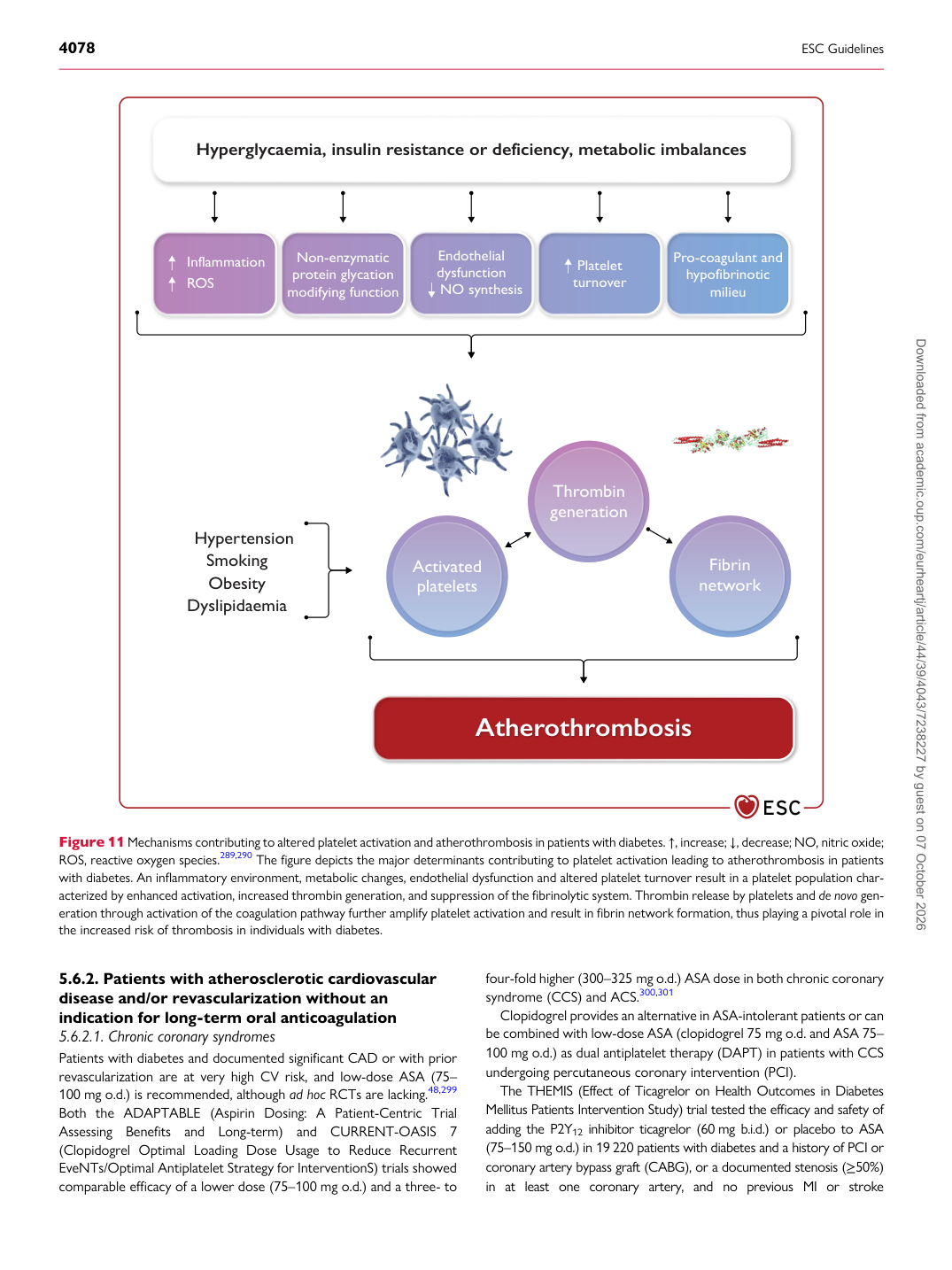
Figure 11 Mechanisms contributing to altered platelet activation and atherothrombosis in patients with diabetes. ↑, increase; ↓, decrease; NO, nitric oxide; ROS, reactive oxygen species.289,290 The figure depicts the major determinants contributing to platelet activation leading to atherothrombosis in patients with diabetes. An inflammatory environment, metabolic changes, endothelial dysfunction and altered platelet turnover result in a platelet population characterized by enhanced activation, increased thrombin generation, and suppression of the fibrinolytic system. Thrombin release by platelets and de novo generation through activation of the coagulation pathway further amplify platelet activation and result in fibrin network formation, thus playing a pivotal role in the increased risk of thrombosis in individuals with diabetes. Downloaded from academic.oup.com/eurheartj/article/44/39/4043/7238227 by guest on 07 October 2026