p.35 抽出テキスト
5.6 Antithrombotic therapy and diabetes

Several mechanisms contribute to platelet activation and coagulation in diabetes (Figure 11). The pharmacology of different antithrombotic agents can be found in the Supplementary data online, Section 2.7 and Figures S1–5.

5.6.1 Patients without a history of symptomatic

atherosclerotic cardiovascular disease or revascularization The largest meta-analysis on 95 000 individual participant data (IPD) of patients at average CV risk (0.57% MACE/year) from six RCTs, included 3818 (4%) patients with diabetes. In the whole cohort, low-dose acetylsalicylic acid (ASA) significantly reduced MACE vs. control (absolute risk reduction [ARR] 0.06%/year; P = 0.0001), while increasing major extracranial bleed (0.10% vs. 0.07%/year; absolute risk increase 0.03%/year; P < 0.0001; Supplementary data online, Table S11).291 A similar proportional benefit-risk profile was also observed in the diabetes subgroup (Supplementary data online, Table S11).

The ASCEND (A Study of Cardiovascular Events iN Diabetes) trial was the largest, adequately powered, placebo-controlled RCT testing low-dose ASA in patients with T1DM or T2DM (n = 15 480) with no evident CVD.292 Over 7.4 years, ASA significantly reduced serious vascular events vs. placebo (8.5% vs. 9.6%, respectively; RR 0.88; 95% CI, 0.79–0.90; P = 0.01; number needed to treat [NNT] 91; Supplementary data online, Table S11), with a relative benefit similar to the previous meta-analysis.291 Bleeding Academic Research Consortium (BARC) type 3–5 bleeding (Supplementary data online, Figure S6) occurred in 4.1% vs. 3.2% of patients in the ASA and placebo arms, respectively (RR 1.29; 95% CI, 1.09–1.52; P = 0.003; number needed to harm [NNH] 111). ASA-associated major bleeding excess was largely gastrointestinal, without differences in fatal, intracranial, and ocular bleeding. The NNT/NNH ratio was 0.8. The pre-specified sub-group analysis based on vascular risk score at baseline was consistent with the overall population (Supplementary data online, Figure S7). The benefit of ASA in the ASCEND trial was observed on top of statins (75% of patients) and/or anti-hypertensive (∼60% of patients) drugs.292 Consistently, a recent IPD meta-analysis of 18 162 patients with multiple CV risk factors and no previous ASCVD (risk 1.7%/ year) showed a significant benefit of low-dose ASA, incremental to lipid- and BP-lowering drugs. This was also observed in a diabetes subgroup (Supplementary data online, Table S11).293 A 9.2-year follow-up analysis of the ASCEND trial excluded harm of ASA on incident dementia, with a trend towards a reduction (HR 0.89; 95% CI, 0.75–1.06) confirmed by a meta-analysis of three large primary prevention RCTs (HR 0.92; 95% CI, 0.84–1.01; P = 0.09).294 Large, observational, prospective data suggest CAC as a non-invasive biomarker to identify asymptomatic patients at the highest risk of ASCVD or revascularization, with or without diabetes, who may largely benefit from ASA.295 Ongoing trials are testing the relevance of CAC score and related thresholds in improving primary prevention, including in asymptomatic patients with diabetes.296–298 In summary, in patients with diabetes and no history of symptomatic ASCVD or revascularization, ASA (75–100 mg o.d.) may be considered to prevent the first severe vascular event. However, in patients with diabetes with asymptomatic ASCVD (including documented CAD confirmed by imaging) and a higher CV risk, the net benefit of platelet inhibition by ASA may be higher and thus, therapy needs to be individualized.

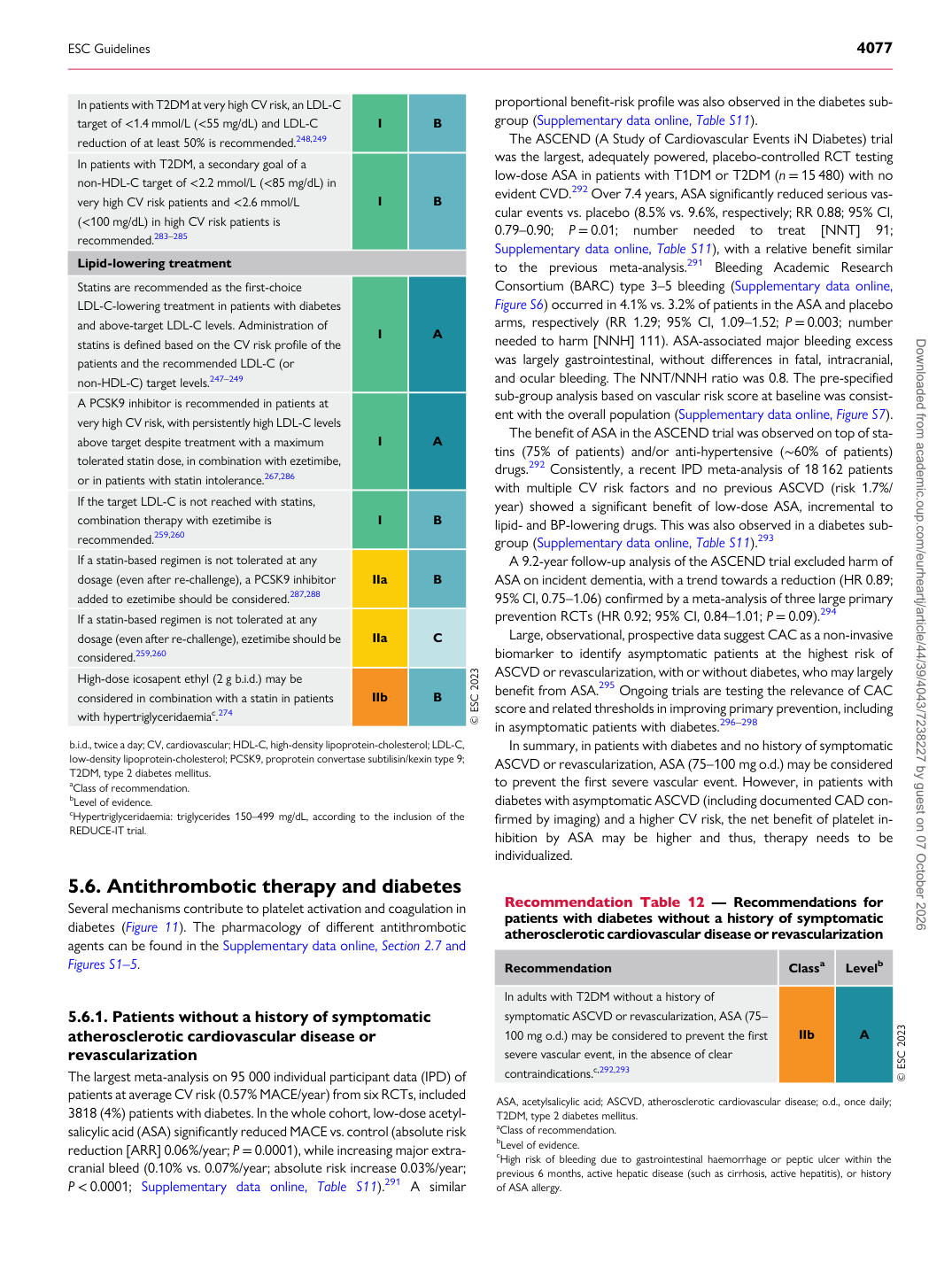
In patients with T2DM at very high CV risk, an LDL-C target of <1.4 mmol/L (<55 mg/dL) and LDL-C reduction of at least 50% is recommended.248,249 I B In patients with T2DM, a secondary goal of a non-HDL-C target of <2.2 mmol/L (<85 mg/dL) in very high CV risk patients and <2.6 mmol/L (<100 mg/dL) in high CV risk patients is recommended.283–285 I B Lipid-lowering treatment Statins are recommended as the first-choice LDL-C-lowering treatment in patients with diabetes and above-target LDL-C levels. Administration of statins is defined based on the CV risk profile of the patients and the recommended LDL-C (or non-HDL-C) target levels.247–249 I A A PCSK9 inhibitor is recommended in patients at very high CV risk, with persistently high LDL-C levels above target despite treatment with a maximum tolerated statin dose, in combination with ezetimibe, or in patients with statin intolerance.267,286 I A If the target LDL-C is not reached with statins, combination therapy with ezetimibe is recommended.259,260 I B If a statin-based regimen is not tolerated at any dosage (even after re-challenge), a PCSK9 inhibitor added to ezetimibe should be considered.287,288 IIa B If a statin-based regimen is not tolerated at any dosage (even after re-challenge), ezetimibe should be considered.259,260 IIa C High-dose icosapent ethyl (2 g b.i.d.) may be considered in combination with a statin in patients with hypertriglyceridaemiac.274 IIb B © ESC 2023

b.i.d., twice a day; CV, cardiovascular; HDL-C, high-density lipoprotein-cholesterol; LDL-C, low-density lipoprotein-cholesterol; PCSK9, proprotein convertase subtilisin/kexin type 9; T2DM, type 2 diabetes mellitus. aClass of recommendation. bLevel of evidence. cHypertriglyceridaemia: triglycerides 150–499 mg/dL, according to the inclusion of the REDUCE-IT trial.

Recommendation Table 12 — Recommendations for patients with diabetes without a history of symptomatic atherosclerotic cardiovascular disease or revascularization

Recommendation Classa Levelb

In adults with T2DM without a history of symptomatic ASCVD or revascularization, ASA (75– 100 mg o.d.) may be considered to prevent the first severe vascular event, in the absence of clear contraindications.c,292,293 IIb A © ESC 2023

ASA, acetylsalicylic acid; ASCVD, atherosclerotic cardiovascular disease; o.d., once daily; T2DM, type 2 diabetes mellitus. aClass of recommendation. bLevel of evidence. cHigh risk of bleeding due to gastrointestinal haemorrhage or peptic ulcer within the previous 6 months, active hepatic disease (such as cirrhosis, active hepatitis), or history of ASA allergy.

ESC Guidelines                                                                                                                                                                                          4077

Downloaded from academic.oup.com/eurheartj/article/44/39/4043/7238227 by guest on 07 October 2026