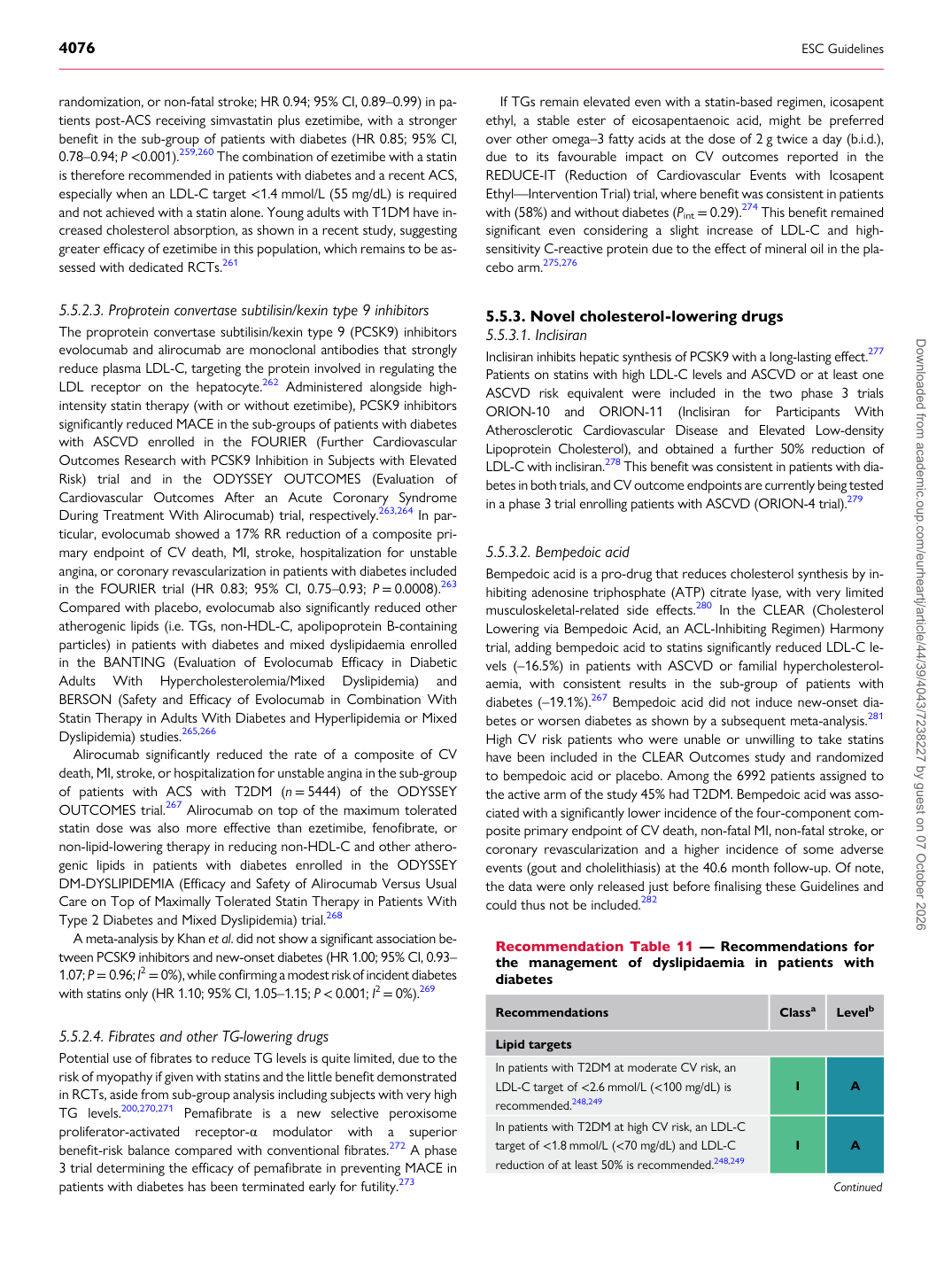
p.34 抽出テキスト
randomization, or non-fatal stroke; HR 0.94; 95% CI, 0.89–0.99) in patients post-ACS receiving simvastatin plus ezetimibe, with a stronger benefit in the sub-group of patients with diabetes (HR 0.85; 95% CI, 0.78–0.94; P <0.001).259,260 The combination of ezetimibe with a statin is therefore recommended in patients with diabetes and a recent ACS, especially when an LDL-C target <1.4 mmol/L (55 mg/dL) is required and not achieved with a statin alone. Young adults with T1DM have increased cholesterol absorption, as shown in a recent study, suggesting greater efficacy of ezetimibe in this population, which remains to be assessed with dedicated RCTs.261

5.5.2.3 Proprotein convertase subtilisin/kexin type 9 inhibitors

The proprotein convertase subtilisin/kexin type 9 (PCSK9) inhibitors evolocumab and alirocumab are monoclonal antibodies that strongly reduce plasma LDL-C, targeting the protein involved in regulating the LDL receptor on the hepatocyte.262 Administered alongside highintensity statin therapy (with or without ezetimibe), PCSK9 inhibitors significantly reduced MACE in the sub-groups of patients with diabetes with ASCVD enrolled in the FOURIER (Further Cardiovascular Outcomes Research with PCSK9 Inhibition in Subjects with Elevated Risk) trial and in the ODYSSEY OUTCOMES (Evaluation of Cardiovascular Outcomes After an Acute Coronary Syndrome During Treatment With Alirocumab) trial, respectively.263,264 In particular, evolocumab showed a 17% RR reduction of a composite primary endpoint of CV death, MI, stroke, hospitalization for unstable angina, or coronary revascularization in patients with diabetes included in the FOURIER trial (HR 0.83; 95% CI, 0.75–0.93; P = 0.0008).263 Compared with placebo, evolocumab also significantly reduced other atherogenic lipids (i.e. TGs, non-HDL-C, apolipoprotein B-containing particles) in patients with diabetes and mixed dyslipidaemia enrolled in the BANTING (Evaluation of Evolocumab Efficacy in Diabetic Adults With Hypercholesterolemia/Mixed Dyslipidemia) and BERSON (Safety and Efficacy of Evolocumab in Combination With Statin Therapy in Adults With Diabetes and Hyperlipidemia or Mixed Dyslipidemia) studies.265,266 Alirocumab significantly reduced the rate of a composite of CV death, MI, stroke, or hospitalization for unstable angina in the sub-group of patients with ACS with T2DM (n = 5444) of the ODYSSEY OUTCOMES trial.267 Alirocumab on top of the maximum tolerated statin dose was also more effective than ezetimibe, fenofibrate, or non-lipid-lowering therapy in reducing non-HDL-C and other atherogenic lipids in patients with diabetes enrolled in the ODYSSEY DM-DYSLIPIDEMIA (Efficacy and Safety of Alirocumab Versus Usual Care on Top of Maximally Tolerated Statin Therapy in Patients With Type 2 Diabetes and Mixed Dyslipidemia) trial.268 A meta-analysis by Khan et al. did not show a significant association between PCSK9 inhibitors and new-onset diabetes (HR 1.00; 95% CI, 0.93– 1.07; P = 0.96; I2 = 0%), while confirming a modest risk of incident diabetes with statins only (HR 1.10; 95% CI, 1.05–1.15; P < 0.001; I2 = 0%).269

5.5.2.4 Fibrates and other TG-lowering drugs

Potential use of fibrates to reduce TG levels is quite limited, due to the risk of myopathy if given with statins and the little benefit demonstrated in RCTs, aside from sub-group analysis including subjects with very high TG levels.200,270,271 Pemafibrate is a new selective peroxisome proliferator-activated receptor-α modulator with a superior benefit-risk balance compared with conventional fibrates.272 A phase 3 trial determining the efficacy of pemafibrate in preventing MACE in patients with diabetes has been terminated early for futility.273 If TGs remain elevated even with a statin-based regimen, icosapent ethyl, a stable ester of eicosapentaenoic acid, might be preferred over other omega–3 fatty acids at the dose of 2 g twice a day (b.i.d.), due to its favourable impact on CV outcomes reported in the REDUCE-IT (Reduction of Cardiovascular Events with Icosapent Ethyl—Intervention Trial) trial, where benefit was consistent in patients with (58%) and without diabetes (Pint = 0.29).274 This benefit remained significant even considering a slight increase of LDL-C and highsensitivity C-reactive protein due to the effect of mineral oil in the placebo arm.275,276

5.5.3 Novel cholesterol-lowering drugs

5.5.3.1. Inclisiran Inclisiran inhibits hepatic synthesis of PCSK9 with a long-lasting effect.277 Patients on statins with high LDL-C levels and ASCVD or at least one ASCVD risk equivalent were included in the two phase 3 trials ORION-10 and ORION-11 (Inclisiran for Participants With Atherosclerotic Cardiovascular Disease and Elevated Low-density Lipoprotein Cholesterol), and obtained a further 50% reduction of LDL-C with inclisiran.278 This benefit was consistent in patients with diabetes in both trials, and CV outcome endpoints are currently being tested in a phase 3 trial enrolling patients with ASCVD (ORION-4 trial).279

5.5.3.2 Bempedoic acid

Bempedoic acid is a pro-drug that reduces cholesterol synthesis by inhibiting adenosine triphosphate (ATP) citrate lyase, with very limited musculoskeletal-related side effects.280 In the CLEAR (Cholesterol Lowering via Bempedoic Acid, an ACL-Inhibiting Regimen) Harmony trial, adding bempedoic acid to statins significantly reduced LDL-C levels (–16.5%) in patients with ASCVD or familial hypercholesterolaemia, with consistent results in the sub-group of patients with diabetes (–19.1%).267 Bempedoic acid did not induce new-onset diabetes or worsen diabetes as shown by a subsequent meta-analysis.281 High CV risk patients who were unable or unwilling to take statins have been included in the CLEAR Outcomes study and randomized to bempedoic acid or placebo. Among the 6992 patients assigned to the active arm of the study 45% had T2DM. Bempedoic acid was associated with a significantly lower incidence of the four-component composite primary endpoint of CV death, non-fatal MI, non-fatal stroke, or coronary revascularization and a higher incidence of some adverse events (gout and cholelithiasis) at the 40.6 month follow-up. Of note, the data were only released just before finalising these Guidelines and could thus not be included.282

Recommendation Table 11 — Recommendations for the management of dyslipidaemia in patients with diabetes

Recommendations Classa Levelb

Lipid targets In patients with T2DM at moderate CV risk, an LDL-C target of <2.6 mmol/L (<100 mg/dL) is recommended.248,249 I A In patients with T2DM at high CV risk, an LDL-C target of <1.8 mmol/L (<70 mg/dL) and LDL-C reduction of at least 50% is recommended.248,249 I A

Continued Downloaded from academic.oup.com/eurheartj/article/44/39/4043/7238227 by guest on 07 October 2026