p.32 抽出テキスト
Long-term exercise training intervention modestly but significantly reduces SBP (by −7 mmHg) and DBP (by −5 mmHg). Ideally, an exercise prescription aimed at lowering BP in individuals with normal BP or hypertension would include a mix of predominantly aerobic exercise training supplemented with dynamic resistance exercise training.208 A marked improvement in CV risk factors (hypertension, dyslipidaemia, diabetes), associated with marked weight loss, was observed after bariatric surgery.209 In the Look AHEAD trial, those who lost 5 to <10% of body weight had increased odds of achieving a 5 mmHg decrease in SBP and DBP compared with those who lost >10% or <5%.210 The frequency of CV complications appears to be modulated by ethnicity or racial identity.193,211,212

5.4.3.2 Pharmacological treatments in patients with diabetes

If office SBP is ≥140 mmHg and/or DBP is ≥90 mmHg, drug therapy is necessary in combination with non-pharmacological treatment. It is recommended to start with a combination therapy.48 All available BP-lowering drugs can be used, but evidence strongly supports using a renin–angiotensin system (RAS) inhibitor (ACE-I, ARB), particularly in patients with evidence of end-organ damage (albuminuria and left ventricular [LV] hypertrophy).213–216 However, in a recent meta-analysis, RAS inhibitors were not superior to other classes of anti-hypertensive drugs for reducing total or CV mortality and renal events.217 Controlling BP often requires multiple drug therapy with an RAS inhibitor and a calcium channel blocker (CCB) or diuretic, while the combination of an ACE-I with an ARB is not recommended.218 Consider beta-blockers at any treatment step when specifically indicated, e.g. HF, angina, post-MI, AF, or younger women with or planning pregnancy.193 A combination of two or more drugs at fixed doses in a single pill should be considered to improve adherence and to achieve earlier control of BP.48,219 In apparent resistant (including MRA-resistant) hypertension in patients with HFpEF (61% diabetes; post-hoc analysis of PARAGON-HF [Efficacy and Safety of LCZ696 Compared to Valsartan, on Morbidity and Mortality in Heart Failure Patients With Preserved Ejection Fraction] trial) sacubitril/valsartan helped to better control BP compared with valsartan.220

5.4.3.3 Blood pressure changes with glucose-lowering agents

Trials testing GLP-1 RAs have shown a BP decrease with these drugs, partly due to weight loss. A sustained decrease in BP was observed with semaglutide therapy (SBP dose dependent: −1.3 to −2.6 mmHg) with a slight increase in heart rate (+2 to 2.5 beats per minute [b.p.m.]).72 Similar effects were seen in other studies of GLP-1 RAs and derived from meta-analysis.161,221,222 SGLT2 inhibitors induced a larger BP decrease than did GLP-1 RAs without changing heart rate.223–225 A recent meta-analysis including seven RCTs demonstrated that SGLT2 inhibitors were associated with an average reduction of 3.6/1.7 mmHg (systolic/diastolic) in 24 h ambulatory BP, which is comparable with efficacy of low-dose hydrochlorothiazide.224–226

5.4.4 Sex-specific aspects

In general, the diagnosis and treatment of hypertension is comparable between sexes, except for women of child-bearing potential or during pregnancy, when some drugs, such as RAS blockers, can have adverse effects on the foetus, especially in early gestation.227 The possible effect of oral contraceptives on BP should also be considered.48 There is some evidence from RCTs that BP targets during pregnancy should range from 110 to 135 mmHg for SBP and 80 to 85 mmHg for DBP.228 This is also supported by the recent CHAP (Chronic Hypertension and Pregnancy) study of mild chronic hypertension in pregnancy, where 16% of the pregnant women had diabetes.229 The strategy targeting a BP of <140/90 mmHg was related with better pregancy outcomes without an increase in the number of Small for Gestational Age babies.

Women usually show greater differences in BP and higher proportions of hypertension than men already at diagnosis of T2DM compared with women and men without T2DM, and worse BP control thereafter.191,230 Moreover sex-specific, hypertension-mediated organ damage was evidenced with a very high risk of HFpEF in women, especially in the presence of diabetes.231

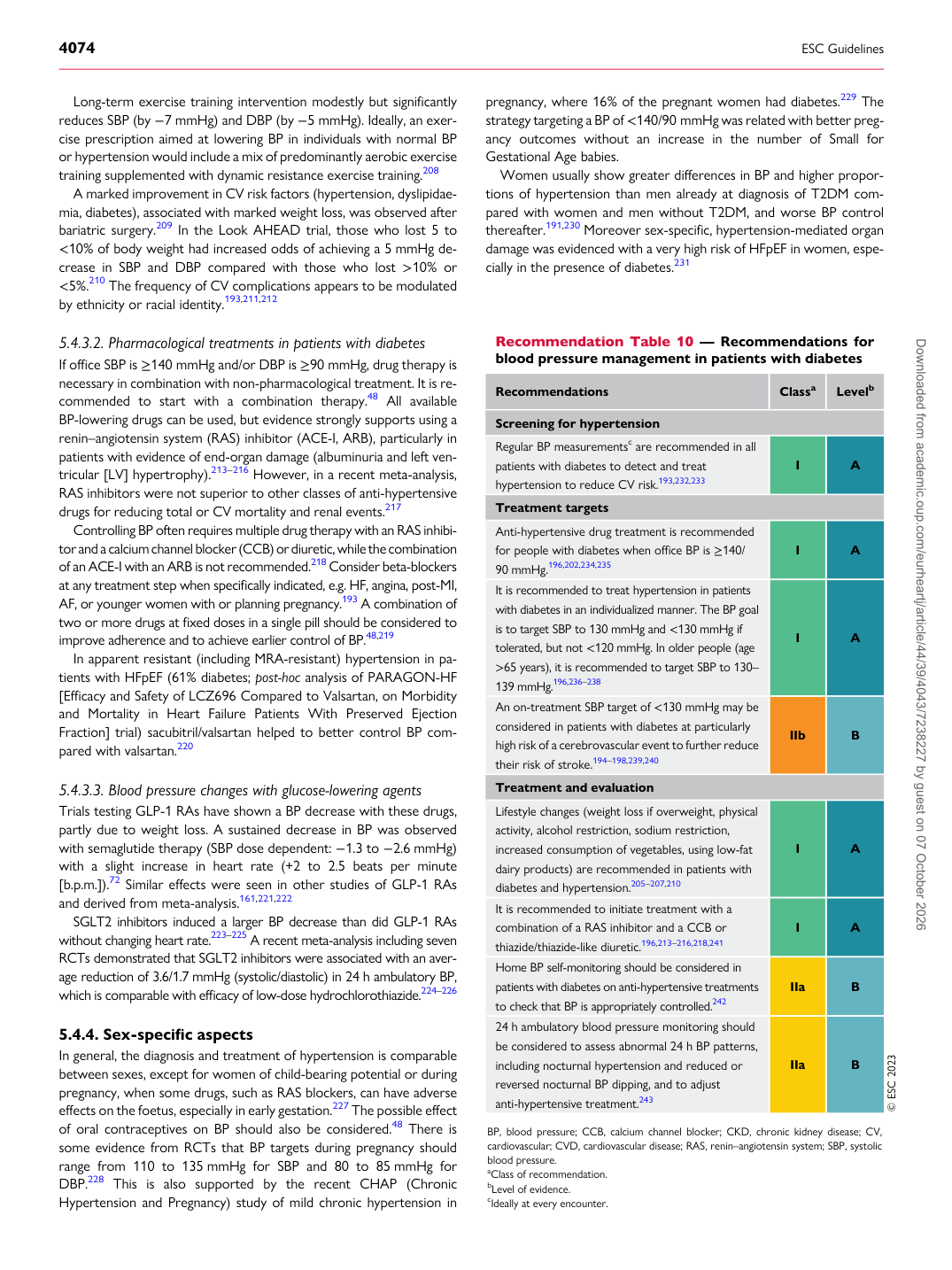
Recommendation Table 10 — Recommendations for blood pressure management in patients with diabetes

Recommendations Classa Levelb

Screening for hypertension Regular BP measurementsc are recommended in all patients with diabetes to detect and treat hypertension to reduce CV risk.193,232,233 I A Treatment targets Anti-hypertensive drug treatment is recommended for people with diabetes when office BP is ≥140/ 90 mmHg.196,202,234,235 I A It is recommended to treat hypertension in patients with diabetes in an individualized manner. The BP goal is to target SBP to 130 mmHg and <130 mmHg if tolerated, but not <120 mmHg. In older people (age >65 years), it is recommended to target SBP to 130– 139 mmHg.196,236–238 I A An on-treatment SBP target of <130 mmHg may be considered in patients with diabetes at particularly high risk of a cerebrovascular event to further reduce their risk of stroke.194–198,239,240 IIb B Treatment and evaluation Lifestyle changes (weight loss if overweight, physical activity, alcohol restriction, sodium restriction, increased consumption of vegetables, using low-fat dairy products) are recommended in patients with diabetes and hypertension.205–207,210 I A It is recommended to initiate treatment with a combination of a RAS inhibitor and a CCB or thiazide/thiazide-like diuretic.196,213–216,218,241 I A Home BP self-monitoring should be considered in patients with diabetes on anti-hypertensive treatments to check that BP is appropriately controlled.242 IIa B 24 h ambulatory blood pressure monitoring should be considered to assess abnormal 24 h BP patterns, including nocturnal hypertension and reduced or reversed nocturnal BP dipping, and to adjust anti-hypertensive treatment.243 IIa B © ESC 2023

BP, blood pressure; CCB, calcium channel blocker; CKD, chronic kidney disease; CV, cardiovascular; CVD, cardiovascular disease; RAS, renin–angiotensin system; SBP, systolic blood pressure. aClass of recommendation. bLevel of evidence. cIdeally at every encounter. Downloaded from academic.oup.com/eurheartj/article/44/39/4043/7238227 by guest on 07 October 2026