p.31 抽出テキスト
<140 mmHg and diastolic blood pressure (DBP) to <90 mmHg in patients with diabetes. However, the optimal BP target in patients with diabetes is still a matter of debate. The UKPDS post-trial, 10-year follow-up study reported no benefits persisting from the earlier period of tight BP control with respect to macrovascular events, death, and microvascular complications, while initial between-group BP differences were no longer maintained.132 RCTs evaluating the benefits and risks of more intense compared with standard hypertension treatment strategies in patients with diabetes are summarized in Supplementary data online, Table S10. In a meta-analysis of RCTs involving patients with diabetes or prediabetes, an SBP reduction to ≤135 mmHg compared with a less intensive control reduced the RR of all-cause mortality by 10% (odds ratio [OR] 0.90; 95% CI, 0.83–0.98), whereas more intensive BP control (≤130 mmHg) was associated with a greater reduction in stroke but did not reduce other events.194,195 Similarly, anti-hypertensive treatment significantly reduced mortality in people with T2DM, CAD, HF, and stroke, with an achieved mean SBP of 138 mmHg, whereas only stroke was reduced significantly, with a mean SBP of 122 mmHg compared with higher BP values.196

Thus, reducing SBP to <130 mmHg may benefit patients with a particularly high risk of a cerebrovascular event, such as those with a history of stroke.193,194,196–200 However, SBP >140 mmHg or <120 mmHg were related to higher risk of adverse renal outcomes in patients with diabetes when compared with those without diabetes and with high CV risk.199–202 The 2018 ESC/ESH Guidelines for the management of arterial hypertension recommend that in all patients with diabetes, office BP should be targeted to an SBP of 130 mmHg, and lower if tolerated but not <120 mmHg; DBP should be lowered to <80 mmHg but not <70 mmHg.193 In older patients (age ≥65 years), the SBP target range should be 130–140 mmHg if tolerated.193 However, more recent data challenge these recommendations for all patients with diabetes, and highlight a potential need for more individualized target levels.157,203,204 The 2021 ESC Prevention Guideline recommends office SBP treatment target ranges of 120–130 mmHg in patients with diabetes, with lower SBP acceptable if tolerated until the age of 69 years.48 In patients aged ≥70 years, SBP values <140 mmHg, down to 130 mmHg if tolerated are recommended. DBP treatment target <80 mmHg is recommended for all treated patients.

5.4.3 Management of hypertension

5.4.3.1. Effects of lifestyle intervention and weight loss Diets rich in vegetables, fruits, and low-fat dairy products, such as the Mediterranean diets and Dietary Approaches to Stop Hypertension-style eating patterns (including reducing sodium to <100 mmol/day and increasing potassium intake), improve BP control.205–207

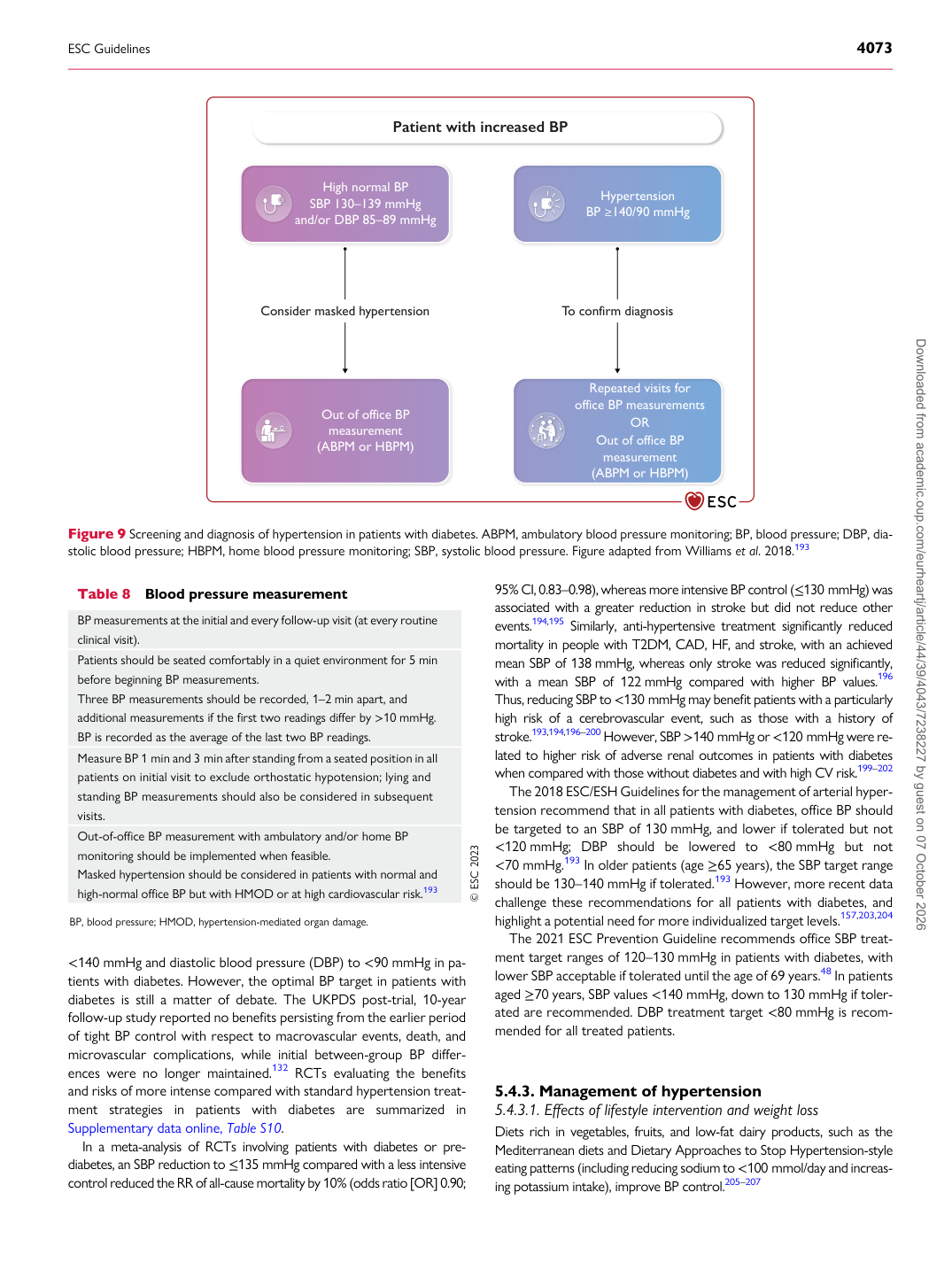
Patient with increased BP

High normal BP SBP 130–139 mmHg and/or DBP 85–89 mmHg Hypertension BP ≥140/90 mmHg

Out of office BP measurement (ABPM or HBPM) Repeated visits for office BP measurements

Consider masked hypertension To confirm diagnosis

Out of office BP measurement (ABPM or HBPM)

OR

Figure 9 Screening and diagnosis of hypertension in patients with diabetes. ABPM, ambulatory blood pressure monitoring; BP, blood pressure; DBP, diastolic blood pressure; HBPM, home blood pressure monitoring; SBP, systolic blood pressure. Figure adapted from Williams et al. 2018.193

Table 8 Blood pressure measurement BP measurements at the initial and every follow-up visit (at every routine clinical visit). Patients should be seated comfortably in a quiet environment for 5 min before beginning BP measurements. Three BP measurements should be recorded, 1–2 min apart, and additional measurements if the first two readings differ by >10 mmHg. BP is recorded as the average of the last two BP readings. Measure BP 1 min and 3 min after standing from a seated position in all patients on initial visit to exclude orthostatic hypotension; lying and standing BP measurements should also be considered in subsequent visits. Out-of-office BP measurement with ambulatory and/or home BP monitoring should be implemented when feasible. Masked hypertension should be considered in patients with normal and high-normal office BP but with HMOD or at high cardiovascular risk.193 © ESC 2023

BP, blood pressure; HMOD, hypertension-mediated organ damage.

ESC Guidelines                                                                                                                                                                                          4073

Downloaded from academic.oup.com/eurheartj/article/44/39/4043/7238227 by guest on 07 October 2026