p.30 抽出テキスト
ASCVD-related events.164 While empagliflozin and canagliflozin improved the composite of CV death, MI, and stroke, all of the SGLT2 inhibitors reduce HF-related endpoints (Section 7) and progression of kidney disease (Section 9).155,190 Thus, SGLT2 inhibitors are recommended to reduce HF hospitalization in patients with T2DM with or at risk of HF, or who have CKD. In patients with newly diagnosed T2DM without CVD or other major CV risk factors who are at low or moderate CV risk, factors other than mitigating CV and kidney risk may play a greater role in selecting glucose-lowering medications, such as affordability, accessibility, side effects, weight benefits, tolerability, and ease of use.

5.4 Blood pressure and diabetes

In the most recent ESC/EURObservational Research Programme (EORP) EUROASPIRE surveys, history of hypertension was present in 80% of men and 87% of women with known diabetes and in 74% of men and 81% of women with newly diagnosed diabetes with a history of coronary heart disease (CHD).191

5.4.1 Screening and diagnosis

Regular BP measurements under standardized conditions are mandatory in all patients with diabetes (Figure 9; Table 8). Hypertension should be confirmed in both arms using multiple readings, including measurements on separate days.48,157 In patients with CVD and values >180/110 mmHg, it could be reasonable to diagnose hypertension at a single visit.192 Details on BP measurements are comprehensively summarized in the 2018 ESC/European Society of Hypertension (ESH) Guidelines for the management of arterial hypertension and in the Supplementary data online, Section 2.6.1.193

5.4.2 Treatment targets

Randomized controlled trials have shown the benefit (reduction of stroke, coronary events, and kidney disease) of lowering SBP to

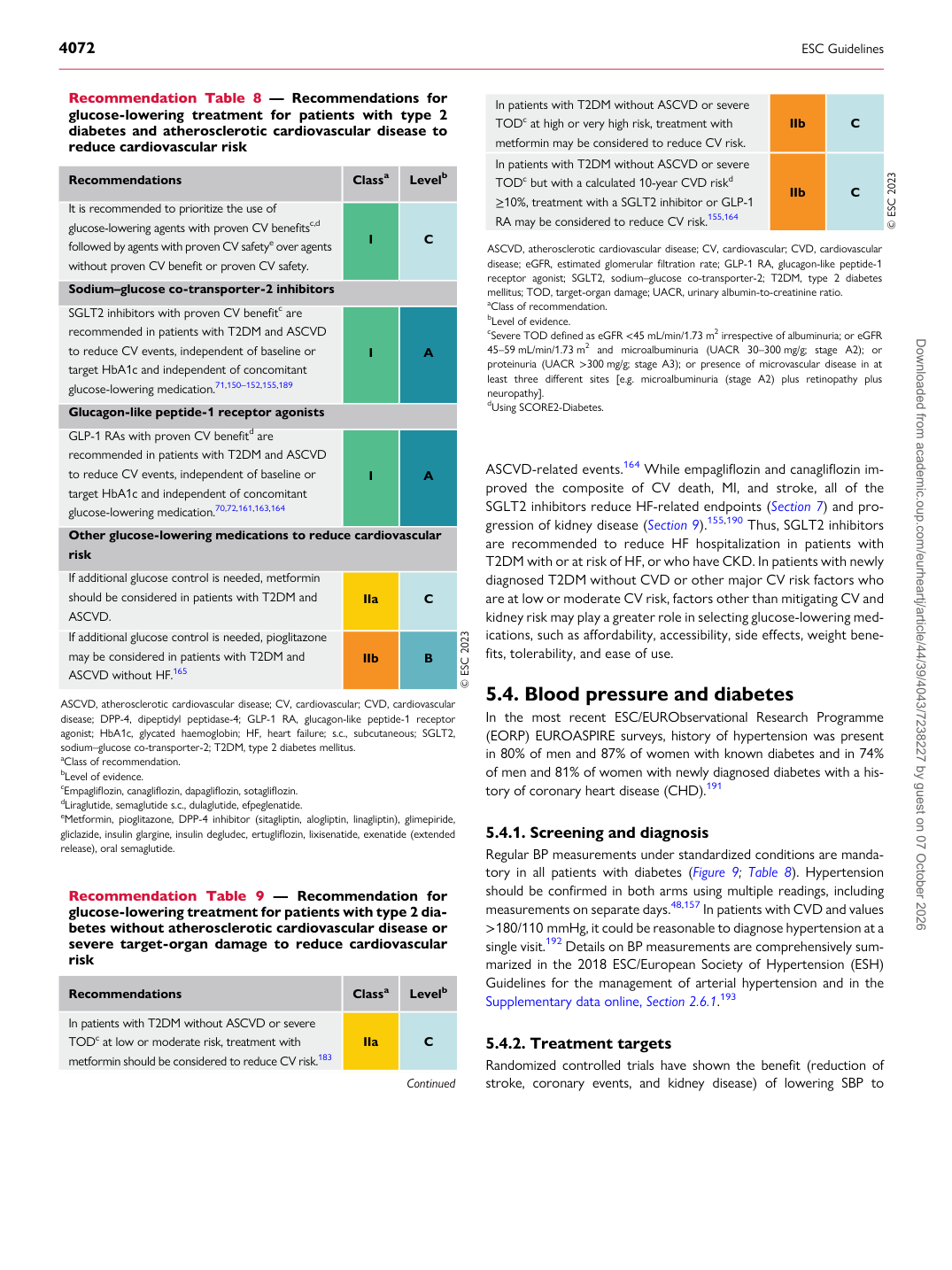
Recommendation Table 8 — Recommendations for glucose-lowering treatment for patients with type 2 diabetes and atherosclerotic cardiovascular disease to reduce cardiovascular risk

Recommendations Classa Levelb

It is recommended to prioritize the use of glucose-lowering agents with proven CV benefitsc,d followed by agents with proven CV safetye over agents without proven CV benefit or proven CV safety. I C Sodium–glucose co-transporter-2 inhibitors SGLT2 inhibitors with proven CV benefitc are recommended in patients with T2DM and ASCVD to reduce CV events, independent of baseline or target HbA1c and independent of concomitant glucose-lowering medication.71,150–152,155,189 I A Glucagon-like peptide-1 receptor agonists GLP-1 RAs with proven CV benefitd are recommended in patients with T2DM and ASCVD to reduce CV events, independent of baseline or target HbA1c and independent of concomitant glucose-lowering medication.70,72,161,163,164 I A Other glucose-lowering medications to reduce cardiovascular risk If additional glucose control is needed, metformin should be considered in patients with T2DM and ASCVD. IIa C If additional glucose control is needed, pioglitazone may be considered in patients with T2DM and ASCVD without HF.165 IIb B © ESC 2023 ASCVD, atherosclerotic cardiovascular disease; CV, cardiovascular; CVD, cardiovascular disease; DPP-4, dipeptidyl peptidase-4; GLP-1 RA, glucagon-like peptide-1 receptor agonist; HbA1c, glycated haemoglobin; HF, heart failure; s.c., subcutaneous; SGLT2, sodium–glucose co-transporter-2; T2DM, type 2 diabetes mellitus. aClass of recommendation. bLevel of evidence. cEmpagliflozin, canagliflozin, dapagliflozin, sotagliflozin. dLiraglutide, semaglutide s.c., dulaglutide, efpeglenatide. eMetformin, pioglitazone, DPP-4 inhibitor (sitagliptin, alogliptin, linagliptin), glimepiride, gliclazide, insulin glargine, insulin degludec, ertugliflozin, lixisenatide, exenatide (extended release), oral semaglutide.

Recommendation Table 9 — Recommendation for glucose-lowering treatment for patients with type 2 diabetes without atherosclerotic cardiovascular disease or severe target-organ damage to reduce cardiovascular risk

Recommendations Classa Levelb

In patients with T2DM without ASCVD or severe TODc at low or moderate risk, treatment with metformin should be considered to reduce CV risk.183 IIa C

Continued In patients with T2DM without ASCVD or severe

TODc at high or very high risk, treatment with metformin may be considered to reduce CV risk. IIb C In patients with T2DM without ASCVD or severe TODc but with a calculated 10-year CVD riskd ≥10%, treatment with a SGLT2 inhibitor or GLP-1 RA may be considered to reduce CV risk.155,164 IIb C © ESC 2023

ASCVD, atherosclerotic cardiovascular disease; CV, cardiovascular; CVD, cardiovascular disease; eGFR, estimated glomerular filtration rate; GLP-1 RA, glucagon-like peptide-1 receptor agonist; SGLT2, sodium–glucose co-transporter-2; T2DM, type 2 diabetes mellitus; TOD, target-organ damage; UACR, urinary albumin-to-creatinine ratio. aClass of recommendation. bLevel of evidence. cSevere TOD defined as eGFR <45 mL/min/1.73 m2 irrespective of albuminuria; or eGFR 45–59 mL/min/1.73 m2 and microalbuminuria (UACR 30–300 mg/g; stage A2); or proteinuria (UACR >300 mg/g; stage A3); or presence of microvascular disease in at least three different sites [e.g. microalbuminuria (stage A2) plus retinopathy plus neuropathy]. dUsing SCORE2-Diabetes. Downloaded from academic.oup.com/eurheartj/article/44/39/4043/7238227 by guest on 07 October 2026