p.29 抽出テキスト
To reduce CV risk independent of glucose controla

GLP-1 RAb

(Class I) SGLT2 inhibitorc

(Class I)

Independent of HbA1c

Independent of concomitant glucose-lowering medication

For additional glucose control

Metformin (Class IIa)

Pioglitazoned

(Class IIb)

Glucose-lowering agents with suggested CV benefit

Glucose-lowering agents with proven CV safety DPP-4 inhibitors (sitagliptin, alogliptin, linagliptin)e

Other GLP-1 RAs (lixisenatide, exenatide ER, oral semaglutide)

Ertugliflozinf

Glucose-lowering agents without CV safety evaluation E.g. short-acting insulins E.g. other sulfonylureas

Sulfonylureas (glimepiride or gliclazide) Insulin glargine or insulin degludec

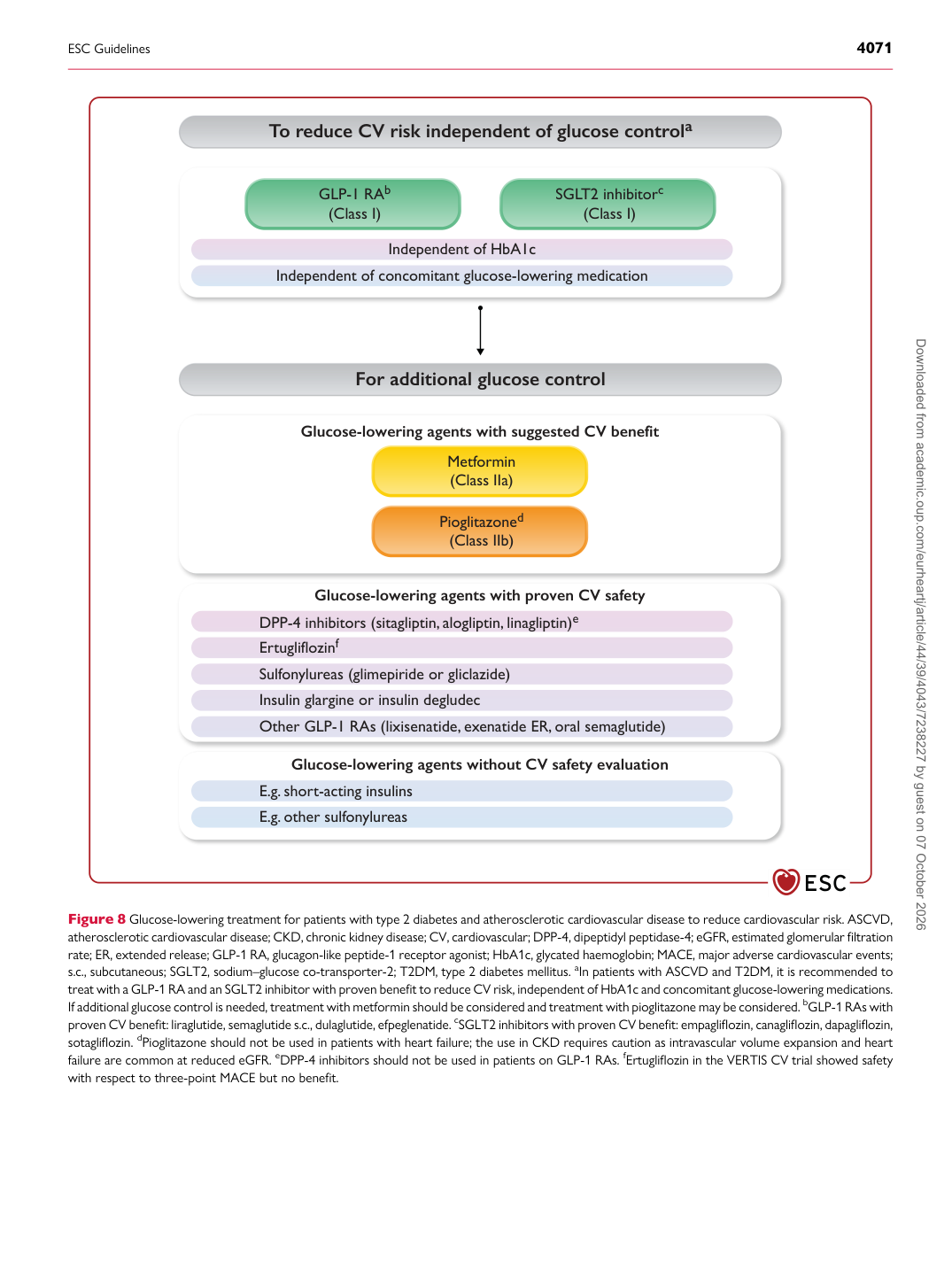
Figure 8 Glucose-lowering treatment for patients with type 2 diabetes and atherosclerotic cardiovascular disease to reduce cardiovascular risk. ASCVD, atherosclerotic cardiovascular disease; CKD, chronic kidney disease; CV, cardiovascular; DPP-4, dipeptidyl peptidase-4; eGFR, estimated glomerular filtration rate; ER, extended release; GLP-1 RA, glucagon-like peptide-1 receptor agonist; HbA1c, glycated haemoglobin; MACE, major adverse cardiovascular events; s.c., subcutaneous; SGLT2, sodium–glucose co-transporter-2; T2DM, type 2 diabetes mellitus. aIn patients with ASCVD and T2DM, it is recommended to treat with a GLP-1 RA and an SGLT2 inhibitor with proven benefit to reduce CV risk, independent of HbA1c and concomitant glucose-lowering medications. If additional glucose control is needed, treatment with metformin should be considered and treatment with pioglitazone may be considered. bGLP-1 RAs with proven CV benefit: liraglutide, semaglutide s.c., dulaglutide, efpeglenatide. cSGLT2 inhibitors with proven CV benefit: empagliflozin, canagliflozin, dapagliflozin, sotagliflozin. dPioglitazone should not be used in patients with heart failure; the use in CKD requires caution as intravascular volume expansion and heart failure are common at reduced eGFR. eDPP-4 inhibitors should not be used in patients on GLP-1 RAs. fErtugliflozin in the VERTIS CV trial showed safety with respect to three-point MACE but no benefit.

ESC Guidelines                                                                                                                                                                                          4071

Downloaded from academic.oup.com/eurheartj/article/44/39/4043/7238227 by guest on 07 October 2026