p.28 抽出テキスト
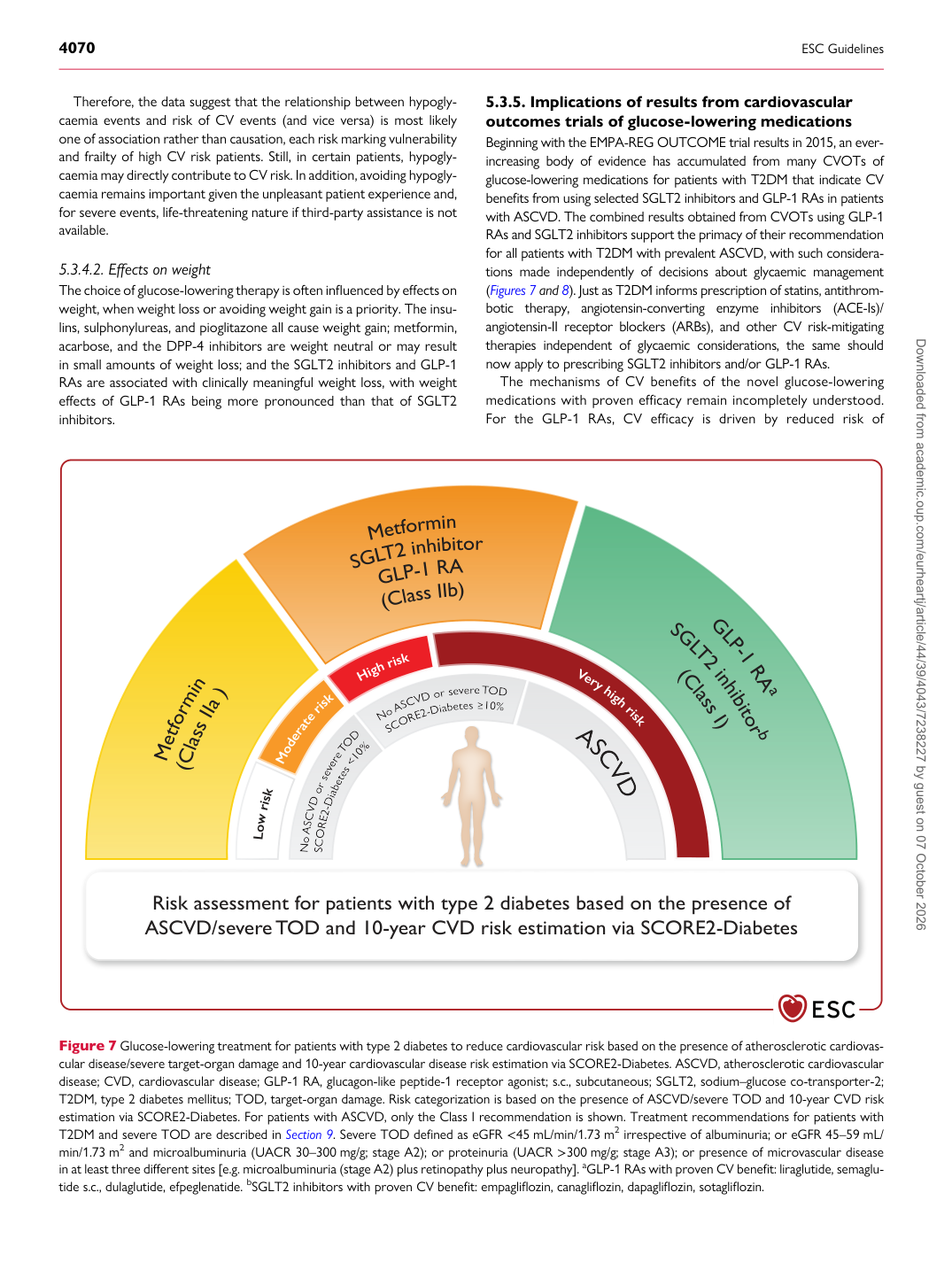
Therefore, the data suggest that the relationship between hypoglycaemia events and risk of CV events (and vice versa) is most likely one of association rather than causation, each risk marking vulnerability and frailty of high CV risk patients. Still, in certain patients, hypoglycaemia may directly contribute to CV risk. In addition, avoiding hypoglycaemia remains important given the unpleasant patient experience and, for severe events, life-threatening nature if third-party assistance is not available. 5.3.4.2 Effects on weight The choice of glucose-lowering therapy is often influenced by effects on weight, when weight loss or avoiding weight gain is a priority. The insulins, sulphonylureas, and pioglitazone all cause weight gain; metformin, acarbose, and the DPP-4 inhibitors are weight neutral or may result in small amounts of weight loss; and the SGLT2 inhibitors and GLP-1 RAs are associated with clinically meaningful weight loss, with weight effects of GLP-1 RAs being more pronounced than that of SGLT2 inhibitors. 5.3.5 Implications of results from cardiovascular outcomes trials of glucose-lowering medications Beginning with the EMPA-REG OUTCOME trial results in 2015, an everincreasing body of evidence has accumulated from many CVOTs of glucose-lowering medications for patients with T2DM that indicate CV benefits from using selected SGLT2 inhibitors and GLP-1 RAs in patients with ASCVD. The combined results obtained from CVOTs using GLP-1 RAs and SGLT2 inhibitors support the primacy of their recommendation for all patients with T2DM with prevalent ASCVD, with such considerations made independently of decisions about glycaemic management (Figures 7 and 8). Just as T2DM informs prescription of statins, antithrombotic therapy, angiotensin-converting enzyme inhibitors (ACE-Is)/ angiotensin-II receptor blockers (ARBs), and other CV risk-mitigating therapies independent of glycaemic considerations, the same should now apply to prescribing SGLT2 inhibitors and/or GLP-1 RAs. The mechanisms of CV benefits of the novel glucose-lowering medications with proven efficacy remain incompletely understood. For the GLP-1 RAs, CV efficacy is driven by reduced risk of Risk assessment for patients with type 2 diabetes based on the presence of ASCVD/severe TOD and 10-year CVD risk estimation via SCORE2-Diabetes Me tfo rm in SG LT 2 i nhi bit or GL P- 1 R A (C la ss I) Me tf or mi n (C la ss II a ) No A SC V D or s ev er e T O D SC O RE 2- Di ab et es < 1 0 % No A SC V D or s ev er e T O D SC O RE 2- Di ab et es 10 % Lo w ris k M od er at e ris k Hi gh ri sk Ve ry h ig h ris k A S C V D (C las s II b) SG LT 2 in hi bi to rb G LP -1 R Aa Figure 7 Glucose-lowering treatment for patients with type 2 diabetes to reduce cardiovascular risk based on the presence of atherosclerotic cardiovascular disease/severe target-organ damage and 10-year cardiovascular disease risk estimation via SCORE2-Diabetes. ASCVD, atherosclerotic cardiovascular disease; CVD, cardiovascular disease; GLP-1 RA, glucagon-like peptide-1 receptor agonist; s.c., subcutaneous; SGLT2, sodium–glucose co-transporter-2; T2DM, type 2 diabetes mellitus; TOD, target-organ damage. Risk categorization is based on the presence of ASCVD/severe TOD and 10-year CVD risk estimation via SCORE2-Diabetes. For patients with ASCVD, only the Class I recommendation is shown. Treatment recommendations for patients with T2DM and severe TOD are described in Section 9. Severe TOD defined as eGFR <45 mL/min/1.73 m2 irrespective of albuminuria; or eGFR 45–59 mL/ min/1.73 m2 and microalbuminuria (UACR 30–300 mg/g; stage A2); or proteinuria (UACR >300 mg/g; stage A3); or presence of microvascular disease in at least three different sites [e.g. microalbuminuria (stage A2) plus retinopathy plus neuropathy]. aGLP-1 RAs with proven CV benefit: liraglutide, semaglutide s.c., dulaglutide, efpeglenatide. bSGLT2 inhibitors with proven CV benefit: empagliflozin, canagliflozin, dapagliflozin, sotagliflozin. Downloaded from academic.oup.com/eurheartj/article/44/39/4043/7238227 by guest on 07 October 2026