p.23 抽出テキスト
5.3 Atherosclerotic cardiovascular disease

risk reduction by glucose-lowering medications in diabetes T2DM is common among patients with ASCVD or at the highest risk of CVD. The converse is also true: ASCVD is common in patients with T2DM.148 Given these relationships, it is key to consider the presence of T2DM when deciding strategies to mitigate CV risk. It is imperative that the first step in this process is to screen all patients with CVD for T2DM. Many decisions are independent of glucose management, therefore, T2DM status can inform clinical decision-making for mitigating CV risk, as discussed for several other interventions in the current Guidelines.149 Capitalizing on the results of multiple dedicated CVOTs of glucose-lowering medications in patients with diabetes and ASCVD or at high CV risk, there is now a wealth of data to inform the preferential use of selected glucose-lowering medications to reduce CV risk, independent of glucose management considerations. Glucose-lowering medications can be prescribed with two parallel, mutually exclusive intentions: (i) to improve CV outcomes and safety; and (ii) to control glucose. On this basis, in the current Guidelines, we have separated prescribing recommendations into those intended to improve CV outcomes and those intended to control glucose. Underpinning these recommendations are results from the key CVOTs delineating the efficacy and safety of glucoselowering therapies for treating T2DM and their effect on CV outcomes. 5.3.1 Glucose-lowering medications with

cardiovascular efficacy demonstrated in dedicated cardiovascular outcomes trials 5.3.1.1. Sodium–glucose co-transporter-2 inhibitors The results of six CVOTs with SGLT2 inhibitors and one trial of a dual SGLT1/2 inhibitor have been published, comprising the EMPA-REG OUTCOME (Empagliflozin Cardiovascular Outcome Event Trial in Type 2 Diabetes Mellitus Patients–Removing Excess Glucose) trial, the CANVAS (Canagliflozin Cardiovascular Assessment Study) programme (two trials combined for analyses), the DECLARE-TIMI 58 (Dapagliflozin Effect on Cardiovascular Events−Thrombolysis In Myocardial Infarction 58) trial, the CREDENCE (Canagliflozin and Renal Events in Diabetes with Established Nephropathy Clinical Evaluation) trial, the VERTIS CV (eValuation of ERTugliflozin effIcacy and Safety CardioVascular Outcomes) trial, and the SCORED (Effect of Sotagliflozin on Cardiovascular and Renal Events in Patients with Type 2 Diabetes and Moderate Renal Impairment Who Are at Cardiovascular Risk) trial (Supplementary data online, Table S7).71,150–154 A meta-analysis of the six SGLT2 inhibitor trials demonstrated a reduction in the primary ASCVD-based composite of time to first event of CV death, MI, or stroke (MACE). This was most apparent in patients with established ASCVD (Figure 5).155 Of note, neither dapagliflozin nor

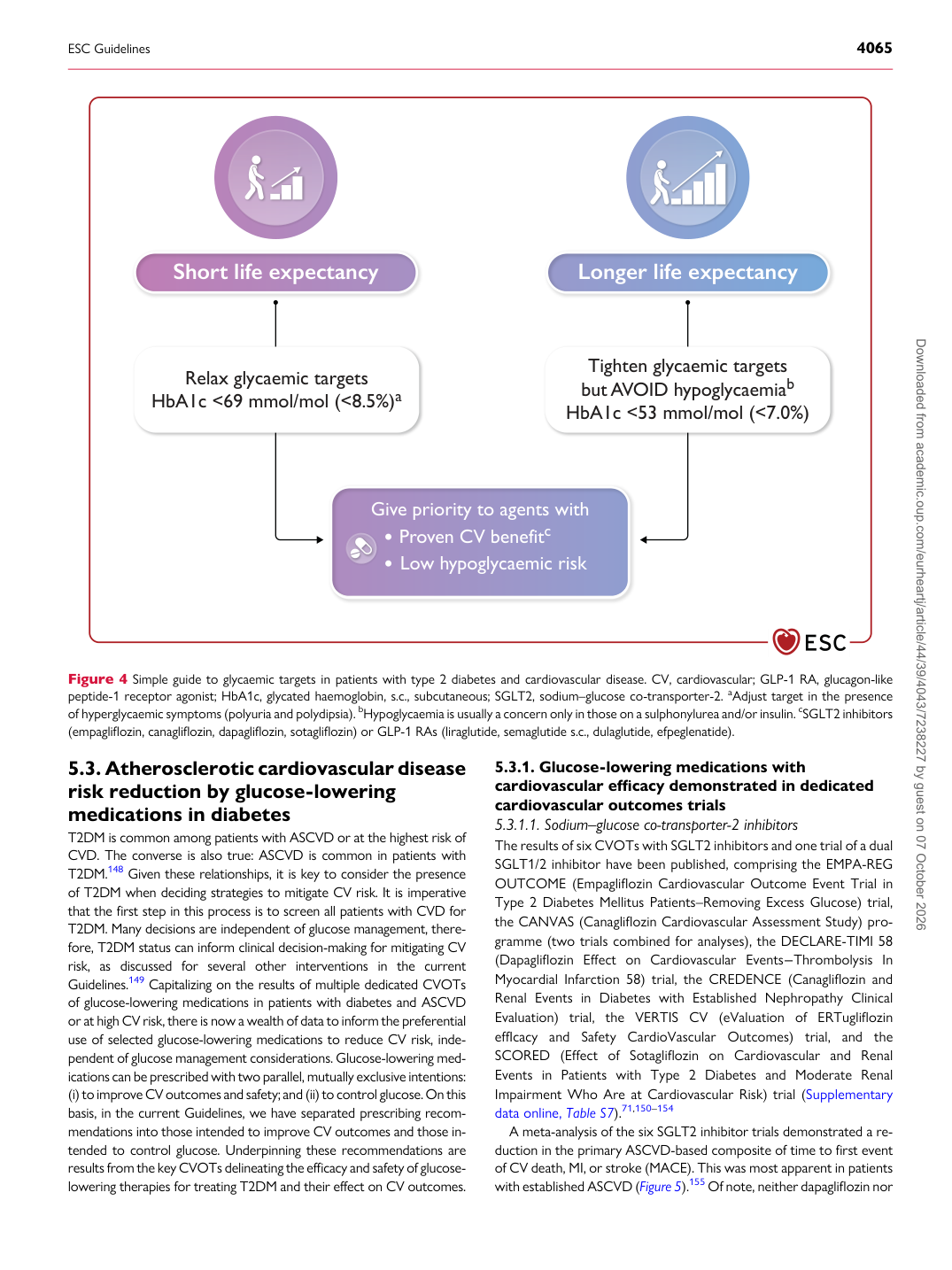
Short life expectancy Longer life expectancy

Relax glycaemic targets HbA1c <69 mmol/mol (<8.5%)a Tighten glycaemic targets but AVOID hypoglycaemiab

HbA1c <53 mmol/mol (<7.0%)

Give priority to agents with

Proven CV benefitc

Low hypoglycaemic risk

Figure 4 Simple guide to glycaemic targets in patients with type 2 diabetes and cardiovascular disease. CV, cardiovascular; GLP-1 RA, glucagon-like peptide-1 receptor agonist; HbA1c, glycated haemoglobin, s.c., subcutaneous; SGLT2, sodium–glucose co-transporter-2. aAdjust target in the presence of hyperglycaemic symptoms (polyuria and polydipsia). bHypoglycaemia is usually a concern only in those on a sulphonylurea and/or insulin. cSGLT2 inhibitors (empagliflozin, canagliflozin, dapagliflozin, sotagliflozin) or GLP-1 RAs (liraglutide, semaglutide s.c., dulaglutide, efpeglenatide).

ESC Guidelines                                                                                                                                                                                          4065

Downloaded from academic.oup.com/eurheartj/article/44/39/4043/7238227 by guest on 07 October 2026