p.22 抽出テキスト
The assessment of lifestyle risk-factor components and stepwise lifestyle recommendations in patients with CVD and diabetes is summarized in more detail in Section 5.7.

5.2 Glycaemic targets

5.2.1. Role of glycated haemoglobin Reducing HbA1c decreases microvascular complications, particularly when achieving near-normal levels (HbA1c <7%, <53 mmol/mol), but the effects on macrovascular disease are more complex.126–129 The DCCT (Diabetes Control and Complications Trial) in T1DM and the UKPDS (United Kindom Prospective Diabetes Study) in newly diagnosed T2DM have shown that reducing HbA1c decreases longterm macrovascular events without having a significant effect in the medium term of 6.5–10.0 years.130–132 Other studies, such as ADVANCE (Action in Diabetes and Vascular Disease: Preterax and Diamicron MR Controlled Evaluation), ACCORD (Action to Control Cardiovascular Risk in Diabetes), and VADT (Veterans Affairs Diabetes Trial), including higher-risk T2DM cohorts, have similarly failed to show an effect for intensive glycaemic control on short/ medium-term macrovascular risk (over 3.5–5.6 years). Meta-analyses of the UKPDS, ADVANCE, ACCORD, and VADT studies, including 27 049 participants, have demonstrated that lowering HbA1c reduces MACE, driven by a reduction in MI (HF and stroke risk were unaffected), and decreases microvascular complications (renal and retinal but not neuropathy).133,134 Of interest, the ACCORD trial, with 35% of participants having a previous CV event, showed increased mortality (HR 1.22; 95% CI, 1.01–1.46; P = 0.04) in the intensive glycaemic arm (HbA1c 6.5%, 48 mmol/mol) compared with controls.129 Also, observational studies have shown a U-shaped relationship between HbA1c and clinical outcome, suggesting that lower HbA1c is not always better.135,136

5.2.2 Additional glycaemic targets

Hypoglycaemia is associated with an increased risk of vascular events, explaining recent consensus advocating hypoglycaemic exposure at <1% (i.e. <15 min/day) in individuals at high CV risk.137,138 A causal relationship between hypoglycaemia and adverse outcomes is not always clear as low glucose levels can be a marker of ill health.139,140 In addition to hypoglycaemia, glycaemic variability is emerging as a potential vascular risk factor, but studies are limited and more research in this area is warranted.

Post-prandial glucose has been suggested to independently predict vascular disease, even in individuals without a previous history of diabetes.141 However, manipulating prandial glucose levels failed to impact clinical outcome, and therefore, this remains an unresolved area.142,143

5.2.3 Glycaemic control following vascular events

Hyperglycaemia following ACS is associated with worse clinical outcome.144 The DIGAMI 1 (Diabetes Mellitus Insulin-Glucose Infusion in Acute Myocardial Infarction) trial demonstrated reduced mortality with intensive glucose control post-ACS, but DIGAMI 2, which was underpowered, failed to confirm these findings.145,146 Unexpectedly, DIGAMI 2 showed a numerical increase in mortality in the intervention arm, particularly in insulin-treated patients, suggesting an adverse role for hypoglycaemia in this population.147 Therefore, large-scale glycaemic studies are required, using continuous glucose monitoring (CGM) to assess glucose levels, to establish whether optimizing glycaemia in patients with CVD and diabetes improves clinical outcome. In summary, glucose control in individuals with diabetes at high CV risk is a complex area and current evidence indicates the need to address multiple glycaemic measures, including personalizing HbA1c targets, minimizing hypoglycaemic exposure, and limiting glucose variability. Figure 4 provides a simple guide to glycaemic control in patients with T2DM and CVD.

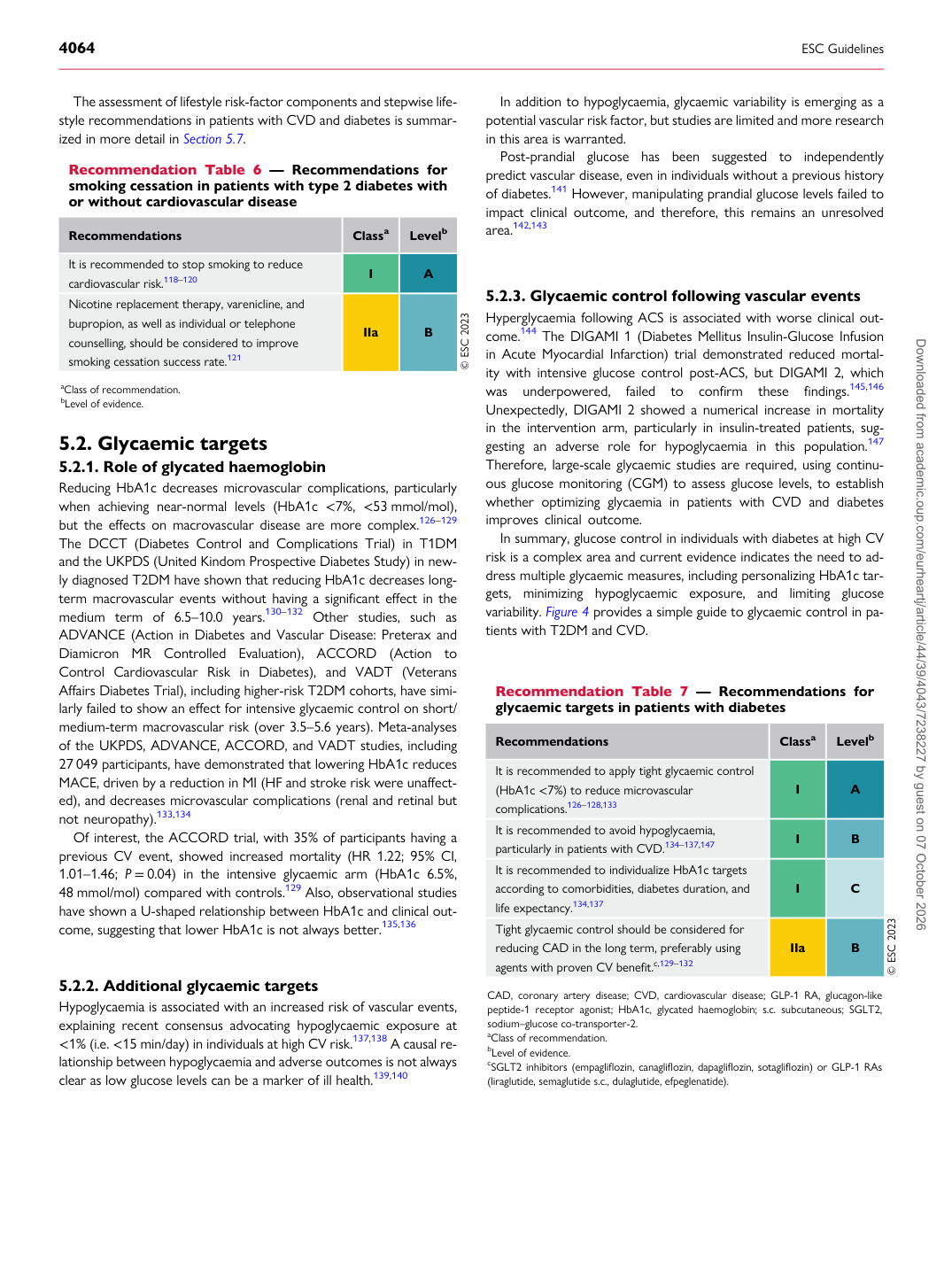
Recommendation Table 6 — Recommendations for smoking cessation in patients with type 2 diabetes with or without cardiovascular disease

Recommendations Classa Levelb

It is recommended to stop smoking to reduce cardiovascular risk.118–120 I A Nicotine replacement therapy, varenicline, and bupropion, as well as individual or telephone counselling, should be considered to improve smoking cessation success rate.121 IIa B © ESC 2023 aClass of recommendation. bLevel of evidence.

Recommendation Table 7 — Recommendations for glycaemic targets in patients with diabetes

Recommendations Classa Levelb

It is recommended to apply tight glycaemic control (HbA1c <7%) to reduce microvascular complications.126–128,133 I A It is recommended to avoid hypoglycaemia, particularly in patients with CVD.134–137,147 I B It is recommended to individualize HbA1c targets according to comorbidities, diabetes duration, and life expectancy.134,137 I C Tight glycaemic control should be considered for reducing CAD in the long term, preferably using agents with proven CV benefit.c,129–132 IIa B © ESC 2023

CAD, coronary artery disease; CVD, cardiovascular disease; GLP-1 RA, glucagon-like peptide-1 receptor agonist; HbA1c, glycated haemoglobin; s.c. subcutaneous; SGLT2, sodium–glucose co-transporter-2. aClass of recommendation. bLevel of evidence. cSGLT2 inhibitors (empagliflozin, canagliflozin, dapagliflozin, sotagliflozin) or GLP-1 RAs (liraglutide, semaglutide s.c., dulaglutide, efpeglenatide). Downloaded from academic.oup.com/eurheartj/article/44/39/4043/7238227 by guest on 07 October 2026