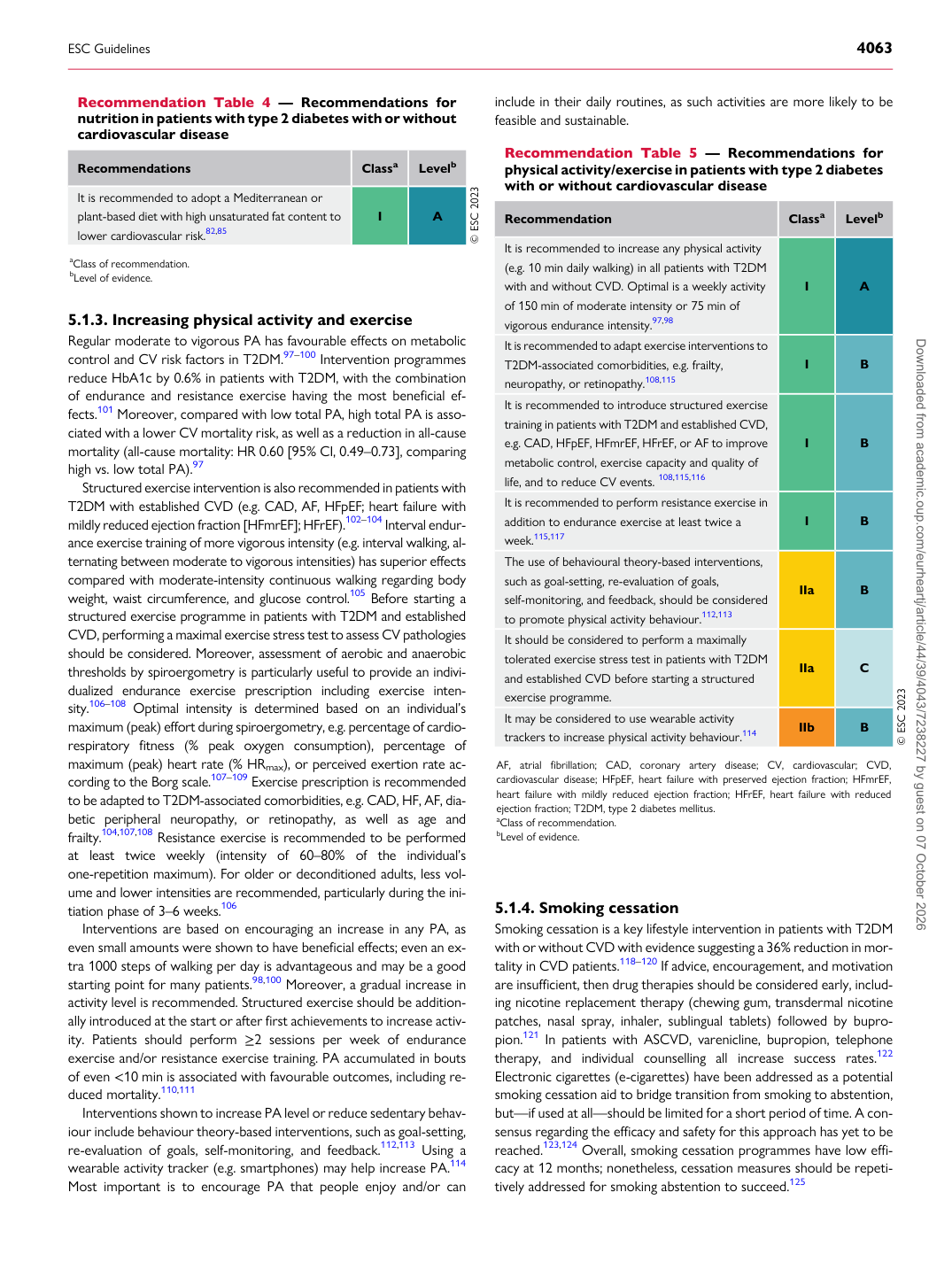
p.21 抽出テキスト
5.1.3 Increasing physical activity and exercise

Regular moderate to vigorous PA has favourable effects on metabolic control and CV risk factors in T2DM.97–100 Intervention programmes reduce HbA1c by 0.6% in patients with T2DM, with the combination of endurance and resistance exercise having the most beneficial effects.101 Moreover, compared with low total PA, high total PA is associated with a lower CV mortality risk, as well as a reduction in all-cause mortality (all-cause mortality: HR 0.60 [95% CI, 0.49–0.73], comparing high vs. low total PA).97 Structured exercise intervention is also recommended in patients with T2DM with established CVD (e.g. CAD, AF, HFpEF; heart failure with mildly reduced ejection fraction [HFmrEF]; HFrEF).102–104 Interval endurance exercise training of more vigorous intensity (e.g. interval walking, alternating between moderate to vigorous intensities) has superior effects compared with moderate-intensity continuous walking regarding body weight, waist circumference, and glucose control.105 Before starting a structured exercise programme in patients with T2DM and established CVD, performing a maximal exercise stress test to assess CV pathologies should be considered. Moreover, assessment of aerobic and anaerobic thresholds by spiroergometry is particularly useful to provide an individualized endurance exercise prescription including exercise intensity.106–108 Optimal intensity is determined based on an individual’s maximum (peak) effort during spiroergometry, e.g. percentage of cardiorespiratory fitness (% peak oxygen consumption), percentage of maximum (peak) heart rate (% HRmax), or perceived exertion rate according to the Borg scale.107–109 Exercise prescription is recommended to be adapted to T2DM-associated comorbidities, e.g. CAD, HF, AF, diabetic peripheral neuropathy, or retinopathy, as well as age and frailty.104,107,108 Resistance exercise is recommended to be performed at least twice weekly (intensity of 60–80% of the individual’s one-repetition maximum). For older or deconditioned adults, less volume and lower intensities are recommended, particularly during the initiation phase of 3–6 weeks.106 Interventions are based on encouraging an increase in any PA, as even small amounts were shown to have beneficial effects; even an extra 1000 steps of walking per day is advantageous and may be a good starting point for many patients.98,100 Moreover, a gradual increase in activity level is recommended. Structured exercise should be additionally introduced at the start or after first achievements to increase activity. Patients should perform ≥2 sessions per week of endurance exercise and/or resistance exercise training. PA accumulated in bouts of even <10 min is associated with favourable outcomes, including reduced mortality.110,111 Interventions shown to increase PA level or reduce sedentary behaviour include behaviour theory-based interventions, such as goal-setting, re-evaluation of goals, self-monitoring, and feedback.112,113 Using a wearable activity tracker (e.g. smartphones) may help increase PA.114 Most important is to encourage PA that people enjoy and/or can include in their daily routines, as such activities are more likely to be feasible and sustainable.

5.1.4 Smoking cessation

Smoking cessation is a key lifestyle intervention in patients with T2DM with or without CVD with evidence suggesting a 36% reduction in mortality in CVD patients.118–120 If advice, encouragement, and motivation are insufficient, then drug therapies should be considered early, including nicotine replacement therapy (chewing gum, transdermal nicotine patches, nasal spray, inhaler, sublingual tablets) followed by bupropion.121 In patients with ASCVD, varenicline, bupropion, telephone therapy, and individual counselling all increase success rates.122 Electronic cigarettes (e-cigarettes) have been addressed as a potential smoking cessation aid to bridge transition from smoking to abstention, but—if used at all—should be limited for a short period of time. A consensus regarding the efficacy and safety for this approach has yet to be reached.123,124 Overall, smoking cessation programmes have low efficacy at 12 months; nonetheless, cessation measures should be repetitively addressed for smoking abstention to succeed.125

Recommendation Table 5 — Recommendations for physical activity/exercise in patients with type 2 diabetes with or without cardiovascular disease

Recommendation Classa Levelb

It is recommended to increase any physical activity (e.g. 10 min daily walking) in all patients with T2DM with and without CVD. Optimal is a weekly activity of 150 min of moderate intensity or 75 min of vigorous endurance intensity.97,98 I A It is recommended to adapt exercise interventions to T2DM-associated comorbidities, e.g. frailty, neuropathy, or retinopathy.108,115 I B It is recommended to introduce structured exercise training in patients with T2DM and established CVD, e.g. CAD, HFpEF, HFmrEF, HFrEF, or AF to improve metabolic control, exercise capacity and quality of life, and to reduce CV events. 108,115,116 I B It is recommended to perform resistance exercise in addition to endurance exercise at least twice a week.115,117 I B The use of behavioural theory-based interventions, such as goal-setting, re-evaluation of goals, self-monitoring, and feedback, should be considered to promote physical activity behaviour.112,113 IIa B It should be considered to perform a maximally tolerated exercise stress test in patients with T2DM and established CVD before starting a structured exercise programme. IIa C It may be considered to use wearable activity trackers to increase physical activity behaviour.114 IIb B © ESC 2023

AF, atrial fibrillation; CAD, coronary artery disease; CV, cardiovascular; CVD, cardiovascular disease; HFpEF, heart failure with preserved ejection fraction; HFmrEF, heart failure with mildly reduced ejection fraction; HFrEF, heart failure with reduced ejection fraction; T2DM, type 2 diabetes mellitus. aClass of recommendation. bLevel of evidence.

Recommendation Table 4 — Recommendations for nutrition in patients with type 2 diabetes with or without cardiovascular disease

Recommendations Classa Levelb

It is recommended to adopt a Mediterranean or plant-based diet with high unsaturated fat content to lower cardiovascular risk.82,85 I A © ESC 2023 aClass of recommendation. bLevel of evidence.

ESC Guidelines                                                                                                                                                                                          4063

Downloaded from academic.oup.com/eurheartj/article/44/39/4043/7238227 by guest on 07 October 2026