p.20 抽出テキスト
care.56 However, microvascular disease complications (i.e. development of CKD) were significantly reduced (hazard ratio [HR] 0.69; 95% confidence interval [CI], 0.55–0.87; P = 0.002) by lifestyle intervention, an effect associated with improvements in CV risk factors.57 Additional analyses 16.7 years after the start of the study (9.6 years of intervention and then observation) revealed that participants who lost ≥10% of weight at 1 year of intervention had a 21% reduced risk of mortality (HR 0.79; 95% CI, 0.67–0.94; P = 0.007).58 The decline in body fat mass was significantly associated with a lower risk of HF with reduced ejection fraction (HFrEF) and HF with preserved ejection fraction (HFpEF), while a decline in waist circumference was only significantly associated with a lower risk of HFpEF.59 In addition, baseline cardio-pulmonary fitness was associated with reduced risks of mortality and CV events during follow-up of 9.2 years.60 The DiRECT (Diabetes Remission Clinical Trial)—an open-label, cluster-randomized trial in patients with T2DM—assigned practices to provide either a weight-management programme including exercise (intervention group) or best-practice care by guidelines (control group). At 12 months, almost half of the participants in the intervention group achieved remission to a non-diabetic state and were off glucoselowering drugs.61 Home-based exercise intervention in patients with CAD and T2DM (ARTEMIS study; Finnish randomized controlled trial [RCT]; n = 127; 2-year controlled, home-based exercise training vs. usual care), however, did not significantly improve CV risk factors despite significant improvements in exercise capacity (P = 0.030).62

5.1.1 Weight reduction

In patients with obesity and T2DM, reducing weight is one of the cornerstones of treatment.63 Weight loss of >5% improves glycaemic control, lipid levels, and BP in overweight and obese adults with T2DM.64,65 These effects can be achieved by improving energy balance and/or introducing obesity medications. Orlistat, naltrexone/bupropion, and phentermine/topiramate are each associated with achieving >5% weight loss at 52 weeks compared with placebo.66 However, glucoselowering agents such as GLP-1 RAs, the dual agonist tirzepatide, and SGLT2 inhibitors also significantly reduce body weight.67,68 Adding exercise to a GLP-1 RA (liraglutide) had a greater effect on weight reduction and maintenance.69 Comparing the effects on weight reduction between GLP-1 RAs and SGLT2 inhibitors, the former seems to be superior. Given the additional beneficial effects of GLP-1 RAs and SGLT2 inhibitors on CV outcomes in T2DM (Section 5.3), these agents should be the preferred glucose-lowering medication in overweight and obese patients with CVD and T2DM, as obesity medications have, to date, not shown to reduce CV events.70–72 If weight is not managed effectively by lifestyle interventions and medication, bariatric surgery should be considered in patients with T2DM and a BMI ≥35 kg/m2 (≥Class II; WHO classification) to achieve long-term weight loss, reduce blood glucose, and improve CV risk factors. Data from the Swedish Obesity Subjects (SOS) study revealed that after 24-year follow-up, bariatric surgery was associated with a prolonged life expectancy compared with lifestyle and intensive medical management alone.73,74 The corresponding HR was 0.70 (95% CI, 0.57–0.85) for CV death and 0.77 (95% CI, 0.61–0.96) for death from cancer.75,76 This evidence has been extended to patients with CVD and obesity, as a large case-control study (n = 2638) revealed that bariatric surgery was also associated with a lower incidence of major adverse cardiovascular events (MACE) in those patients.77 Still, potential adverse events after bariatric surgery should also be considered.78 5.1.2 Change in diet or nutrition

In general, patients with T2DM should follow nutritional recommendations that reduce body weight and improve metabolic control and outcomes.48 A Mediterranean-style eating pattern improves glycaemic control, lipids, and BP.80,81 If this diet is supplemented with olive oil or nuts, as in the non-randomized PREvencion con Dieta MEDiterranea (PREDIMED) study in individuals at high CV risk (49% T2DM), the risk of ASCVD was reduced by 28–31%.82 Recent data from the Coronary Diet Intervention With Olive Oil and Cardiovascular Prevention (CORDIOPREV) study confirmed the benefit of a Mediterranean diet by showing that male patients with established CAD benefitted more from a Mediterranean diet than from a low-fat diet intervention after 7 years of follow-up. A shift from a more animal-based to a plant-based food pattern may also reduce ASCVD risk.83–85 Data from studies on supplementation with n–3 fatty acids do not support recommending n–3 fatty acid supplements for secondary prevention of CVD in T2DM.86,87 The consumption of sugars, sugar-sweetened soft drinks, and fruit juices should be avoided.88,89 Moreover, alcohol intake should generally be moderate, as any amount of alcohol uniformly increases BP and BMI.90–92 A high-protein diet (30% protein, 40% carbohydrates, and 30% fat) seems to be superior to a standard-protein diet (15% protein, 55% carbohydrates, and 30% fat) in overweight and obese (mean weight 107.8 ± 20.8 kg) patients with HF; both diets were equal in reducing body weight (3.6 vs. 2.9 kg, respectively) and waist circumference (1.9 vs. 1.3 cm, respectively), but the high-protein diet resulted in greater reductions in CV risk factors, e.g. HbA1c, cholesterol, triglycerides, and BP.93 People with CVD and T2DM are encouraged to reduce sodium intake, as this may reduce systolic BP by, on average, 5.8 mmHg in hypertensive patients and 1.9 mmHg in normotensive patients.94,95 In a meta-analysis, in hypertensive and normotensive people, reducing salt intake by 2.5 g/day resulted in a 20% relative reduction of ASCVD events.95 In addition, salt substitution with reduced sodium levels and increased potassium levels has been shown to reduce stroke, CVD, and overall mortality in patients with high CV risk.96

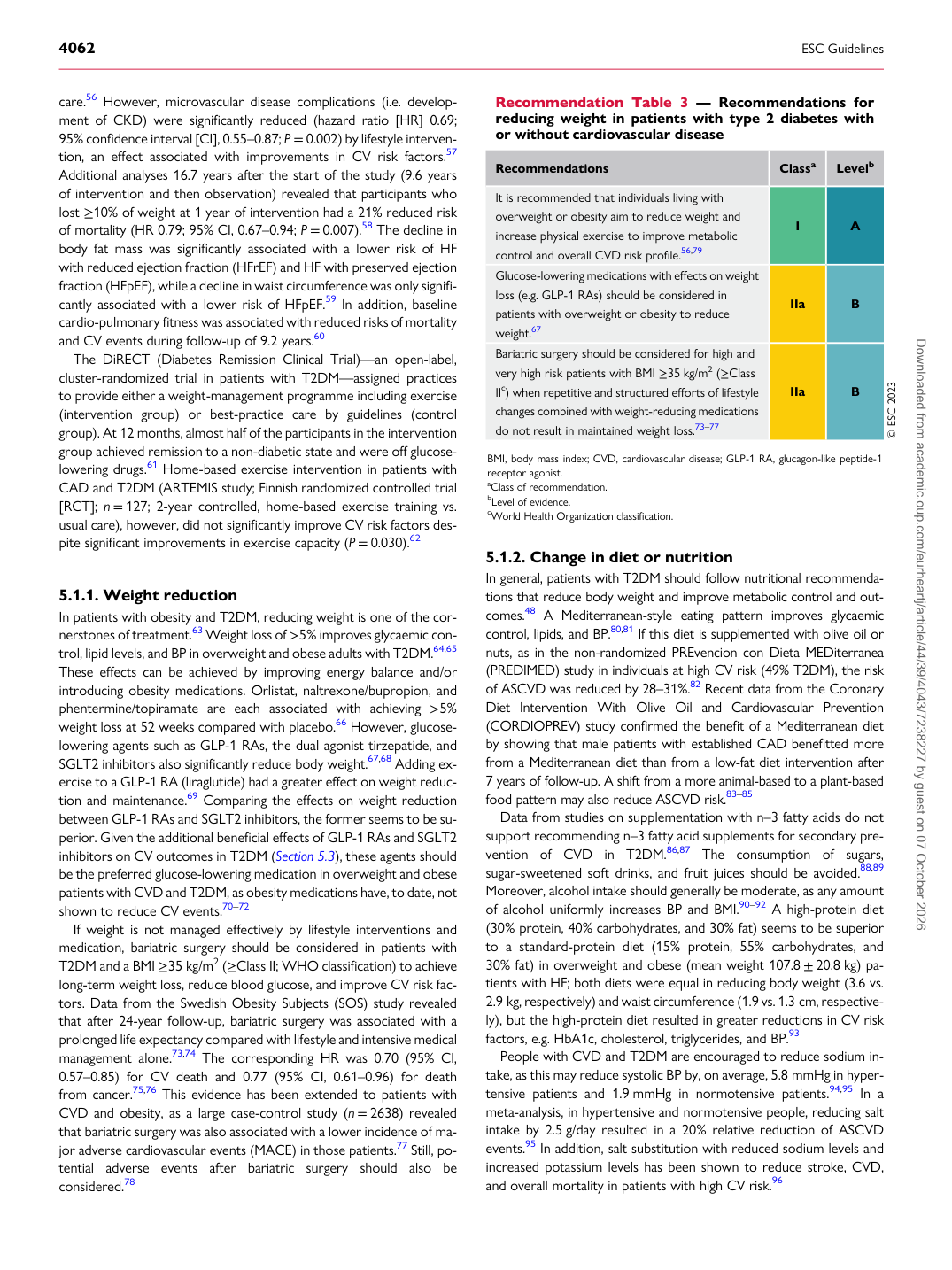
Recommendation Table 3 — Recommendations for reducing weight in patients with type 2 diabetes with or without cardiovascular disease

Recommendations Classa Levelb

It is recommended that individuals living with overweight or obesity aim to reduce weight and increase physical exercise to improve metabolic control and overall CVD risk profile.56,79 I A Glucose-lowering medications with effects on weight loss (e.g. GLP-1 RAs) should be considered in patients with overweight or obesity to reduce weight.67 IIa B Bariatric surgery should be considered for high and very high risk patients with BMI ≥35 kg/m2 (≥Class IIc) when repetitive and structured efforts of lifestyle changes combined with weight-reducing medications do not result in maintained weight loss.73–77 IIa B © ESC 2023

BMI, body mass index; CVD, cardiovascular disease; GLP-1 RA, glucagon-like peptide-1 receptor agonist. aClass of recommendation. bLevel of evidence. cWorld Health Organization classification. Downloaded from academic.oup.com/eurheartj/article/44/39/4043/7238227 by guest on 07 October 2026