p.19 抽出テキスト
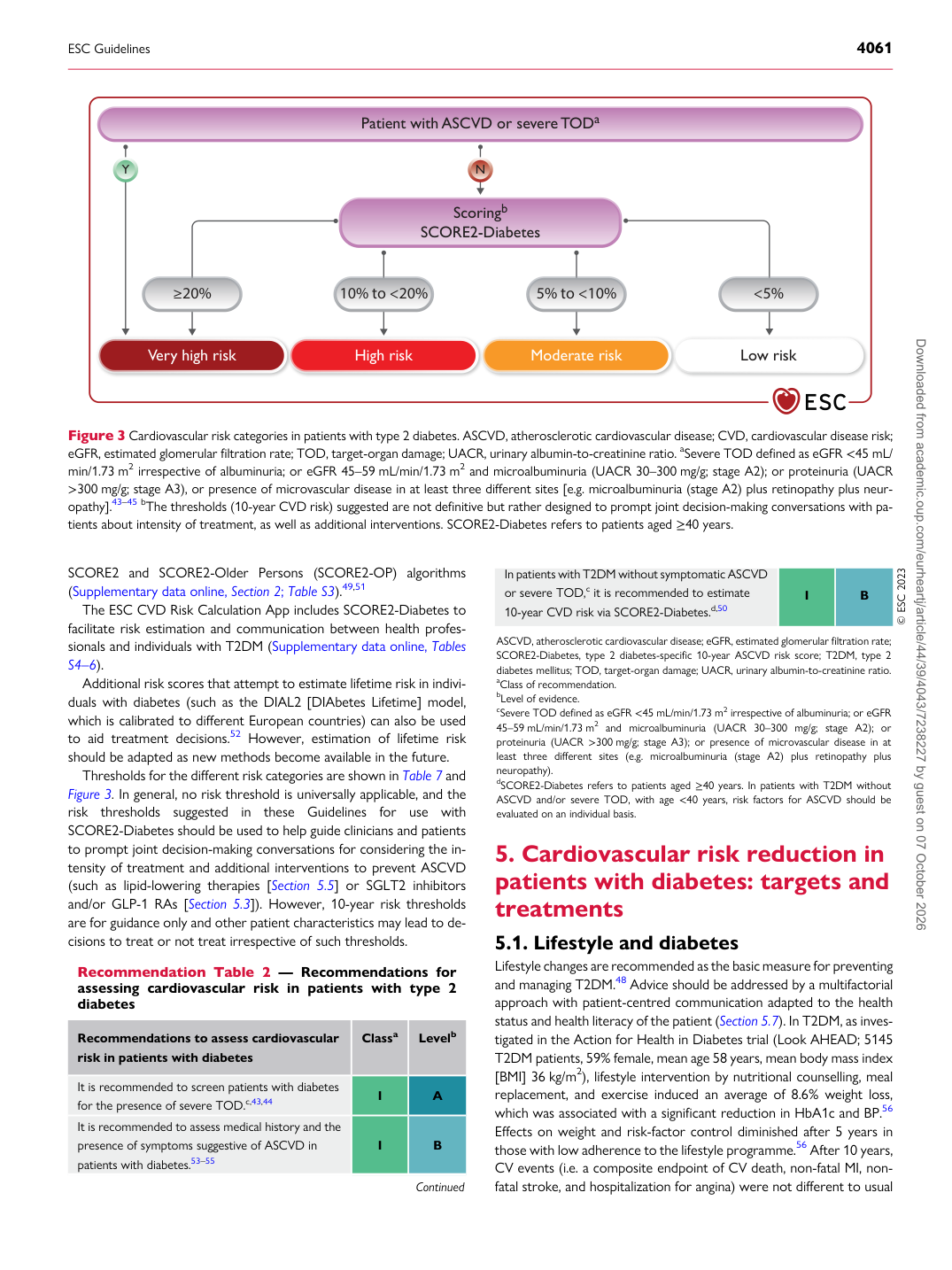
SCORE2 and SCORE2-Older Persons (SCORE2-OP) algorithms (Supplementary data online, Section 2; Table S3).49,51 The ESC CVD Risk Calculation App includes SCORE2-Diabetes to facilitate risk estimation and communication between health professionals and individuals with T2DM (Supplementary data online, Tables S4–6). Additional risk scores that attempt to estimate lifetime risk in individuals with diabetes (such as the DIAL2 [DIAbetes Lifetime] model, which is calibrated to different European countries) can also be used to aid treatment decisions.52 However, estimation of lifetime risk should be adapted as new methods become available in the future. Thresholds for the different risk categories are shown in Table 7 and Figure 3. In general, no risk threshold is universally applicable, and the risk thresholds suggested in these Guidelines for use with SCORE2-Diabetes should be used to help guide clinicians and patients to prompt joint decision-making conversations for considering the intensity of treatment and additional interventions to prevent ASCVD (such as lipid-lowering therapies [Section 5.5] or SGLT2 inhibitors and/or GLP-1 RAs [Section 5.3]). However, 10-year risk thresholds are for guidance only and other patient characteristics may lead to decisions to treat or not treat irrespective of such thresholds. 5 Cardiovascular risk reduction in

patients with diabetes: targets and treatments

5.1 Lifestyle and diabetes

Lifestyle changes are recommended as the basic measure for preventing and managing T2DM.48 Advice should be addressed by a multifactorial approach with patient-centred communication adapted to the health status and health literacy of the patient (Section 5.7). In T2DM, as investigated in the Action for Health in Diabetes trial (Look AHEAD; 5145 T2DM patients, 59% female, mean age 58 years, mean body mass index [BMI] 36 kg/m2), lifestyle intervention by nutritional counselling, meal replacement, and exercise induced an average of 8.6% weight loss, which was associated with a significant reduction in HbA1c and BP.56 Effects on weight and risk-factor control diminished after 5 years in those with low adherence to the lifestyle programme.56 After 10 years, CV events (i.e. a composite endpoint of CV death, non-fatal MI, nonfatal stroke, and hospitalization for angina) were not different to usual

Very high risk High risk Moderate risk Low risk

Scoringb SCORE2-Diabetes

Patient with ASCVD or severe TODa

Y

≥20% 10% to <20% 5% to <10% <5%

N

Figure 3 Cardiovascular risk categories in patients with type 2 diabetes. ASCVD, atherosclerotic cardiovascular disease; CVD, cardiovascular disease risk; eGFR, estimated glomerular filtration rate; TOD, target-organ damage; UACR, urinary albumin-to-creatinine ratio. aSevere TOD defined as eGFR <45 mL/ min/1.73 m2 irrespective of albuminuria; or eGFR 45–59 mL/min/1.73 m2 and microalbuminuria (UACR 30–300 mg/g; stage A2); or proteinuria (UACR >300 mg/g; stage A3), or presence of microvascular disease in at least three different sites [e.g. microalbuminuria (stage A2) plus retinopathy plus neuropathy].43–45 bThe thresholds (10-year CVD risk) suggested are not definitive but rather designed to prompt joint decision-making conversations with patients about intensity of treatment, as well as additional interventions. SCORE2-Diabetes refers to patients aged ≥40 years.

Recommendation Table 2 — Recommendations for assessing cardiovascular risk in patients with type 2 diabetes

Recommendations to assess cardiovascular risk in patients with diabetes Classa Levelb

It is recommended to screen patients with diabetes for the presence of severe TOD.c,43,44 I A It is recommended to assess medical history and the presence of symptoms suggestive of ASCVD in patients with diabetes.53–55 I B

Continued In patients with T2DM without symptomatic ASCVD

or severe TOD,c it is recommended to estimate 10-year CVD risk via SCORE2-Diabetes.d,50 I B © ESC 2023 ASCVD, atherosclerotic cardiovascular disease; eGFR, estimated glomerular filtration rate; SCORE2-Diabetes, type 2 diabetes-specific 10-year ASCVD risk score; T2DM, type 2 diabetes mellitus; TOD, target-organ damage; UACR, urinary albumin-to-creatinine ratio. aClass of recommendation. bLevel of evidence. cSevere TOD defined as eGFR <45 mL/min/1.73 m2 irrespective of albuminuria; or eGFR 45–59 mL/min/1.73 m2 and microalbuminuria (UACR 30–300 mg/g; stage A2); or proteinuria (UACR >300 mg/g; stage A3); or presence of microvascular disease in at least three different sites (e.g. microalbuminuria (stage A2) plus retinopathy plus neuropathy). dSCORE2-Diabetes refers to patients aged ≥40 years. In patients with T2DM without ASCVD and/or severe TOD, with age <40 years, risk factors for ASCVD should be evaluated on an individual basis.

ESC Guidelines                                                                                                                                                                                          4061

Downloaded from academic.oup.com/eurheartj/article/44/39/4043/7238227 by guest on 07 October 2026