p.18 抽出テキスト
during admission with normal HbA1c) should undergo post-discharge glucose testing, preferably with OGTT, to rule out persistent abnormal glucose metabolism. Although OGTT has been previously advocated for diabetes screening in individuals with CVD, practicalities and low reproducibility of the test limited widespread use.34,35 Importantly, evidence indicates that HbA1c, or fasting glucose, are stronger predictors of vascular complications than 2 h OGTT and it is therefore best to adopt these simple measures for general screening, particularly given their high reproducibility.35–38

4 Cardiovascular risk assessment

in patients with type 2 diabetes

Individuals with T2DM are at a two- to four-fold higher risk of developing CVD during their lifetime alongside its manifestations CAD, stroke, HF, and AF, as well as peripheral artery diseases (PAD).40,41 In addition, many patients with CVD have undiagnosed T2DM. Given that having diabetes and CVD, especially at a younger age, has a major impact on prognosis, it is of utmost importance to screen patients with CVD for diabetes and to assess CV risk in individuals with diabetes, and evaluate them for CV and kidney disease.42

4.1. Assessing cardiovascular risk in type 2 diabetes When assessing CV risk in individuals with T2DM, it is important to consider medical and family history, symptoms, findings from examination, laboratory and other diagnostic test results, and the presence of ASCVD or severe TOD. There is not enough robust evidence to suggest that assessment of coronary artery calcium (CAC) or intima media thickness help reclassify CV risk in people with T2DM. Severe TOD is defined as: (i) Estimated glomerular filtration rate (eGFR) <45 mL/min/1.73 m2 irrespective of albuminuria, or (ii) eGFR 45–59 mL/min/1.73 m2 and microalbuminuria (urinary albumin-to-creatinine ratio [UACR] 30–300 mg/g; stage A2), or (iii) Proteinuria (UACR >300 mg/g; stage A3), or (iv) Presence of microvascular disease in at least three different sites

(e.g. microalbuminuria (stage A2) plus retinopathy plus neuropathy; see Section 9.1 for CKD screening).43–45 4.1.1. Cardiovascular risk categories in type 2

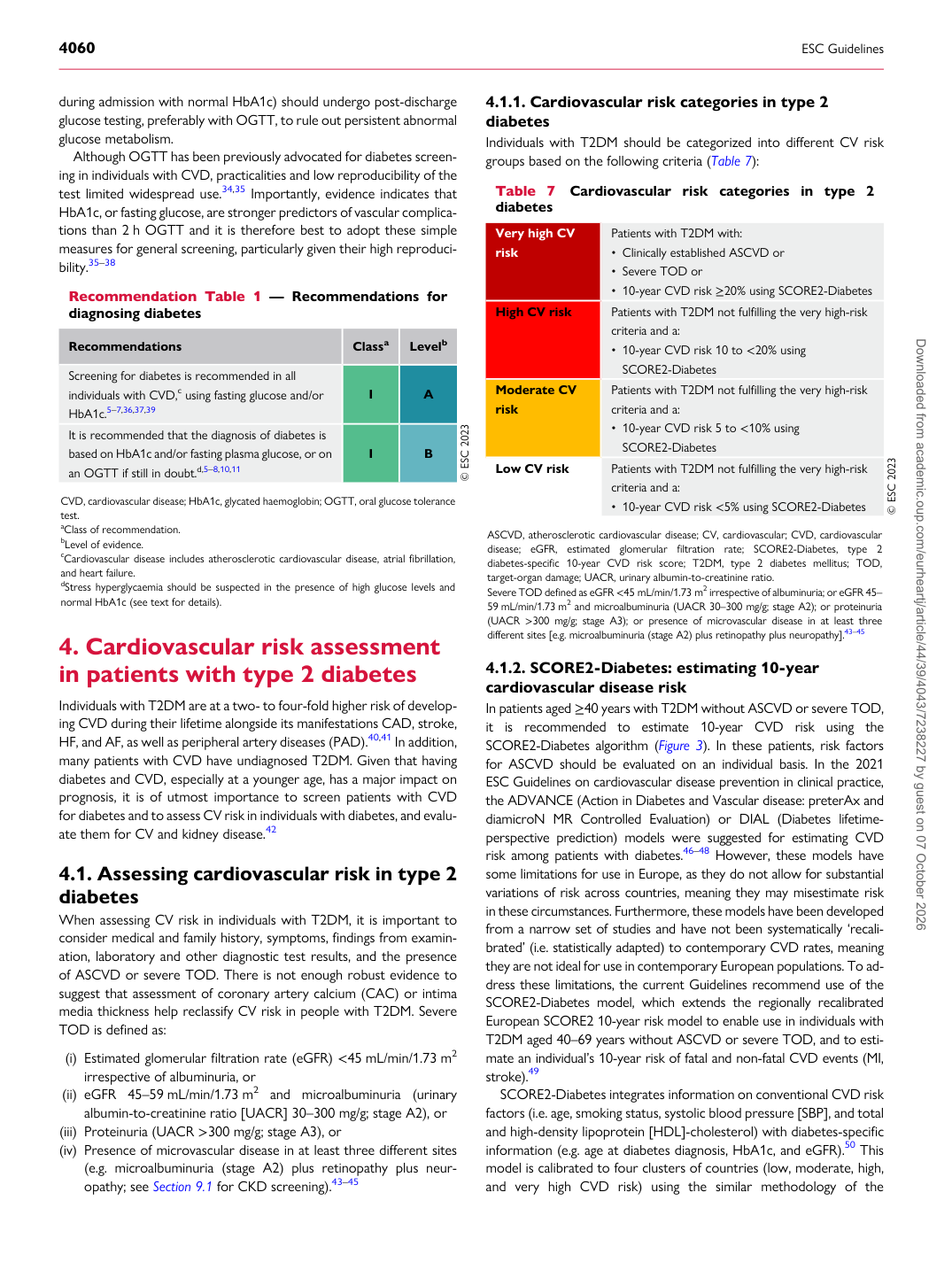
diabetes Individuals with T2DM should be categorized into different CV risk groups based on the following criteria (Table 7):

4.1.2 SCORE2-Diabetes: estimating 10-year

cardiovascular disease risk In patients aged ≥40 years with T2DM without ASCVD or severe TOD, it is recommended to estimate 10-year CVD risk using the SCORE2-Diabetes algorithm (Figure 3). In these patients, risk factors for ASCVD should be evaluated on an individual basis. In the 2021 ESC Guidelines on cardiovascular disease prevention in clinical practice, the ADVANCE (Action in Diabetes and Vascular disease: preterAx and diamicroN MR Controlled Evaluation) or DIAL (Diabetes lifetimeperspective prediction) models were suggested for estimating CVD risk among patients with diabetes.46–48 However, these models have some limitations for use in Europe, as they do not allow for substantial variations of risk across countries, meaning they may misestimate risk in these circumstances. Furthermore, these models have been developed from a narrow set of studies and have not been systematically ‘recalibrated’ (i.e. statistically adapted) to contemporary CVD rates, meaning they are not ideal for use in contemporary European populations. To address these limitations, the current Guidelines recommend use of the SCORE2-Diabetes model, which extends the regionally recalibrated European SCORE2 10-year risk model to enable use in individuals with T2DM aged 40–69 years without ASCVD or severe TOD, and to estimate an individual’s 10-year risk of fatal and non-fatal CVD events (MI, stroke).49 SCORE2-Diabetes integrates information on conventional CVD risk factors (i.e. age, smoking status, systolic blood pressure [SBP], and total and high-density lipoprotein [HDL]-cholesterol) with diabetes-specific information (e.g. age at diabetes diagnosis, HbA1c, and eGFR).50 This model is calibrated to four clusters of countries (low, moderate, high, and very high CVD risk) using the similar methodology of the

Recommendation Table 1 — Recommendations for diagnosing diabetes

Recommendations Classa Levelb

Screening for diabetes is recommended in all individuals with CVD,c using fasting glucose and/or HbA1c.5–7,36,37,39 I A It is recommended that the diagnosis of diabetes is based on HbA1c and/or fasting plasma glucose, or on an OGTT if still in doubt.d,5–8,10,11 I B © ESC 2023

CVD, cardiovascular disease; HbA1c, glycated haemoglobin; OGTT, oral glucose tolerance test. aClass of recommendation. bLevel of evidence. cCardiovascular disease includes atherosclerotic cardiovascular disease, atrial fibrillation, and heart failure. dStress hyperglycaemia should be suspected in the presence of high glucose levels and normal HbA1c (see text for details). Table 7 Cardiovascular risk categories in type 2 diabetes

Very high CV risk Patients with T2DM with:

• Clinically established ASCVD or • Severe TOD or • 10-year CVD risk ≥20% using SCORE2-Diabetes

High CV risk Patients with T2DM not fulfilling the very high-risk criteria and a:

• 10-year CVD risk 10 to <20% using

SCORE2-Diabetes

Moderate CV risk Patients with T2DM not fulfilling the very high-risk

criteria and a: • 10-year CVD risk 5 to <10% using

SCORE2-Diabetes

Low CV risk Patients with T2DM not fulfilling the very high-risk

criteria and a: • 10-year CVD risk <5% using SCORE2-Diabetes © ESC 2023

ASCVD, atherosclerotic cardiovascular disease; CV, cardiovascular; CVD, cardiovascular disease; eGFR, estimated glomerular filtration rate; SCORE2-Diabetes, type 2 diabetes-specific 10-year CVD risk score; T2DM, type 2 diabetes mellitus; TOD, target-organ damage; UACR, urinary albumin-to-creatinine ratio. Severe TOD defined as eGFR <45 mL/min/1.73 m2 irrespective of albuminuria; or eGFR 45– 59 mL/min/1.73 m2 and microalbuminuria (UACR 30–300 mg/g; stage A2); or proteinuria (UACR >300 mg/g; stage A3); or presence of microvascular disease in at least three different sites [e.g. microalbuminuria (stage A2) plus retinopathy plus neuropathy].43–45 Downloaded from academic.oup.com/eurheartj/article/44/39/4043/7238227 by guest on 07 October 2026