p.14 抽出テキスト
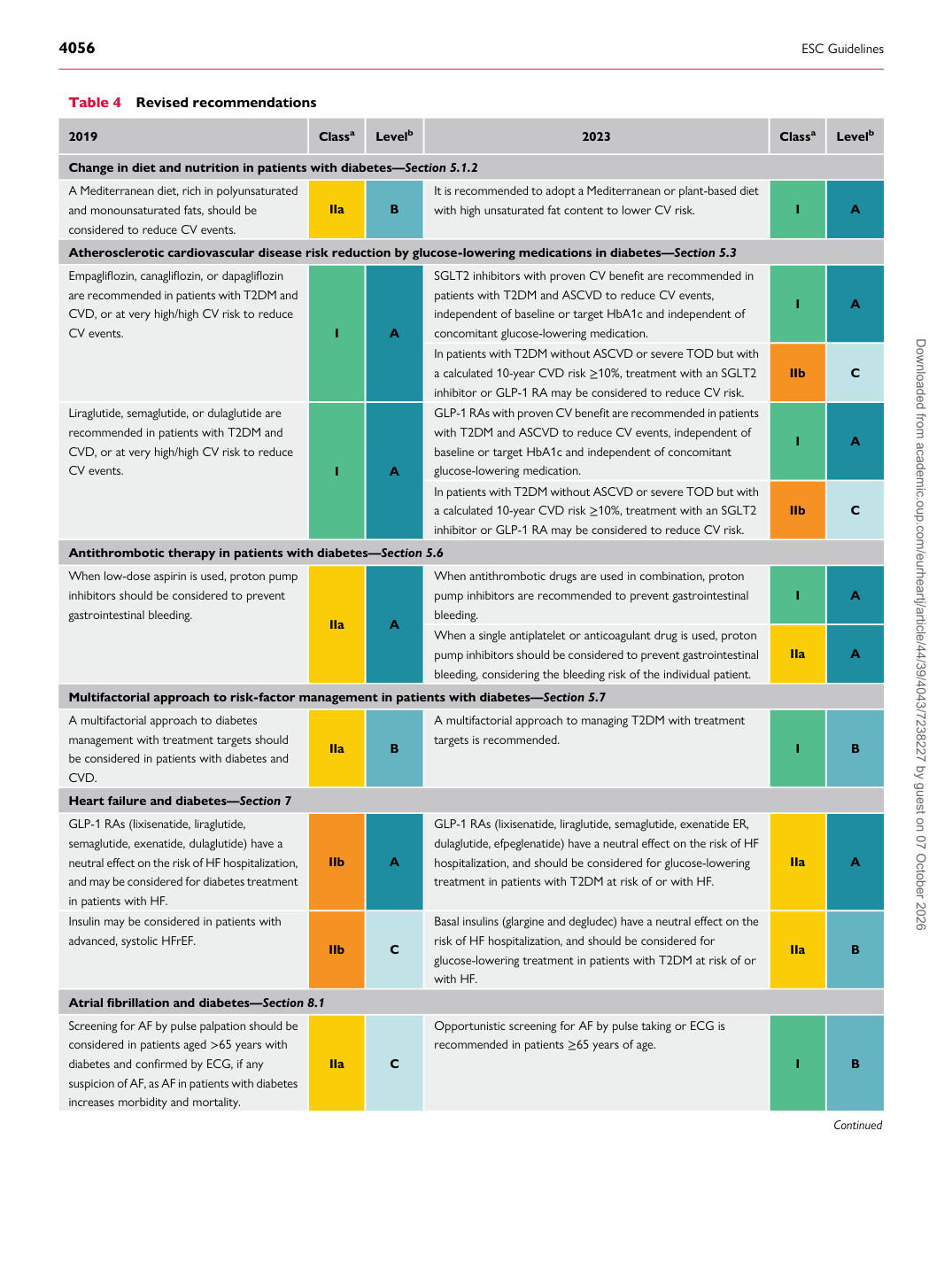
Table 4 Revised recommendations

2019 Classa Levelb 2023 Classa Levelb

Change in diet and nutrition in patients with diabetes—Section 5.1.2 A Mediterranean diet, rich in polyunsaturated and monounsaturated fats, should be considered to reduce CV events. IIa B It is recommended to adopt a Mediterranean or plant-based diet

with high unsaturated fat content to lower CV risk. I A

Atherosclerotic cardiovascular disease risk reduction by glucose-lowering medications in diabetes—Section 5.3 Empagliflozin, canagliflozin, or dapagliflozin are recommended in patients with T2DM and CVD, or at very high/high CV risk to reduce CV events. I A SGLT2 inhibitors with proven CV benefit are recommended in patients with T2DM and ASCVD to reduce CV events,

independent of baseline or target HbA1c and independent of concomitant glucose-lowering medication. I A In patients with T2DM without ASCVD or severe TOD but with a calculated 10-year CVD risk ≥10%, treatment with an SGLT2 inhibitor or GLP-1 RA may be considered to reduce CV risk. IIb C

Liraglutide, semaglutide, or dulaglutide are recommended in patients with T2DM and CVD, or at very high/high CV risk to reduce CV events. I A GLP-1 RAs with proven CV benefit are recommended in patients with T2DM and ASCVD to reduce CV events, independent of

baseline or target HbA1c and independent of concomitant glucose-lowering medication. I A In patients with T2DM without ASCVD or severe TOD but with a calculated 10-year CVD risk ≥10%, treatment with an SGLT2 inhibitor or GLP-1 RA may be considered to reduce CV risk. IIb C

Antithrombotic therapy in patients with diabetes—Section 5.6 When low-dose aspirin is used, proton pump inhibitors should be considered to prevent gastrointestinal bleeding. IIa A When antithrombotic drugs are used in combination, proton

pump inhibitors are recommended to prevent gastrointestinal bleeding. I A When a single antiplatelet or anticoagulant drug is used, proton pump inhibitors should be considered to prevent gastrointestinal bleeding, considering the bleeding risk of the individual patient. IIa A

Multifactorial approach to risk-factor management in patients with diabetes—Section 5.7 A multifactorial approach to diabetes management with treatment targets should be considered in patients with diabetes and CVD. IIa B A multifactorial approach to managing T2DM with treatment

targets is recommended. I B

Heart failure and diabetes—Section 7 GLP-1 RAs (lixisenatide, liraglutide, semaglutide, exenatide, dulaglutide) have a neutral effect on the risk of HF hospitalization, and may be considered for diabetes treatment in patients with HF. IIb A GLP-1 RAs (lixisenatide, liraglutide, semaglutide, exenatide ER,

dulaglutide, efpeglenatide) have a neutral effect on the risk of HF hospitalization, and should be considered for glucose-lowering treatment in patients with T2DM at risk of or with HF. IIa A

Insulin may be considered in patients with advanced, systolic HFrEF. IIb C Basal insulins (glargine and degludec) have a neutral effect on the

risk of HF hospitalization, and should be considered for glucose-lowering treatment in patients with T2DM at risk of or with HF. IIa B

Atrial fibrillation and diabetes—Section 8.1 Screening for AF by pulse palpation should be considered in patients aged >65 years with diabetes and confirmed by ECG, if any suspicion of AF, as AF in patients with diabetes increases morbidity and mortality. IIa C Opportunistic screening for AF by pulse taking or ECG is

recommended in patients ≥65 years of age.

I B

Continued Downloaded from academic.oup.com/eurheartj/article/44/39/4043/7238227 by guest on 07 October 2026