p.13 抽出テキスト
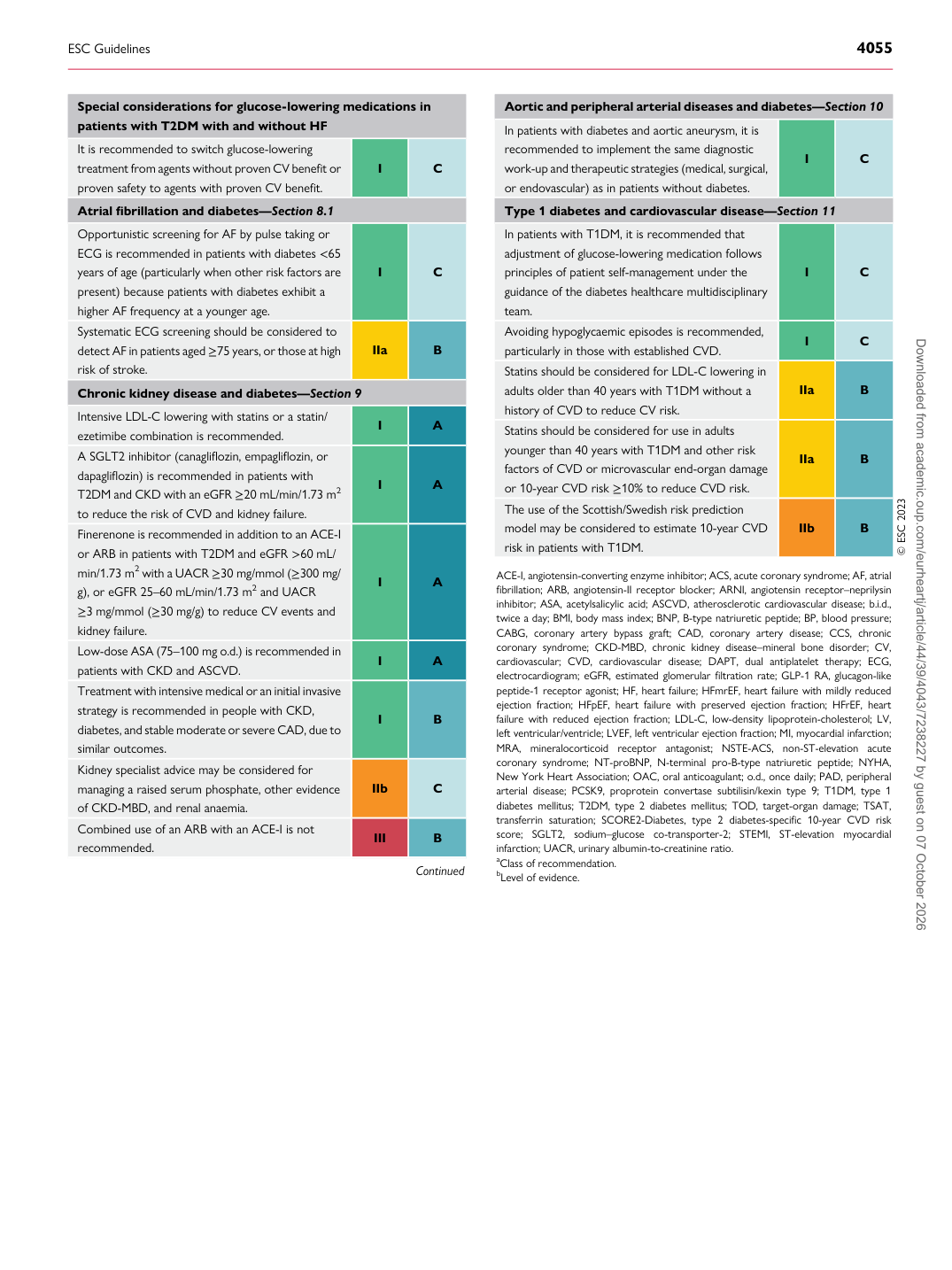
Special considerations for glucose-lowering medications in patients with T2DM with and without HF It is recommended to switch glucose-lowering treatment from agents without proven CV benefit or proven safety to agents with proven CV benefit. I C Atrial fibrillation and diabetes—Section 8.1 Opportunistic screening for AF by pulse taking or ECG is recommended in patients with diabetes <65 years of age (particularly when other risk factors are present) because patients with diabetes exhibit a higher AF frequency at a younger age. I C Systematic ECG screening should be considered to detect AF in patients aged ≥75 years, or those at high risk of stroke. IIa B Chronic kidney disease and diabetes—Section 9 Intensive LDL-C lowering with statins or a statin/ ezetimibe combination is recommended. I A A SGLT2 inhibitor (canagliflozin, empagliflozin, or dapagliflozin) is recommended in patients with T2DM and CKD with an eGFR ≥20 mL/min/1.73 m2 to reduce the risk of CVD and kidney failure. I A Finerenone is recommended in addition to an ACE-I or ARB in patients with T2DM and eGFR >60 mL/ min/1.73 m2 with a UACR ≥30 mg/mmol (≥300 mg/ g), or eGFR 25–60 mL/min/1.73 m2 and UACR ≥3 mg/mmol (≥30 mg/g) to reduce CV events and kidney failure. I A Low-dose ASA (75–100 mg o.d.) is recommended in patients with CKD and ASCVD. I A Treatment with intensive medical or an initial invasive strategy is recommended in people with CKD, diabetes, and stable moderate or severe CAD, due to similar outcomes. I B Kidney specialist advice may be considered for managing a raised serum phosphate, other evidence of CKD-MBD, and renal anaemia. IIb C Combined use of an ARB with an ACE-I is not recommended. III B

Continued Aortic and peripheral arterial diseases and diabetes—Section 10

In patients with diabetes and aortic aneurysm, it is recommended to implement the same diagnostic work-up and therapeutic strategies (medical, surgical, or endovascular) as in patients without diabetes. I C Type 1 diabetes and cardiovascular disease—Section 11 In patients with T1DM, it is recommended that adjustment of glucose-lowering medication follows principles of patient self-management under the guidance of the diabetes healthcare multidisciplinary team. I C Avoiding hypoglycaemic episodes is recommended, particularly in those with established CVD. I C Statins should be considered for LDL-C lowering in adults older than 40 years with T1DM without a history of CVD to reduce CV risk. IIa B Statins should be considered for use in adults younger than 40 years with T1DM and other risk factors of CVD or microvascular end-organ damage or 10-year CVD risk ≥10% to reduce CVD risk. IIa B The use of the Scottish/Swedish risk prediction model may be considered to estimate 10-year CVD risk in patients with T1DM. IIb B © ESC 2023

ACE-I, angiotensin-converting enzyme inhibitor; ACS, acute coronary syndrome; AF, atrial fibrillation; ARB, angiotensin-II receptor blocker; ARNI, angiotensin receptor–neprilysin inhibitor; ASA, acetylsalicylic acid; ASCVD, atherosclerotic cardiovascular disease; b.i.d., twice a day; BMI, body mass index; BNP, B-type natriuretic peptide; BP, blood pressure; CABG, coronary artery bypass graft; CAD, coronary artery disease; CCS, chronic coronary syndrome; CKD-MBD, chronic kidney disease–mineral bone disorder; CV, cardiovascular; CVD, cardiovascular disease; DAPT, dual antiplatelet therapy; ECG, electrocardiogram; eGFR, estimated glomerular filtration rate; GLP-1 RA, glucagon-like peptide-1 receptor agonist; HF, heart failure; HFmrEF, heart failure with mildly reduced ejection fraction; HFpEF, heart failure with preserved ejection fraction; HFrEF, heart failure with reduced ejection fraction; LDL-C, low-density lipoprotein-cholesterol; LV, left ventricular/ventricle; LVEF, left ventricular ejection fraction; MI, myocardial infarction; MRA, mineralocorticoid receptor antagonist; NSTE-ACS, non-ST-elevation acute coronary syndrome; NT-proBNP, N-terminal pro-B-type natriuretic peptide; NYHA, New York Heart Association; OAC, oral anticoagulant; o.d., once daily; PAD, peripheral arterial disease; PCSK9, proprotein convertase subtilisin/kexin type 9; T1DM, type 1 diabetes mellitus; T2DM, type 2 diabetes mellitus; TOD, target-organ damage; TSAT, transferrin saturation; SCORE2-Diabetes, type 2 diabetes-specific 10-year CVD risk score; SGLT2, sodium–glucose co-transporter-2; STEMI, ST-elevation myocardial infarction; UACR, urinary albumin-to-creatinine ratio. aClass of recommendation. bLevel of evidence.

ESC Guidelines                                                                                                                                                                                          4055

Downloaded from academic.oup.com/eurheartj/article/44/39/4043/7238227 by guest on 07 October 2026