p.12 抽出テキスト
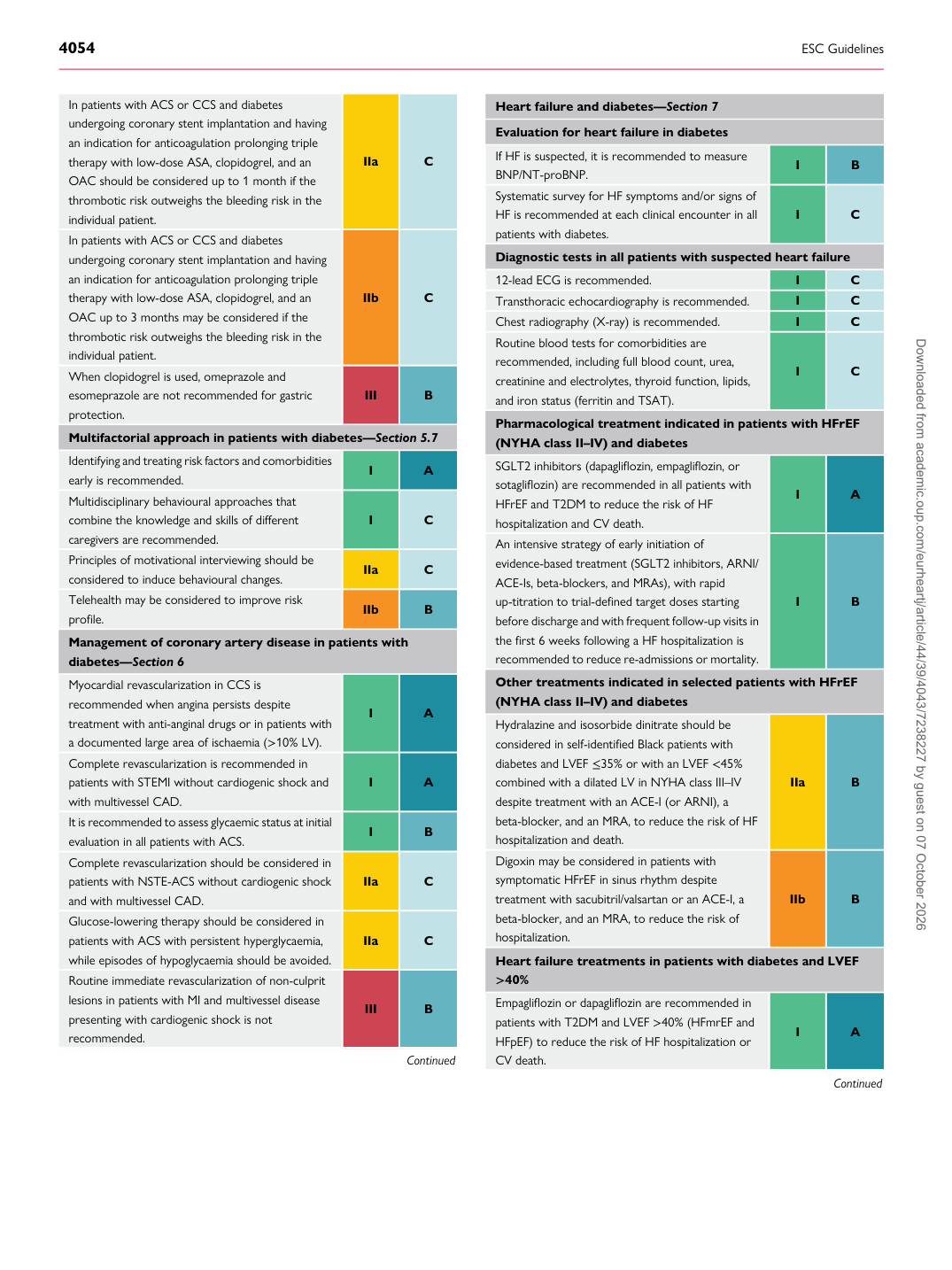
In patients with ACS or CCS and diabetes undergoing coronary stent implantation and having an indication for anticoagulation prolonging triple therapy with low-dose ASA, clopidogrel, and an OAC should be considered up to 1 month if the thrombotic risk outweighs the bleeding risk in the individual patient. IIa C In patients with ACS or CCS and diabetes undergoing coronary stent implantation and having an indication for anticoagulation prolonging triple therapy with low-dose ASA, clopidogrel, and an OAC up to 3 months may be considered if the thrombotic risk outweighs the bleeding risk in the individual patient. IIb C When clopidogrel is used, omeprazole and esomeprazole are not recommended for gastric protection. III B Multifactorial approach in patients with diabetes—Section 5.7 Identifying and treating risk factors and comorbidities early is recommended. I A Multidisciplinary behavioural approaches that combine the knowledge and skills of different caregivers are recommended. I C Principles of motivational interviewing should be considered to induce behavioural changes. IIa C Telehealth may be considered to improve risk profile. IIb B Management of coronary artery disease in patients with diabetes—Section 6 Myocardial revascularization in CCS is recommended when angina persists despite treatment with anti-anginal drugs or in patients with a documented large area of ischaemia (>10% LV). I A Complete revascularization is recommended in patients with STEMI without cardiogenic shock and with multivessel CAD. I A It is recommended to assess glycaemic status at initial evaluation in all patients with ACS. I B Complete revascularization should be considered in patients with NSTE-ACS without cardiogenic shock and with multivessel CAD. IIa C Glucose-lowering therapy should be considered in patients with ACS with persistent hyperglycaemia, while episodes of hypoglycaemia should be avoided. IIa C Routine immediate revascularization of non-culprit lesions in patients with MI and multivessel disease presenting with cardiogenic shock is not recommended. III B

Continued Heart failure and diabetes—Section 7

Evaluation for heart failure in diabetes If HF is suspected, it is recommended to measure BNP/NT-proBNP. I B Systematic survey for HF symptoms and/or signs of HF is recommended at each clinical encounter in all patients with diabetes. I C Diagnostic tests in all patients with suspected heart failure 12-lead ECG is recommended. I C Transthoracic echocardiography is recommended. I C Chest radiography (X-ray) is recommended. I C Routine blood tests for comorbidities are recommended, including full blood count, urea, creatinine and electrolytes, thyroid function, lipids, and iron status (ferritin and TSAT). I C Pharmacological treatment indicated in patients with HFrEF (NYHA class II–IV) and diabetes SGLT2 inhibitors (dapagliflozin, empagliflozin, or sotagliflozin) are recommended in all patients with HFrEF and T2DM to reduce the risk of HF hospitalization and CV death. I A An intensive strategy of early initiation of evidence-based treatment (SGLT2 inhibitors, ARNI/ ACE-Is, beta-blockers, and MRAs), with rapid up-titration to trial-defined target doses starting before discharge and with frequent follow-up visits in the first 6 weeks following a HF hospitalization is recommended to reduce re-admissions or mortality. I B Other treatments indicated in selected patients with HFrEF (NYHA class II–IV) and diabetes Hydralazine and isosorbide dinitrate should be considered in self-identified Black patients with diabetes and LVEF ≤35% or with an LVEF <45% combined with a dilated LV in NYHA class III–IV despite treatment with an ACE-I (or ARNI), a beta-blocker, and an MRA, to reduce the risk of HF hospitalization and death. IIa B Digoxin may be considered in patients with symptomatic HFrEF in sinus rhythm despite treatment with sacubitril/valsartan or an ACE-I, a beta-blocker, and an MRA, to reduce the risk of hospitalization. IIb B Heart failure treatments in patients with diabetes and LVEF >40% Empagliflozin or dapagliflozin are recommended in patients with T2DM and LVEF >40% (HFmrEF and HFpEF) to reduce the risk of HF hospitalization or CV death. I A

Continued Downloaded from academic.oup.com/eurheartj/article/44/39/4043/7238227 by guest on 07 October 2026