p.11 抽出テキスト
2.2 What is new

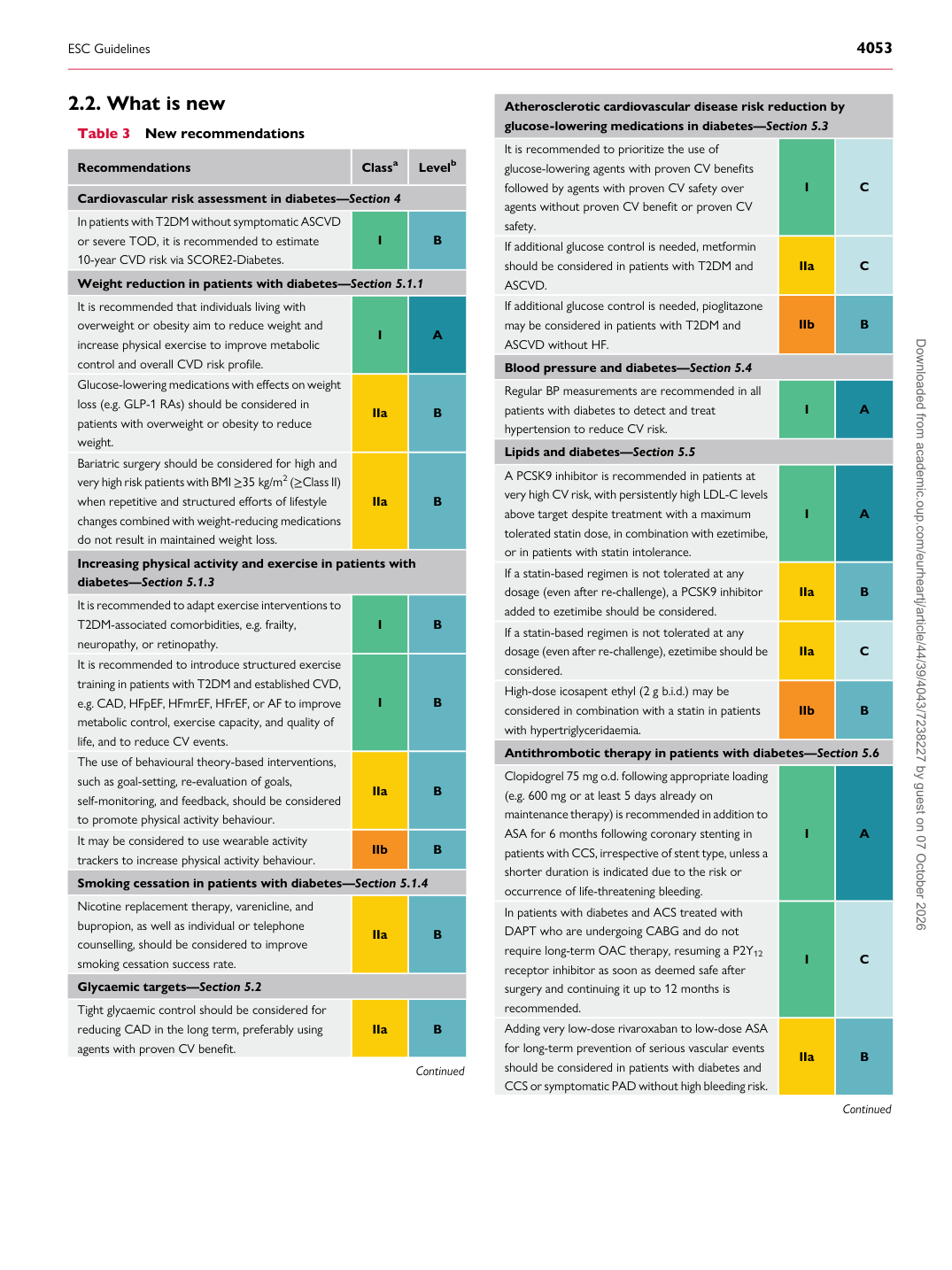
Table 3 New recommendations

Recommendations Classa Levelb

Cardiovascular risk assessment in diabetes—Section 4 In patients with T2DM without symptomatic ASCVD or severe TOD, it is recommended to estimate 10-year CVD risk via SCORE2-Diabetes. I B Weight reduction in patients with diabetes—Section 5.1.1 It is recommended that individuals living with overweight or obesity aim to reduce weight and increase physical exercise to improve metabolic control and overall CVD risk profile. I A Glucose-lowering medications with effects on weight loss (e.g. GLP-1 RAs) should be considered in patients with overweight or obesity to reduce weight. IIa B Bariatric surgery should be considered for high and very high risk patients with BMI ≥35 kg/m2 (≥Class II) when repetitive and structured efforts of lifestyle changes combined with weight-reducing medications do not result in maintained weight loss. IIa B Increasing physical activity and exercise in patients with diabetes—Section 5.1.3 It is recommended to adapt exercise interventions to T2DM-associated comorbidities, e.g. frailty, neuropathy, or retinopathy. I B It is recommended to introduce structured exercise training in patients with T2DM and established CVD, e.g. CAD, HFpEF, HFmrEF, HFrEF, or AF to improve metabolic control, exercise capacity, and quality of life, and to reduce CV events. I B The use of behavioural theory-based interventions, such as goal-setting, re-evaluation of goals, self-monitoring, and feedback, should be considered to promote physical activity behaviour. IIa B It may be considered to use wearable activity trackers to increase physical activity behaviour. IIb B Smoking cessation in patients with diabetes—Section 5.1.4 Nicotine replacement therapy, varenicline, and bupropion, as well as individual or telephone counselling, should be considered to improve smoking cessation success rate. IIa B Glycaemic targets—Section 5.2 Tight glycaemic control should be considered for reducing CAD in the long term, preferably using agents with proven CV benefit. IIa B

Continued Atherosclerotic cardiovascular disease risk reduction by

glucose-lowering medications in diabetes—Section 5.3 It is recommended to prioritize the use of glucose-lowering agents with proven CV benefits followed by agents with proven CV safety over agents without proven CV benefit or proven CV safety. I C If additional glucose control is needed, metformin should be considered in patients with T2DM and ASCVD. IIa C If additional glucose control is needed, pioglitazone may be considered in patients with T2DM and ASCVD without HF. IIb B Blood pressure and diabetes—Section 5.4 Regular BP measurements are recommended in all patients with diabetes to detect and treat hypertension to reduce CV risk. I A Lipids and diabetes—Section 5.5 A PCSK9 inhibitor is recommended in patients at very high CV risk, with persistently high LDL-C levels above target despite treatment with a maximum tolerated statin dose, in combination with ezetimibe, or in patients with statin intolerance. I A If a statin-based regimen is not tolerated at any dosage (even after re-challenge), a PCSK9 inhibitor added to ezetimibe should be considered. IIa B If a statin-based regimen is not tolerated at any dosage (even after re-challenge), ezetimibe should be considered. IIa C High-dose icosapent ethyl (2 g b.i.d.) may be considered in combination with a statin in patients with hypertriglyceridaemia. IIb B Antithrombotic therapy in patients with diabetes—Section 5.6 Clopidogrel 75 mg o.d. following appropriate loading (e.g. 600 mg or at least 5 days already on maintenance therapy) is recommended in addition to ASA for 6 months following coronary stenting in patients with CCS, irrespective of stent type, unless a shorter duration is indicated due to the risk or occurrence of life-threatening bleeding. I A In patients with diabetes and ACS treated with DAPT who are undergoing CABG and do not require long-term OAC therapy, resuming a P2Y12 receptor inhibitor as soon as deemed safe after surgery and continuing it up to 12 months is recommended. I C Adding very low-dose rivaroxaban to low-dose ASA for long-term prevention of serious vascular events should be considered in patients with diabetes and CCS or symptomatic PAD without high bleeding risk. IIa B

Continued

ESC Guidelines                                                                                                                                                                                          4053

Downloaded from academic.oup.com/eurheartj/article/44/39/4043/7238227 by guest on 07 October 2026