p.91 抽出テキスト
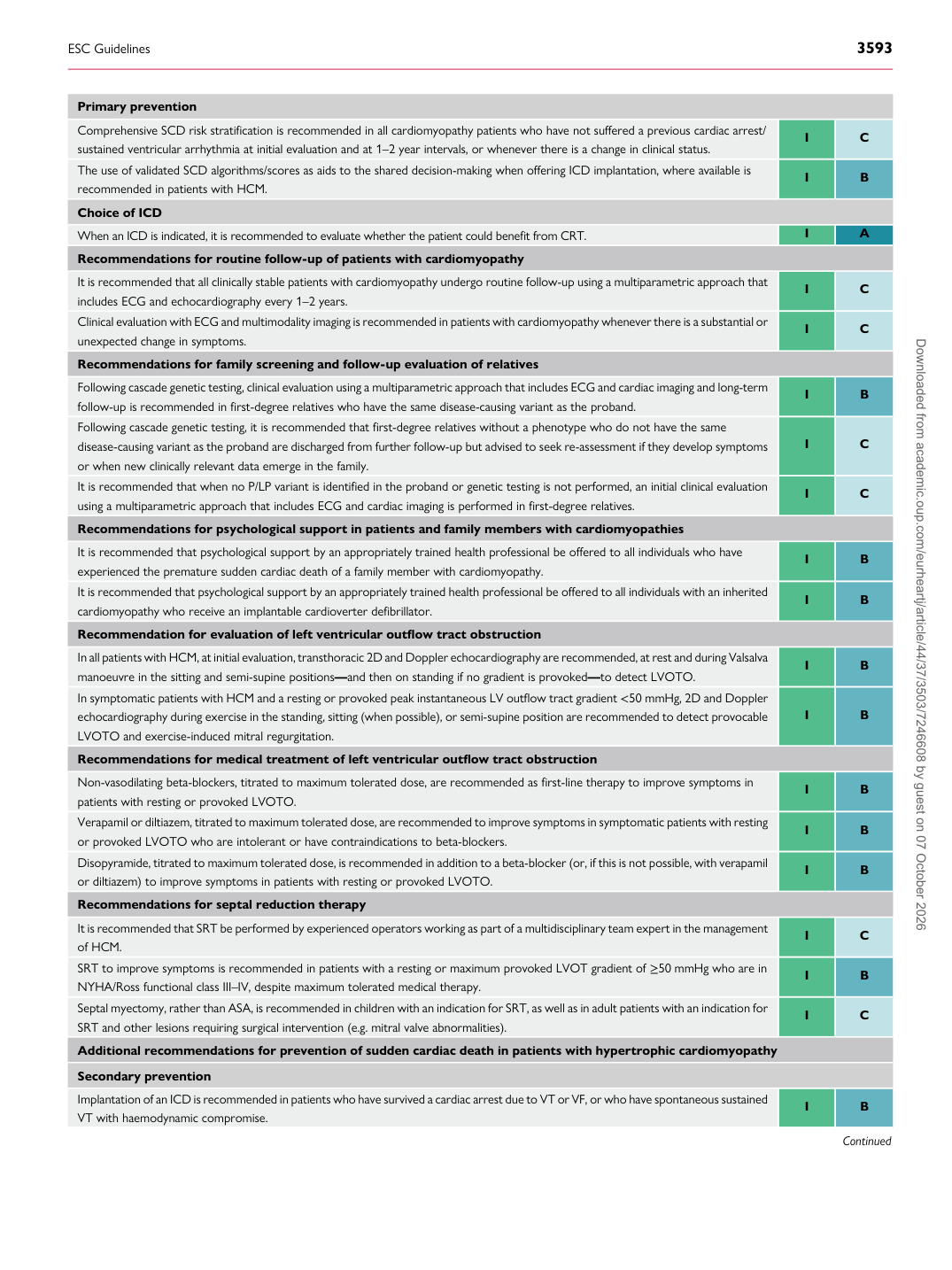
Primary prevention Comprehensive SCD risk stratification is recommended in all cardiomyopathy patients who have not suffered a previous cardiac arrest/ sustained ventricular arrhythmia at initial evaluation and at 1–2 year intervals, or whenever there is a change in clinical status. I C The use of validated SCD algorithms/scores as aids to the shared decision-making when offering ICD implantation, where available is recommended in patients with HCM. I B Choice of ICD When an ICD is indicated, it is recommended to evaluate whether the patient could benefit from CRT. I A Recommendations for routine follow-up of patients with cardiomyopathy It is recommended that all clinically stable patients with cardiomyopathy undergo routine follow-up using a multiparametric approach that includes ECG and echocardiography every 1–2 years. I C Clinical evaluation with ECG and multimodality imaging is recommended in patients with cardiomyopathy whenever there is a substantial or unexpected change in symptoms. I C Recommendations for family screening and follow-up evaluation of relatives Following cascade genetic testing, clinical evaluation using a multiparametric approach that includes ECG and cardiac imaging and long-term follow-up is recommended in first-degree relatives who have the same disease-causing variant as the proband. I B Following cascade genetic testing, it is recommended that first-degree relatives without a phenotype who do not have the same disease-causing variant as the proband are discharged from further follow-up but advised to seek re-assessment if they develop symptoms or when new clinically relevant data emerge in the family. I C It is recommended that when no P/LP variant is identified in the proband or genetic testing is not performed, an initial clinical evaluation using a multiparametric approach that includes ECG and cardiac imaging is performed in first-degree relatives. I C Recommendations for psychological support in patients and family members with cardiomyopathies It is recommended that psychological support by an appropriately trained health professional be offered to all individuals who have experienced the premature sudden cardiac death of a family member with cardiomyopathy. I B It is recommended that psychological support by an appropriately trained health professional be offered to all individuals with an inherited cardiomyopathy who receive an implantable cardioverter defibrillator. I B Recommendation for evaluation of left ventricular outflow tract obstruction In all patients with HCM, at initial evaluation, transthoracic 2D and Doppler echocardiography are recommended, at rest and during Valsalva manoeuvre in the sitting and semi-supine positions—and then on standing if no gradient is provoked—to detect LVOTO. I B In symptomatic patients with HCM and a resting or provoked peak instantaneous LV outflow tract gradient <50 mmHg, 2D and Doppler echocardiography during exercise in the standing, sitting (when possible), or semi-supine position are recommended to detect provocable LVOTO and exercise-induced mitral regurgitation. I B Recommendations for medical treatment of left ventricular outflow tract obstruction Non-vasodilating beta-blockers, titrated to maximum tolerated dose, are recommended as first-line therapy to improve symptoms in patients with resting or provoked LVOTO. I B Verapamil or diltiazem, titrated to maximum tolerated dose, are recommended to improve symptoms in symptomatic patients with resting or provoked LVOTO who are intolerant or have contraindications to beta-blockers. I B Disopyramide, titrated to maximum tolerated dose, is recommended in addition to a beta-blocker (or, if this is not possible, with verapamil or diltiazem) to improve symptoms in patients with resting or provoked LVOTO. I B Recommendations for septal reduction therapy It is recommended that SRT be performed by experienced operators working as part of a multidisciplinary team expert in the management of HCM. I C SRT to improve symptoms is recommended in patients with a resting or maximum provoked LVOT gradient of ≥50 mmHg who are in NYHA/Ross functional class III–IV, despite maximum tolerated medical therapy. I B Septal myectomy, rather than ASA, is recommended in children with an indication for SRT, as well as in adult patients with an indication for SRT and other lesions requiring surgical intervention (e.g. mitral valve abnormalities). I C Additional recommendations for prevention of sudden cardiac death in patients with hypertrophic cardiomyopathy Secondary prevention Implantation of an ICD is recommended in patients who have survived a cardiac arrest due to VT or VF, or who have spontaneous sustained VT with haemodynamic compromise. I B

Continued

ESC Guidelines                                                                                                                                                                                          3593

Downloaded from academic.oup.com/eurheartj/article/44/37/3503/7246608 by guest on 07 October 2026