p.89 抽出テキスト
(d) Lack of studies addressing the optimal timing to start ERT in adolescents and adults with late-onset Pompe disease. (e) Lack of standardized protocols to treat cross-reactive immunologic material-negative patients. (f) Lack of standardization of clinical endpoints in ERT/chaperone therapy trials. (g) Lack of head-to-head comparisons between agalsidase alpha and beta. (h) Optimal time to begin treatment in asymptomatic female patients with non-classic disease. (11) Amyloid:

(a) Further studies are needed to assess the efficacy and safety of tafamidis in NYHA class III patients. (b) SCD risk stratification and indications for ICD implantation should be carefully defined, taking into account the estimated life expectancy, competitive non-cardiovascular mortality, and the high rate of pulseless electrical activity. (c) The need for drug therapy in patients with cardiac amyloid-

osis and subclinical cardiac involvement (i.e asymptomatic patients, positive scintigraphy with negative ECHO) has not been clearly defined. (12) Sports:

(a) ‘Return to play’ for patients with low-risk cardiomyopathies (and how to define low risk in relation to exercise). (b) SCD risk and exercise recommendations in phenotypenegative gene carriers. (c) Role of exercise in disease expression and progression. (d) Large, adequately powered randomized prospective studies are necessary to provide evidence-based recommendations for optimal exercise prescription without compromising safety. (13) Reproductive issues:

(a) Several cardiomyopathies lack specific outcome data regarding pregnancy. (b) There is a lack of randomized trials on the use of AADs, heart failure drugs, and interventions during pregnancy. (14) Non-cardiac interventions:

(a) There is a lack specific outcome data regarding risks of noncardiac interventions. (15) Management of cardiovascular risk factors in patients with

cardiomyopathies: (a) There is a lack of data on the impact of comorbidities on

penetrance, severity, and outcome of cardiomyopathies.

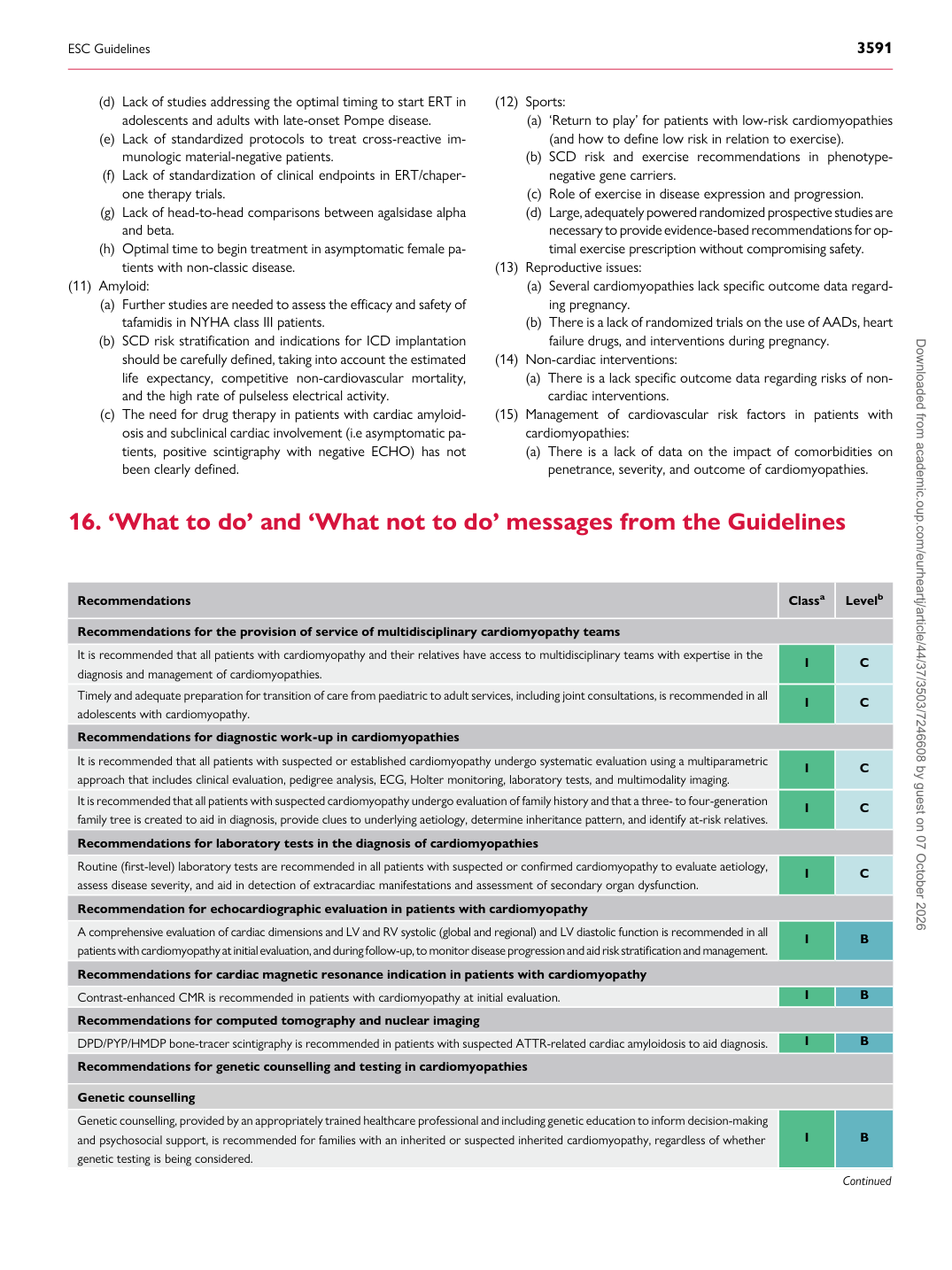
16 ‘What to do’ and ‘What not to do’ messages from the Guidelines

Recommendations Classa Levelb

Recommendations for the provision of service of multidisciplinary cardiomyopathy teams It is recommended that all patients with cardiomyopathy and their relatives have access to multidisciplinary teams with expertise in the diagnosis and management of cardiomyopathies. I C Timely and adequate preparation for transition of care from paediatric to adult services, including joint consultations, is recommended in all adolescents with cardiomyopathy. I C Recommendations for diagnostic work-up in cardiomyopathies It is recommended that all patients with suspected or established cardiomyopathy undergo systematic evaluation using a multiparametric approach that includes clinical evaluation, pedigree analysis, ECG, Holter monitoring, laboratory tests, and multimodality imaging. I C It is recommended that all patients with suspected cardiomyopathy undergo evaluation of family history and that a three- to four-generation family tree is created to aid in diagnosis, provide clues to underlying aetiology, determine inheritance pattern, and identify at-risk relatives. I C Recommendations for laboratory tests in the diagnosis of cardiomyopathies Routine (first-level) laboratory tests are recommended in all patients with suspected or confirmed cardiomyopathy to evaluate aetiology, assess disease severity, and aid in detection of extracardiac manifestations and assessment of secondary organ dysfunction. I C Recommendation for echocardiographic evaluation in patients with cardiomyopathy A comprehensive evaluation of cardiac dimensions and LV and RV systolic (global and regional) and LV diastolic function is recommended in all patients with cardiomyopathy at initial evaluation, and during follow-up, to monitor disease progression and aid risk stratification and management. I B Recommendations for cardiac magnetic resonance indication in patients with cardiomyopathy Contrast-enhanced CMR is recommended in patients with cardiomyopathy at initial evaluation. I B Recommendations for computed tomography and nuclear imaging DPD/PYP/HMDP bone-tracer scintigraphy is recommended in patients with suspected ATTR-related cardiac amyloidosis to aid diagnosis. I B Recommendations for genetic counselling and testing in cardiomyopathies

Genetic counselling Genetic counselling, provided by an appropriately trained healthcare professional and including genetic education to inform decision-making and psychosocial support, is recommended for families with an inherited or suspected inherited cardiomyopathy, regardless of whether genetic testing is being considered. I B

Continued

ESC Guidelines                                                                                                                                                                                          3591

Downloaded from academic.oup.com/eurheartj/article/44/37/3503/7246608 by guest on 07 October 2026