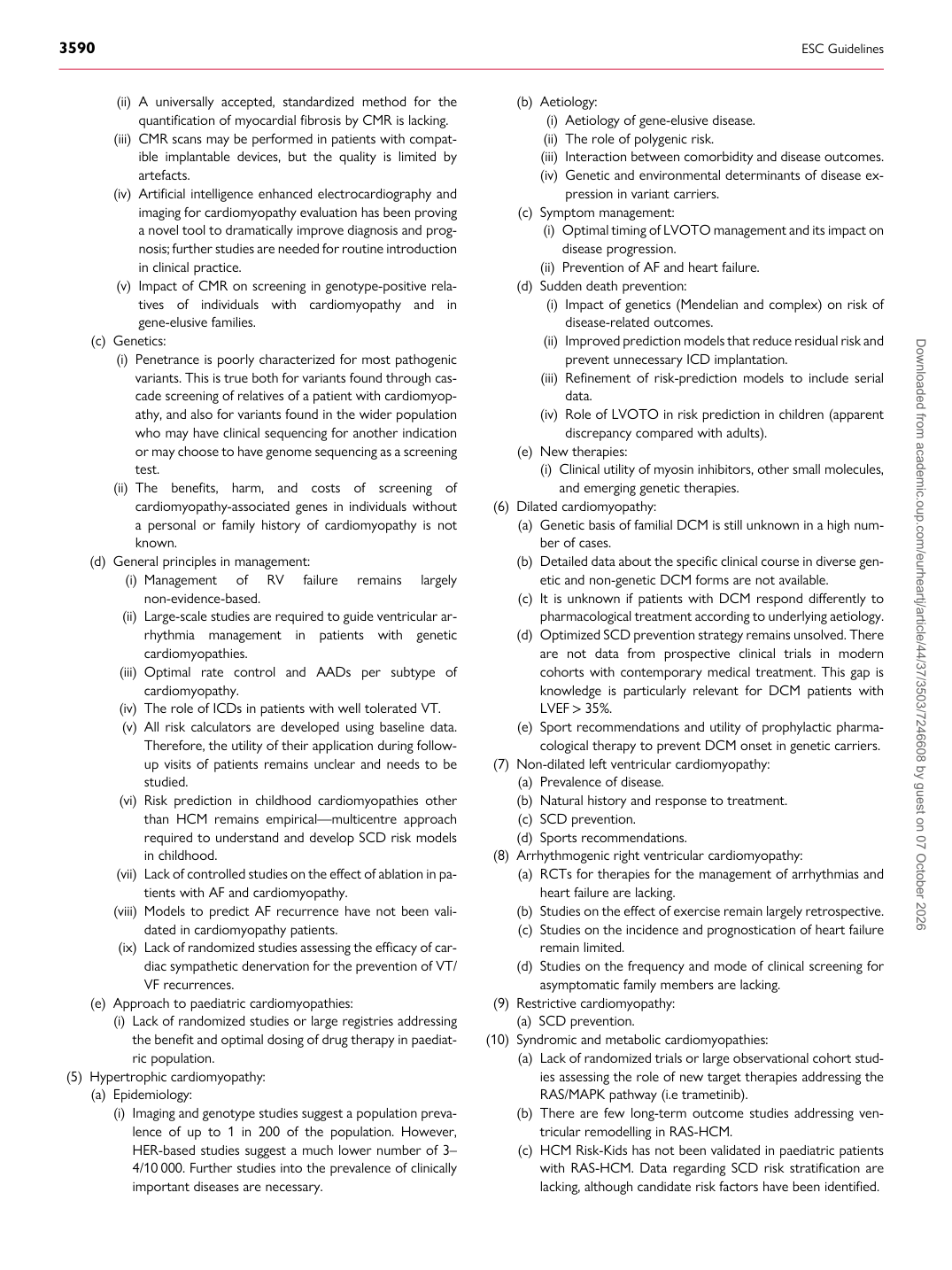
p.88 抽出テキスト
(ii) A universally accepted, standardized method for the quantification of myocardial fibrosis by CMR is lacking. (iii) CMR scans may be performed in patients with compatible implantable devices, but the quality is limited by artefacts. (iv) Artificial intelligence enhanced electrocardiography and imaging for cardiomyopathy evaluation has been proving a novel tool to dramatically improve diagnosis and prognosis; further studies are needed for routine introduction in clinical practice. (v) Impact of CMR on screening in genotype-positive relatives of individuals with cardiomyopathy and in gene-elusive families. (c) Genetics:

(i) Penetrance is poorly characterized for most pathogenic variants. This is true both for variants found through cascade screening of relatives of a patient with cardiomyopathy, and also for variants found in the wider population who may have clinical sequencing for another indication or may choose to have genome sequencing as a screening test. (ii) The benefits, harm, and costs of screening of cardiomyopathy-associated genes in individuals without a personal or family history of cardiomyopathy is not known. (d) General principles in management:

(i) Management of RV failure remains largely non-evidence-based. (ii) Large-scale studies are required to guide ventricular arrhythmia management in patients with genetic cardiomyopathies. (iii) Optimal rate control and AADs per subtype of cardiomyopathy. (iv) The role of ICDs in patients with well tolerated VT. (v) All risk calculators are developed using baseline data. Therefore, the utility of their application during followup visits of patients remains unclear and needs to be studied. (vi) Risk prediction in childhood cardiomyopathies other than HCM remains empirical—multicentre approach required to understand and develop SCD risk models in childhood. (vii) Lack of controlled studies on the effect of ablation in patients with AF and cardiomyopathy. (viii) Models to predict AF recurrence have not been validated in cardiomyopathy patients. (ix) Lack of randomized studies assessing the efficacy of cardiac sympathetic denervation for the prevention of VT/ VF recurrences. (e) Approach to paediatric cardiomyopathies:

(i) Lack of randomized studies or large registries addressing the benefit and optimal dosing of drug therapy in paediatric population. (5) Hypertrophic cardiomyopathy:

(a) Epidemiology:

(i) Imaging and genotype studies suggest a population preva-

lence of up to 1 in 200 of the population. However, HER-based studies suggest a much lower number of 3– 4/10 000. Further studies into the prevalence of clinically important diseases are necessary. (b) Aetiology:

(i) Aetiology of gene-elusive disease. (ii) The role of polygenic risk. (iii) Interaction between comorbidity and disease outcomes. (iv) Genetic and environmental determinants of disease expression in variant carriers. (c) Symptom management:

(i) Optimal timing of LVOTO management and its impact on disease progression. (ii) Prevention of AF and heart failure. (d) Sudden death prevention:

(i) Impact of genetics (Mendelian and complex) on risk of disease-related outcomes. (ii) Improved prediction models that reduce residual risk and prevent unnecessary ICD implantation. (iii) Refinement of risk-prediction models to include serial data. (iv) Role of LVOTO in risk prediction in children (apparent discrepancy compared with adults). (e) New therapies:

(i) Clinical utility of myosin inhibitors, other small molecules, and emerging genetic therapies. (6) Dilated cardiomyopathy:

(a) Genetic basis of familial DCM is still unknown in a high number of cases. (b) Detailed data about the specific clinical course in diverse genetic and non-genetic DCM forms are not available. (c) It is unknown if patients with DCM respond differently to pharmacological treatment according to underlying aetiology. (d) Optimized SCD prevention strategy remains unsolved. There are not data from prospective clinical trials in modern cohorts with contemporary medical treatment. This gap is knowledge is particularly relevant for DCM patients with LVEF > 35%. (e) Sport recommendations and utility of prophylactic pharmacological therapy to prevent DCM onset in genetic carriers. (7) Non-dilated left ventricular cardiomyopathy:

(a) Prevalence of disease. (b) Natural history and response to treatment. (c) SCD prevention. (d) Sports recommendations. (8) Arrhythmogenic right ventricular cardiomyopathy:

(a) RCTs for therapies for the management of arrhythmias and heart failure are lacking. (b) Studies on the effect of exercise remain largely retrospective. (c) Studies on the incidence and prognostication of heart failure remain limited. (d) Studies on the frequency and mode of clinical screening for asymptomatic family members are lacking. (9) Restrictive cardiomyopathy: (a) SCD prevention. (10) Syndromic and metabolic cardiomyopathies:

(a) Lack of randomized trials or large observational cohort studies assessing the role of new target therapies addressing the RAS/MAPK pathway (i.e trametinib). (b) There are few long-term outcome studies addressing ventricular remodelling in RAS-HCM. (c) HCM Risk-Kids has not been validated in paediatric patients

with RAS-HCM. Data regarding SCD risk stratification are lacking, although candidate risk factors have been identified. Downloaded from academic.oup.com/eurheartj/article/44/37/3503/7246608 by guest on 07 October 2026