p.83 抽出テキスト
EF <20%, severe mitral regurgitation, RV failure, AF, and/or hypotension.1143

8.2.2.7 Peripartum cardiomyopathy

Genetic studies in patients with PPCM have revealed genetic similarity between PPCM and DCM. Specifically, an overrepresentation of truncating variants has been demonstrated in TTN, FLNC, BAG3, and DSP, with TTN truncating variants most commonly involved (found in ∼10% of patients).44,45 It has been suggested that approaches to genetic testing in PPCM should mirror those taken in DCM.45 Medications used to treat heart failure during pregnancy require special considerations as discussed above. In the presence of persistant cardiac dysfunction, medication should be continued. Use of bromocriptine as diseasespecific therapy in patients with PPCM as an addition to standard heart failure therapy has shown promising results in two clinical trials.1144,1145 In severe cases of PPCM, temporary MCS has been used successfully and should be considered in patients with haemodynamic instability despite inotropic support.1146 In patients with PPCM, thresholds for early ICD implantations should be higher than in other conditions because of a high rate of spontaneous recovery after delivery.1147 8.3 Recommendations for non-cardiac

surgery Cardiomyopathies, in general, are associated with an increased incidence of peri-operative heart failure and arrhythmias, although the significant variability in the phenotypic expression of cardiomyopathies must be considered. Special attention should be given to the clinical status, LVEF, volume overload, and increased levels of natriuretic peptides. In the period after non-cardiac surgery (NCS), fluids given during the operation may be mobilized, causing hypervolaemia and pulmonary congestion. Careful attention to fluid balance is therefore essential.1148,1149 Obstructive HCM deserves specific consideration due to its peculiar pathophysiology, with adequate intra-operative vigilance, avoiding factors and medication that may increase LVOTO and prompt pharmacological treatment and intravascular fluid therapy if needed (see Supplementary data online, Table S7).1150,1151 Natriuretic peptide concentrations are quantitative plasma biomarkers for the presence and severity of haemodynamic cardiac stress and heart failure, and elevated NT-proBNP concentrations may facilitate detection of heart failure, optimal intra-operative monitoring, and initiation or optimization of heart failure therapy after surgery.1152 Moreover, in cardiomyopathy patients elevated NT-proBNP values are strong predictors of overall prognosis.1153–1156 Patients with a first-degree relative with a genetic cardiomyopathy should be evaluated with an ECG and an echocardiographic examination to rule out the presence of the disease, irrespective of age (see Section 6.11). There are no specific data on risks of NCS in phenotype-negative family members; however, they are at risk of developing the disease, which may be subclinical at the time of the NCS.1157 Data in children with HCM undergoing general anaesthesia for cardiac and non-cardiac procedures show that, in a specialist setting with multidisciplinary involvement, perioperative morbidity and mortality are extremely low.1158

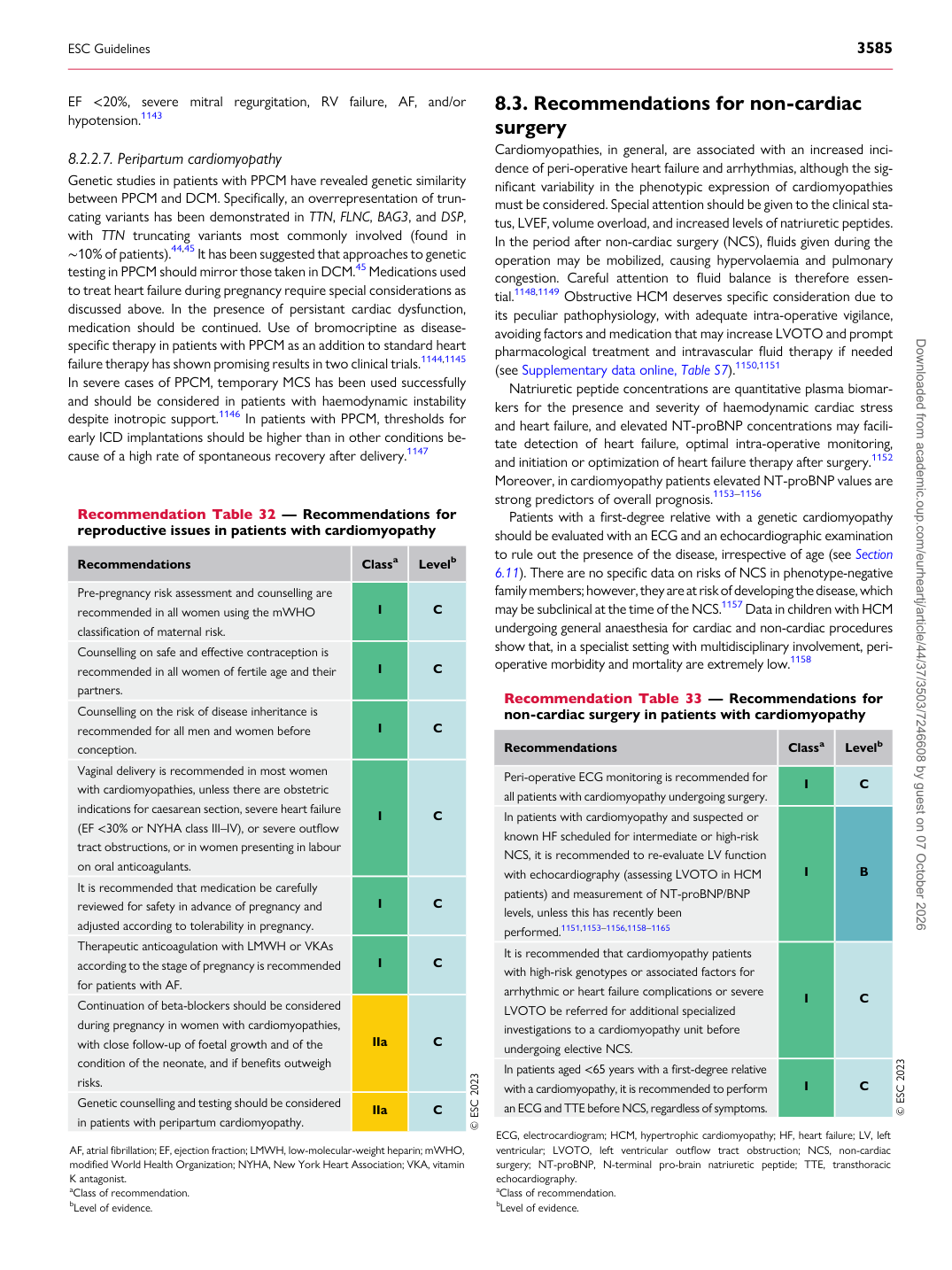
Recommendation Table 32 — Recommendations for reproductive issues in patients with cardiomyopathy

Recommendations Classa Levelb

Pre-pregnancy risk assessment and counselling are recommended in all women using the mWHO classification of maternal risk. I C Counselling on safe and effective contraception is recommended in all women of fertile age and their partners. I C Counselling on the risk of disease inheritance is recommended for all men and women before conception. I C Vaginal delivery is recommended in most women with cardiomyopathies, unless there are obstetric indications for caesarean section, severe heart failure (EF <30% or NYHA class III–IV), or severe outflow tract obstructions, or in women presenting in labour on oral anticoagulants. I C It is recommended that medication be carefully reviewed for safety in advance of pregnancy and adjusted according to tolerability in pregnancy. I C Therapeutic anticoagulation with LMWH or VKAs according to the stage of pregnancy is recommended for patients with AF. I C Continuation of beta-blockers should be considered during pregnancy in women with cardiomyopathies, with close follow-up of foetal growth and of the condition of the neonate, and if benefits outweigh risks. IIa C Genetic counselling and testing should be considered in patients with peripartum cardiomyopathy. IIa C © ESC 2023

AF, atrial fibrillation; EF, ejection fraction; LMWH, low-molecular-weight heparin; mWHO, modified World Health Organization; NYHA, New York Heart Association; VKA, vitamin K antagonist. aClass of recommendation. bLevel of evidence. Recommendation Table 33 — Recommendations for non-cardiac surgery in patients with cardiomyopathy

Recommendations Classa Levelb

Peri-operative ECG monitoring is recommended for all patients with cardiomyopathy undergoing surgery. I C In patients with cardiomyopathy and suspected or known HF scheduled for intermediate or high-risk NCS, it is recommended to re-evaluate LV function with echocardiography (assessing LVOTO in HCM patients) and measurement of NT-proBNP/BNP levels, unless this has recently been performed.1151,1153–1156,1158–1165 I B It is recommended that cardiomyopathy patients with high-risk genotypes or associated factors for arrhythmic or heart failure complications or severe LVOTO be referred for additional specialized investigations to a cardiomyopathy unit before undergoing elective NCS. I C In patients aged <65 years with a first-degree relative with a cardiomyopathy, it is recommended to perform an ECG and TTE before NCS, regardless of symptoms. I C © ESC 2023

ECG, electrocardiogram; HCM, hypertrophic cardiomyopathy; HF, heart failure; LV, left ventricular; LVOTO, left ventricular outflow tract obstruction; NCS, non-cardiac surgery; NT-proBNP, N-terminal pro-brain natriuretic peptide; TTE, transthoracic echocardiography. aClass of recommendation. bLevel of evidence.

ESC Guidelines                                                                                                                                                                                          3585

Downloaded from academic.oup.com/eurheartj/article/44/37/3503/7246608 by guest on 07 October 2026