p.81 抽出テキスト
8.2 Reproductive issues

Pregnancy and the post-partum period constitute periods of increased risk of cardiovascular complications in women with cardiomyopathy.1127–1130 Cardiomyopathy can also be first diagnosed in pregnancy or arise during pregnancy as PPCM.1131 The risk associated with pregnancy in a patient with a cardiomyopathy is estimated using the modified World Health Organization (mWHO) classification.1130 Pregnancy is contraindicated in women with WHO class IV, including patients with EF <30% or NYHA class III–IV or previous PPCM with persisting impairment of the LV function.

8.2.1 Contraception, in vitro fertilization, and

hormonal treatment Counselling on safe and effective contraception is indicated in all women of fertile age. Ethinyloestradiol-containing contraceptives have the greatest risk of thrombosis1132 and are not advised in women with a high risk of thrombo-embolic disease. Progestin-only contraceptives are an alternative, as they have little or no effect on coagulation factors, blood pressure, and lipid levels. Levonorgestrel-based longacting reversible contraception implants or intrauterine devices are the safest and most effective contraceptives and have few side effects affecting cardiomyopathies. Medically assisted procreation adds risks beyond those of pregnancy alone; superovulation is pro-thrombotic and can be complicated by ovarian hyperstimulation syndrome, with marked fluid shifts and an even greater risk of thrombosis. Hormonal stimulation should be carefully considered in women who have WHO class III disease (VT or HCM) or who are anticoagulated.

8.2.2 Pregnancy management

8.2.2.1. Pre-pregnancy Patients with a known cardiomyopathy and at risk of developing cardiomyopathy should receive pre-pregnancy counselling by a multidisciplinary team: the pregnancy heart team. The individual risk of the woman by pregnancy should be discussed using the WHO classification, in addition to discussing the likelihood of transmission of the disease to the offspring and how to reduce the transgenerational risk of transmitting the disorder. For individual risk estimation, at a minimum, an ECG, echocardiography, and exercise test should be performed. Several aspects must be discussed with the woman, including long-term prognosis, drug therapy, estimated maternal risk and outcome, and plans for pregnancy care and delivery.

8.2.2.2 Pregnancy

In women with mWHO class II–III, III, and IV (including women with HCM, VTs, and EF <35%), management during pregnancy and around delivery should be conducted in an expert centre by a multidisciplinary team: the pregnancy heart team, including cardiologists with expertise in cardiomyopathies and arrhythmias; obstetricians; and anaesthetists. Depending on the individual case, other specialists may be included (geneticist, cardio-thoracic surgeon, paediatric cardiologist, foetal medicine specialist, neonatologist, etc.). A delivery plan should be created that includes the details of induction; the management of labour and delivery; and post-partum surveillance.

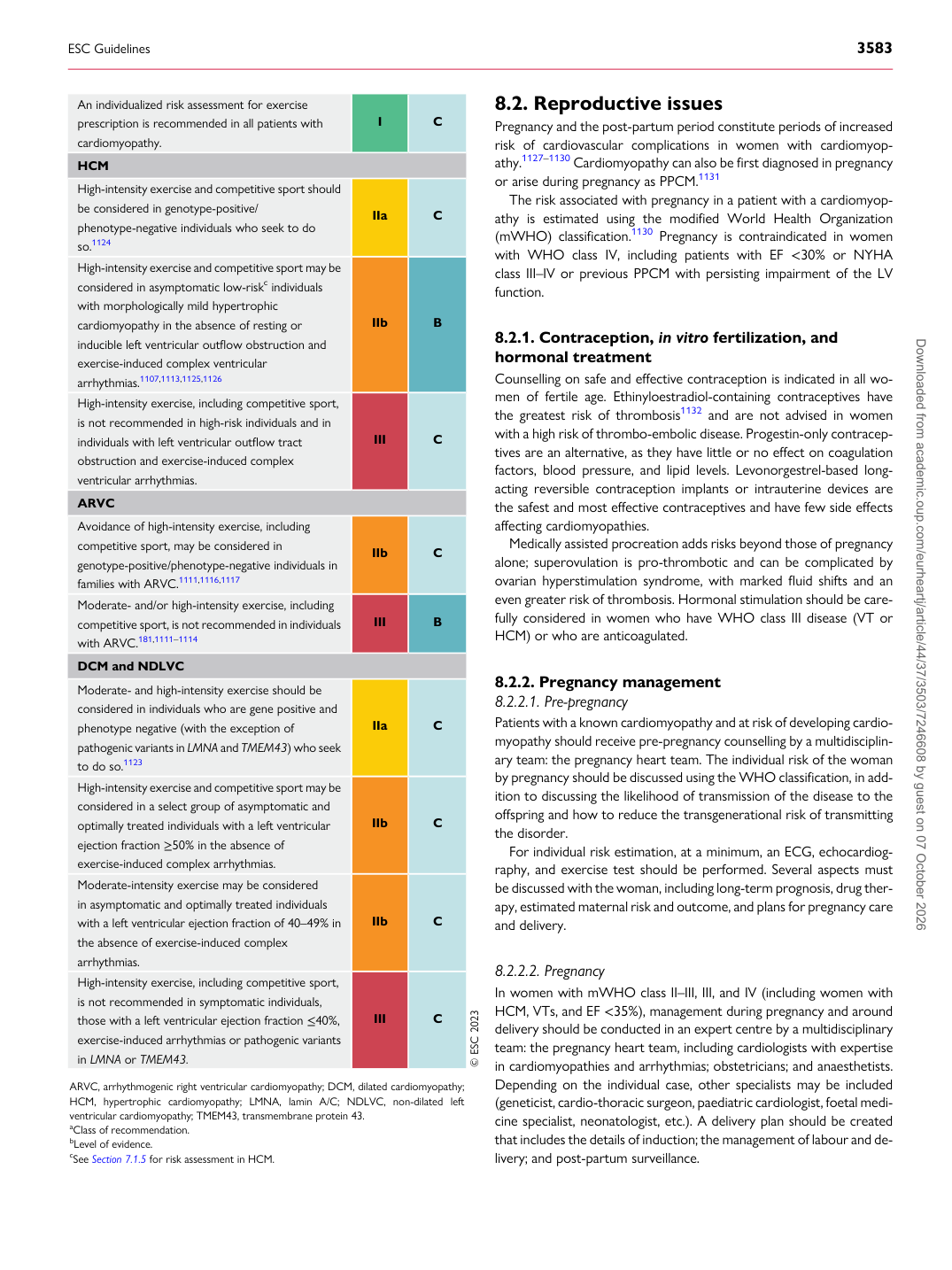
An individualized risk assessment for exercise prescription is recommended in all patients with cardiomyopathy. I C HCM High-intensity exercise and competitive sport should be considered in genotype-positive/ phenotype-negative individuals who seek to do so.1124 IIa C High-intensity exercise and competitive sport may be considered in asymptomatic low-riskc individuals with morphologically mild hypertrophic cardiomyopathy in the absence of resting or inducible left ventricular outflow obstruction and exercise-induced complex ventricular arrhythmias.1107,1113,1125,1126 IIb B High-intensity exercise, including competitive sport, is not recommended in high-risk individuals and in individuals with left ventricular outflow tract obstruction and exercise-induced complex ventricular arrhythmias. III C ARVC Avoidance of high-intensity exercise, including competitive sport, may be considered in genotype-positive/phenotype-negative individuals in families with ARVC.1111,1116,1117 IIb C Moderate- and/or high-intensity exercise, including competitive sport, is not recommended in individuals with ARVC.181,1111–1114 III B DCM and NDLVC Moderate- and high-intensity exercise should be considered in individuals who are gene positive and phenotype negative (with the exception of pathogenic variants in LMNA and TMEM43) who seek to do so.1123 IIa C High-intensity exercise and competitive sport may be considered in a select group of asymptomatic and optimally treated individuals with a left ventricular ejection fraction ≥50% in the absence of exercise-induced complex arrhythmias. IIb C Moderate-intensity exercise may be considered in asymptomatic and optimally treated individuals with a left ventricular ejection fraction of 40–49% in the absence of exercise-induced complex arrhythmias. IIb C High-intensity exercise, including competitive sport, is not recommended in symptomatic individuals, those with a left ventricular ejection fraction ≤40%, exercise-induced arrhythmias or pathogenic variants in LMNA or TMEM43. III C © ESC 2023

ARVC, arrhythmogenic right ventricular cardiomyopathy; DCM, dilated cardiomyopathy; HCM, hypertrophic cardiomyopathy; LMNA, lamin A/C; NDLVC, non-dilated left ventricular cardiomyopathy; TMEM43, transmembrane protein 43. aClass of recommendation. bLevel of evidence. cSee Section 7.1.5 for risk assessment in HCM.

ESC Guidelines                                                                                                                                                                                          3583

Downloaded from academic.oup.com/eurheartj/article/44/37/3503/7246608 by guest on 07 October 2026