p.78 抽出テキスト
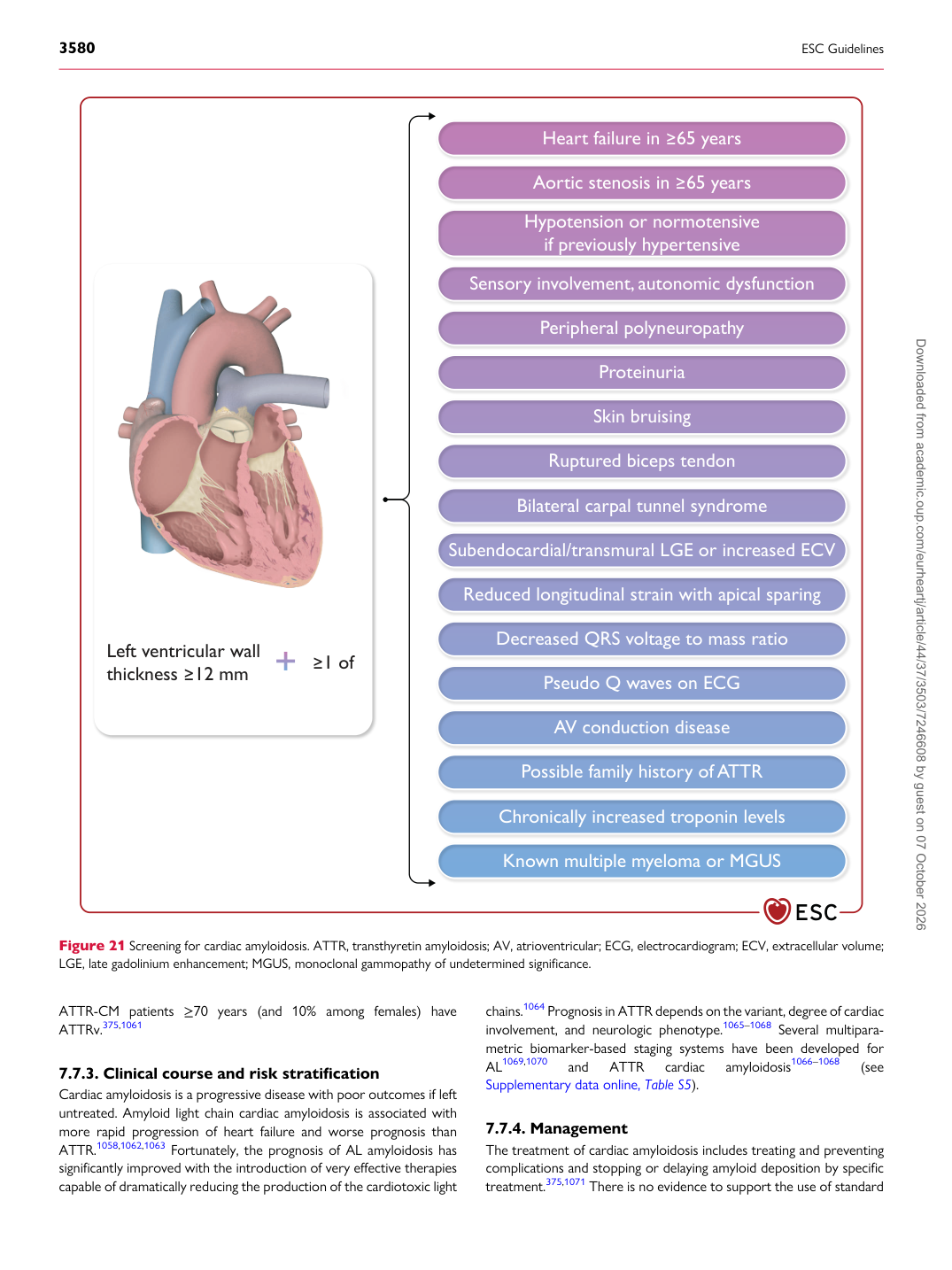
ATTR-CM patients ≥70 years (and 10% among females) have ATTRv.375,1061 7.7.3 Clinical course and risk stratification Cardiac amyloidosis is a progressive disease with poor outcomes if left untreated. Amyloid light chain cardiac amyloidosis is associated with more rapid progression of heart failure and worse prognosis than ATTR.1058,1062,1063 Fortunately, the prognosis of AL amyloidosis has significantly improved with the introduction of very effective therapies capable of dramatically reducing the production of the cardiotoxic light chains.1064 Prognosis in ATTR depends on the variant, degree of cardiac involvement, and neurologic phenotype.1065–1068 Several multiparametric biomarker-based staging systems have been developed for AL1069,1070 and ATTR cardiac amyloidosis1066–1068 (see Supplementary data online, Table S5). 7.7.4 Management The treatment of cardiac amyloidosis includes treating and preventing complications and stopping or delaying amyloid deposition by specific treatment.375,1071 There is no evidence to support the use of standard Heart failure in 65 years Aortic stenosis in 65 years Hypotension or normotensive if previously hypertensive Sensory involvement, autonomic dysfunction Peripheral polyneuropathy Proteinuria Skin bruising Bilateral carpal tunnel syndrome Ruptured biceps tendon Subendocardial/transmural LGE or increased ECV Reduced longitudinal strain with apical sparing Decreased QRS voltage to mass ratio Pseudo Q waves on ECG AV conduction disease Possible family history of ATTR Chronically increased troponin levels Known multiple myeloma or MGUS Left ventricular wall thickness 12 mm 1 of Figure 21 Screening for cardiac amyloidosis. ATTR, transthyretin amyloidosis; AV, atrioventricular; ECG, electrocardiogram; ECV, extracellular volume; LGE, late gadolinium enhancement; MGUS, monoclonal gammopathy of undetermined significance. Downloaded from academic.oup.com/eurheartj/article/44/37/3503/7246608 by guest on 07 October 2026