p.72 抽出テキスト
Restrictive cardiomyopathy is associated with the worst prognosis of all the cardiomyopathy phenotypes. Survival data are limited to small windows of observation. The prognosis of RCM largely depends on the restrictive physiology, regardless of the underlying cause.968–971 More than 50% of children with RCM are at risk of death (including SCD) or transplantation shortly after diagnosis; clinical features putatively associated with increased risk of death or transplantation include: heart failure symptoms; reduced LV systolic function; increased left atrial size; syncope; ischaemia; and impaired LV diastolic function on echocardiography.286,969,972,973 Up to 75% of surviving patients demonstrate heart failure, and the outcome is either death or heart transplantation within a few years of diagnosis.968,969 Elevated pulmonary vascular resistance (PVR) is present in up to 40% of children with RCM, and can rise quickly even in the absence of other clinical changes, which has an impact on suitability for and timing of cardiac transplantation.953 Cardiac catheterization with an assessment of PVR is therefore recommended in all children at diagnosis and every 6 to 12 months.953 In adult patients with genetic RCM, the main cause of death is heart failure (more than 40%), with a 5-year survival rate of ∼50% in cohorts that include patients with HCM and restrictive physiology.616 7.6 Syndromic and metabolic

cardiomyopathies It is beyond the scope of these guidelines to provide a detailed review and recommendations on specific cardiomyopathy genocopies and phenocopies. Instead, the Task Force refers the reader to detailed position statements and consensus documents published on behalf of the ESC Working Group on Myocardial and Pericardial Diseases (e.g. on Anderson–Fabry Disease and amyloidosis ).370,375,974 This section highlights only the key diagnostic and management issues. Table 22 summarizes the clinical features and management of syndromic and metabolic cardiomyopathies.

7.6.1 Anderson–Fabry disease

7.6.1.1. Definition Anderson–Fabry disease is an inborn error of metabolism where a deficient or absent enzyme, alpha-galactosidase A (α-Gal A), due to a pathogenic genetic variant in the GLA gene, causes the storage of some degradation cell products, mainly globotriaosylceramide (Gb3) in a patient’s lysosomes.975 This storage causes cell dysfunction in its own right and activates cellular hypertrophy pathways, common to other causes of HCM, as well as inflammation and immune activation.976 It is a multisystem disorder affecting particularly the heart, kidney, and brain. 975 It is inherited in an X-linked manner; males are therefore always affected, while females’ organ involvement usually develops later in life but can become similar to males due to the lyonization phenomena.977,978 Two Anderson–Fabry phenotypes can be distinguished, depending on the gender, lyonization phenomena, and pathogenic genetic variant:976,979 • A severe clinical phenotype, known as ‘classic’ Anderson–Fabry characterized by absent or severely reduced (<1% of mean normal) α-Gal A activity, marked Gb3 accumulation, and childhood or adolescent onset of symptoms followed by progressive multiorgan failure, is most often seen in males (but not exclusively) without residual enzyme activity. • A ‘non-classical’ Anderson–Fabry phenotype or later-onset phenotype with incomplete systemic involvement, which is seen in both males and females, with some level of residual enzyme activity, and in most cases manifesting as isolated cardiac involvement.

7.6.1.2 Diagnosis, clinical work-up, and differential diagnosis

Anderson–Fabry disease should be suspected in patients with LVH and additional cardiac and extracardiac red flags (see Table 23) sought (Figure 20). The diagnosis is established by assessment of α-GalA activity and lyso-Gb3 measurement in male patients; in females, genetic testing is usually required to confirm the diagnosis. Severe LVH (>15 mm) is unlikely to be seen in patients <20 years of age.980 In children and adolescents, diagnosis is made by family history or based on other extracardiac symptoms, but overt LVH is usually not present.981

7.6.1.3 Clinical course, outcome, and risk stratification

Cardiovascular involvement usually manifests as LVH, myocardial fibrosis, inflammation, heart failure, and arrhythmias, which limit QoL and are the most common cause of death. Clinical monitoring is essential to assess disease progression and requires a multidisciplinary approach.980

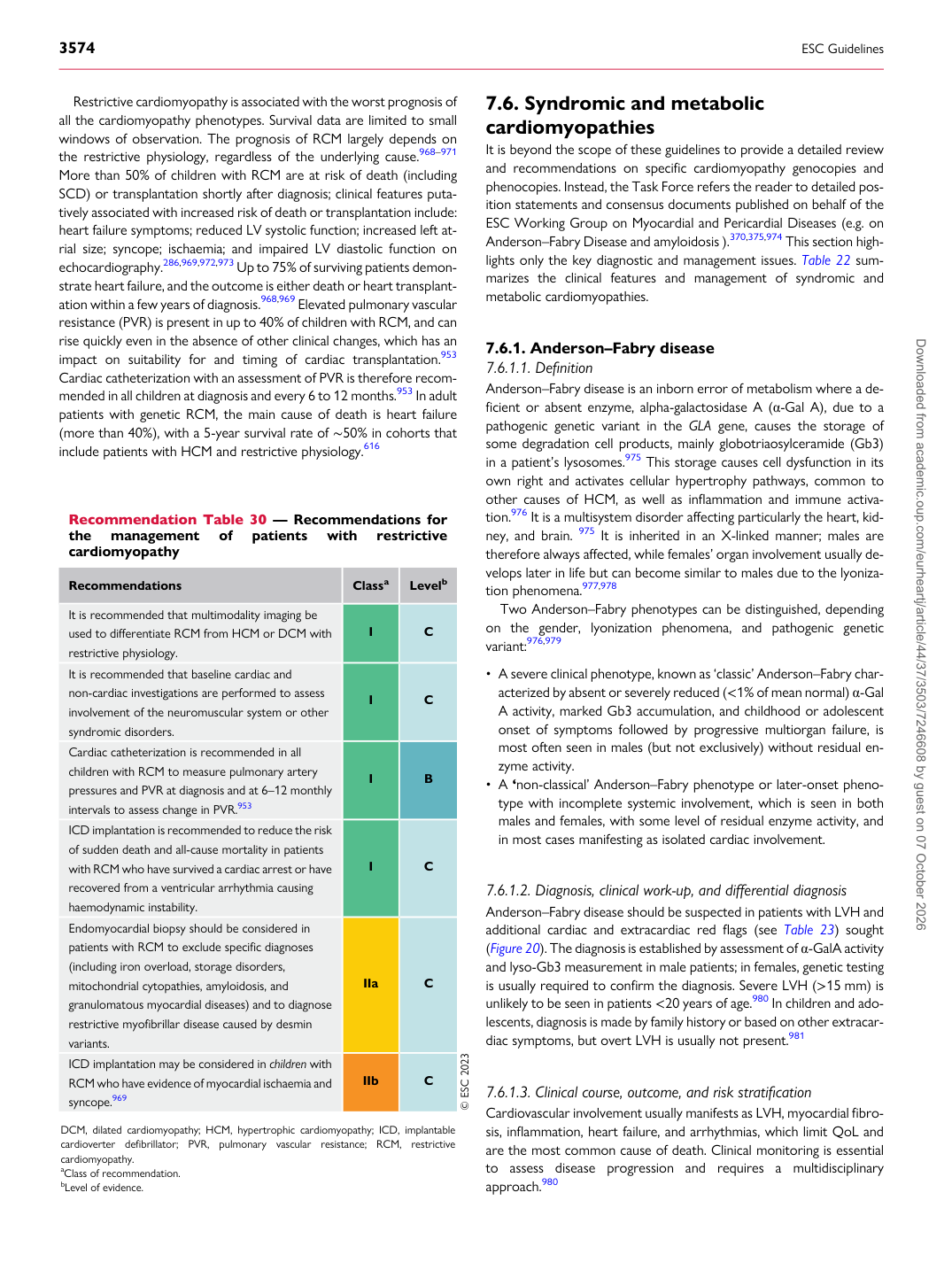
Recommendation Table 30 — Recommendations for the management of patients with restrictive cardiomyopathy

Recommendations Classa Levelb

It is recommended that multimodality imaging be used to differentiate RCM from HCM or DCM with restrictive physiology. I C It is recommended that baseline cardiac and non-cardiac investigations are performed to assess involvement of the neuromuscular system or other syndromic disorders. I C Cardiac catheterization is recommended in all children with RCM to measure pulmonary artery pressures and PVR at diagnosis and at 6–12 monthly intervals to assess change in PVR.953 I B ICD implantation is recommended to reduce the risk of sudden death and all-cause mortality in patients with RCM who have survived a cardiac arrest or have recovered from a ventricular arrhythmia causing haemodynamic instability. I C Endomyocardial biopsy should be considered in patients with RCM to exclude specific diagnoses (including iron overload, storage disorders, mitochondrial cytopathies, amyloidosis, and granulomatous myocardial diseases) and to diagnose restrictive myofibrillar disease caused by desmin variants. IIa C ICD implantation may be considered in children with RCM who have evidence of myocardial ischaemia and syncope.969 IIb C © ESC 2023

DCM, dilated cardiomyopathy; HCM, hypertrophic cardiomyopathy; ICD, implantable cardioverter defibrillator; PVR, pulmonary vascular resistance; RCM, restrictive cardiomyopathy. aClass of recommendation. bLevel of evidence. Downloaded from academic.oup.com/eurheartj/article/44/37/3503/7246608 by guest on 07 October 2026