p.69 抽出テキスト
the most common causes of SCD in registries around the world.935–937 Sudden cardiac death seems to be more prevalent in young athletic individuals affected by the disease.935,938

7.4.5.1 Secondary prevention of sudden cardiac death

Implantable cardioverter defibrillators reduce mortality in survivors of cardiac arrest and in patients who have experienced sustained symptomatic ventricular arrhythmias.531 An ICD is recommended in such patients when the intent is to increase survival; the decision to implant should consider the patient’s view and their QoL, as well as the absence of other diseases likely to cause death within the following year.

7.4.5.2 Primary prevention of sudden cardiac death

Most of the current evidence on the outcomes of patients with ARVC and their predictors is limited to observational retrospective cohort studies that are typically of small size.939 Thus, the number of clinical predictors that can be studied using multivariate models is very limited, and most studies cannot be compared with one another. A systematic review and meta-analysis (n = 18 studies) has shown that the average risk of ventricular arrhythmia ranges from 3.7 to 10.6% per year and that male sex, RV dysfunction, and prior non-sustained or sustained VT/VF consistently predict ventricular arrhythmias in populations with ARVC.939 The first comprehensive effort to offer an approach to risk stratification in the context of decision-making for ICD implantation was made in the 2015 International Task Force consensus statement (ITFC) on the treatment of ARVC/dysplasia, where recommendations were made according to the presence of risk factors that would characterize the risk level of each patient.919 A follow-up study (n = 365) offered a modification on the International Task Force approach that resulted in better discrimination.940 The 2017 AHA/ACC/HRS guideline for management of patients with ventricular arrhythmias and the prevention of sudden cardiac death941 and the 2019 HRS expert consensus statement on evaluation, risk stratification, and management of arrhythmogenic cardiomyopathy4 have also offered alternative approaches to this issue. A risk-prediction model was developed from a multicentre collaboration (n = 528); it utilizes sex, age, recent syncope, NSVT, VE count, number of leads with TWI, and right ventricular ejection fraction (RVEF) as predictors to provide an individualized estimate of sustained ventricular arrhythmias in patients with ARVC (arvcrisk.com).539 A study (n = 617) comparing the previous approaches to risk stratify patients has revealed that the modified ITFC approach provides the highest net benefit, up to an estimated 5-year risk of 25%, whereas AHA and HRS perform best in patients with an estimated 5-year risk >25%.538 In the same study, an estimated 5-year risk of 12.5% seems to be the optimal threshold, beyond which the risk-prediction model has the best performance. An external comparison (n = 140) of the different ARVC risk levels showed that the highest net benefit was seen with a 10% cut-off, using the 2019 ARVC risk calculator.536 In the same study, the 10% cut-off was superior to the HRS and ITFC approaches.536 Another external validation study (n = 128) of the 2019 ARVC risk model showed that although discriminative ability is excellent (c-index 0.84), the model seems to significantly overestimate the risk of patients below the 50% 5-year risk threshold.537 Recently, a correction to the 2019 ARVC risk calculator was issued.539 Two large external validation studies of the updated 2019 ARVC risk calculator have been published, suggesting a good discriminative performance, but the latter study revealed overestimation of risk.524,526 This raises concerns regarding the accuracy of the model in offering an individualized prediction that can help inform patients during decision-making; however, it can remain informative due to its excellent discriminative performance. Furthermore, one study suggested that the updated 2019 ARVC risk calculator performs best in PKP2 patients, but its performance is more limited in gene-negative individuals.524

Therefore, a combination of these approaches is recommended to individualize risk quantification that can aid clinicians in balancing the risks and benefits of ICD implantation. The final decision should be made together with the patient, considering other competing risks and the patient’s risk tolerance. As discussed in Section 7.1.5, the Task Force acknowledges the challenges associated with defining universal thresholds for acceptable risk across different cardiomyopathy phenotypes, but is of the opinion that a similar approach to that taken in risk stratification for HCM, DCM, and NDLVC is reasonable. In this context, the Task Force recommends shared decision-making based on real-world data as well as individual preferences, beliefs, circumstances, and values. Gaps in evidence should be shared with patients, and competing risks related to the disease (heart failure, stroke) and to age and comorbidity, as well as device-related complications, should be discussed. The suggested approach is summarized in Figure 18. Patients with ARVC are known to suffer from sustained VTs that can be well tolerated without leading to SCD. Using appropriate ICD interventions as surrogate for SCD outcome has been shown to overestimate SCD.942 Considering that, in most centres, a high ratio of ARVC patients will be implanted with an ICD, it is conceivable why this may hamper risk stratification for SCD in patients with ARVC. Efforts to address this have been made within several studies,522,523,943–947 where

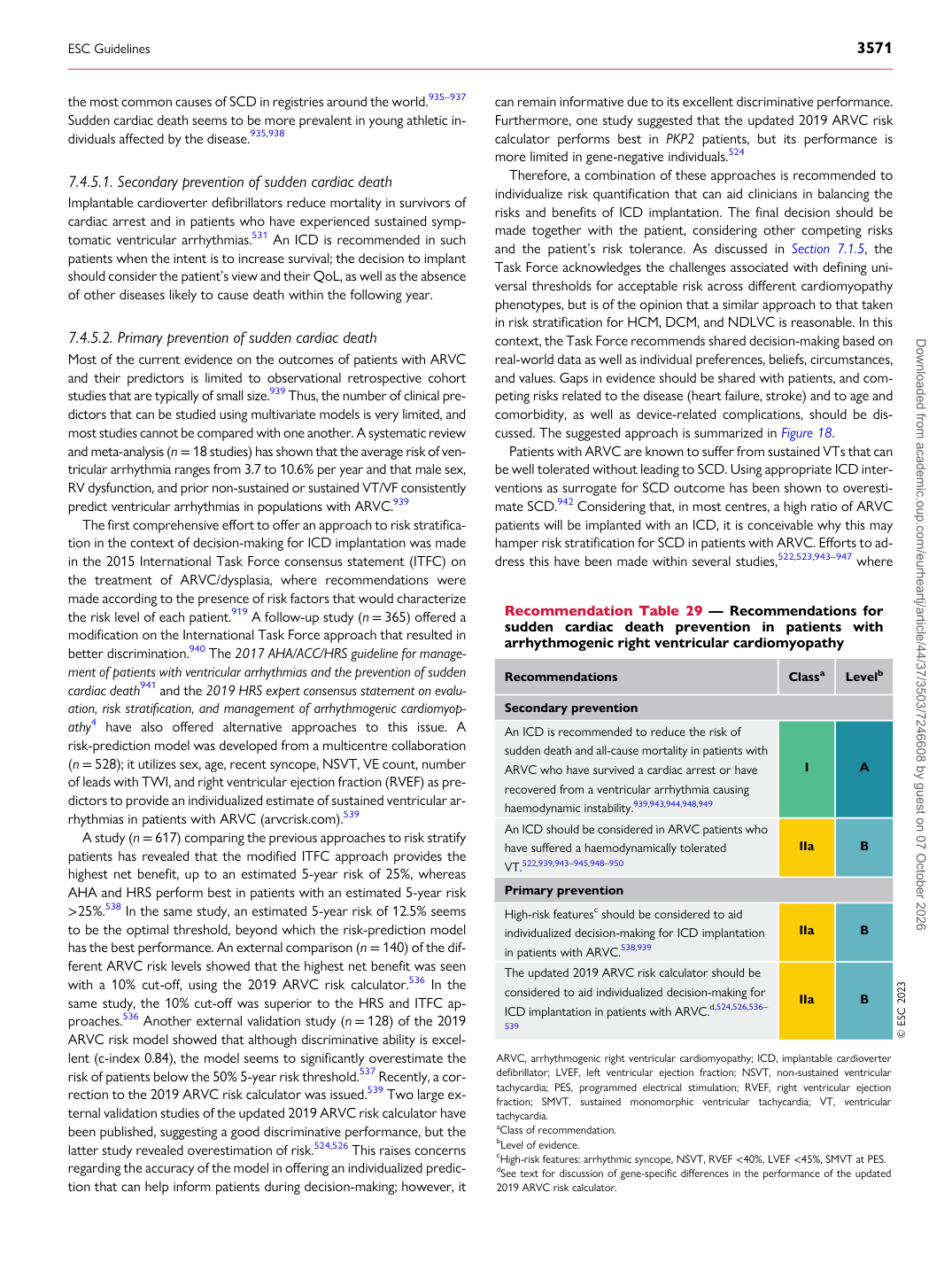
Recommendation Table 29 — Recommendations for sudden cardiac death prevention in patients with arrhythmogenic right ventricular cardiomyopathy

Recommendations Classa Levelb

Secondary prevention An ICD is recommended to reduce the risk of sudden death and all-cause mortality in patients with ARVC who have survived a cardiac arrest or have recovered from a ventricular arrhythmia causing haemodynamic instability.939,943,944,948,949 I A An ICD should be considered in ARVC patients who have suffered a haemodynamically tolerated VT.522,939,943–945,948–950 IIa B Primary prevention High-risk featuresc should be considered to aid individualized decision-making for ICD implantation in patients with ARVC.538,939 IIa B The updated 2019 ARVC risk calculator should be considered to aid individualized decision-making for ICD implantation in patients with ARVC.d,524,526,536–

539 IIa B © ESC 2023

ARVC, arrhythmogenic right ventricular cardiomyopathy; ICD, implantable cardioverter defibrillator; LVEF, left ventricular ejection fraction; NSVT, non-sustained ventricular tachycardia; PES, programmed electrical stimulation; RVEF, right ventricular ejection fraction; SMVT, sustained monomorphic ventricular tachycardia; VT, ventricular tachycardia. aClass of recommendation. bLevel of evidence. cHigh-risk features: arrhythmic syncope, NSVT, RVEF <40%, LVEF <45%, SMVT at PES. dSee text for discussion of gene-specific differences in the performance of the updated 2019 ARVC risk calculator.

ESC Guidelines                                                                                                                                                                                          3571

Downloaded from academic.oup.com/eurheartj/article/44/37/3503/7246608 by guest on 07 October 2026