p.66 抽出テキスト
pacing and cardiac resynchronization therapy, and the 2022 ESC Guidelines for the management of patients with ventricular arrhythmias and the prevention of sudden cardiac death,69,299,336,724 and are discussed in Section 6.10.2.

7.3.5 Sudden cardiac death prevention in non-dilated

left ventricular cardiomyopathy The prediction and prevention of SCD is the cornerstone of the clinical care of patients with NDLVC.

7.3.5.1 Secondary prevention of sudden cardiac death

As in other cardiomyopathy subtypes, ICD implantation is recommended in survivors of cardiac arrest and in patients who have experienced sustained ventricular arrhythmias with haemodynamic compromise;531 the decision to implant should consider the patient’s view and their QoL, as well as the absence of other diseases likely to cause death within 1 year.

7.3.5.2 Primary prevention of sudden cardiac death

There are no available RCTs examining the usefulness of ICDs to prevent SCD in patients with mild or moderate LV dysfunction. Recommendations for ICD implantation in DCM individuals with LVEF <35% are discussed in Section 6.10.2 and also apply to patients with NDLVC and LVEF <35%. Most patients with NDLVC, however, have either normal or mildly impaired LV systolic function. Much of the data on the natural history and risk prediction in NDLVC are derived from cohorts that include either patients with DCM or with ARVC (see Sections 7.2 and 7.4), and data on patients with NDLVC are therefore necessarily very limited. However, the available data suggest that genotype is a major determinant of SCD risk, with patients harbouring variants in PLN, TMEM43, DES, DSP, LMNA, FLNC (truncating variants), and RBM20 having a substantially higher rate of major arrhythmic events than other causes regardless of LVEF.440,542,864–869 For some high-risk genotypes (e.g. LMNA [https://lmna-risk-vta.fr]541), gene-specific (or, in the case of the PLN p.Arg14del variant, variantspecific [https://plnriskcalculator.shinyapps.io/final_shiny])542 riskprediction scores have been developed that consider genotype characteristics and additional phenotypic features. Where such scores are available, they should be used to guide primary prevention ICD implantation (Figure 12). As discussed in Sections 7.1.5 and 7.2.5, the Task Force acknowledges the challenges associated with defining universal thresholds for acceptable risk across different cardiomyopathy phenotypes, but is of the opinion that a similar approach to that taken in risk stratification for HCM is reasonable, although the 2022 ESC Guidelines for the management of patients with ventricular arrhythmias and the prevention of sudden cardiac death have suggested a higher threshold of 10% risk at 5 years to guide primary prevention ICD implantation in patients with NDLVC and LMNA variants.3 This Task Force recommends more overt shared decision-making based on real-world data as well as individual preferences, beliefs, circumstances, and values. Gaps in evidence are acknowledged and should be shared with patients, and competing risks related to the disease (heart failure, stroke) and to age and comorbidity, as well as device-related complications, should be discussed. There are very few data to guide risk stratification in patients with NDLVC without a known causative gene variant, but on the basis of the existing literature, the Task Force suggests that it may be reasonable to consider primary prevention ICD implantation in patients with NSVT, a family history of SCD, or significant LGE. Additional risk factors, such as the burden of VE, may also help guide ICD implantation, but there are no data currently to support a specific threshold for VE burden, and this will depend on the underlying genotype and other clinical factors.542,867,872 In patients with unexplained syncope, PES may provide additional information on the underlying cause.875 There are no definitive data supporting the regular use of PES for primary prevention risk stratification in patients with NDLVC, but may be beneficial in patients with NDLVC and myotonic dystrophy with an independent indication to EP study to assess conduction disturbances,876 although the clinical value of this approach has not been consistently demonstrated.877 Given the overlap with DCM and available data, and in keeping with the 2022 ESC Guidelines for the management of patients with ventricular arrhythmias and the prevention of sudden cardiac death, the Task Force agreed that the recommendations for primary prevention ICD implantation in NDLVC should be the same as those for DCM (Figure 17), but the level of evidence is necessarily lower.

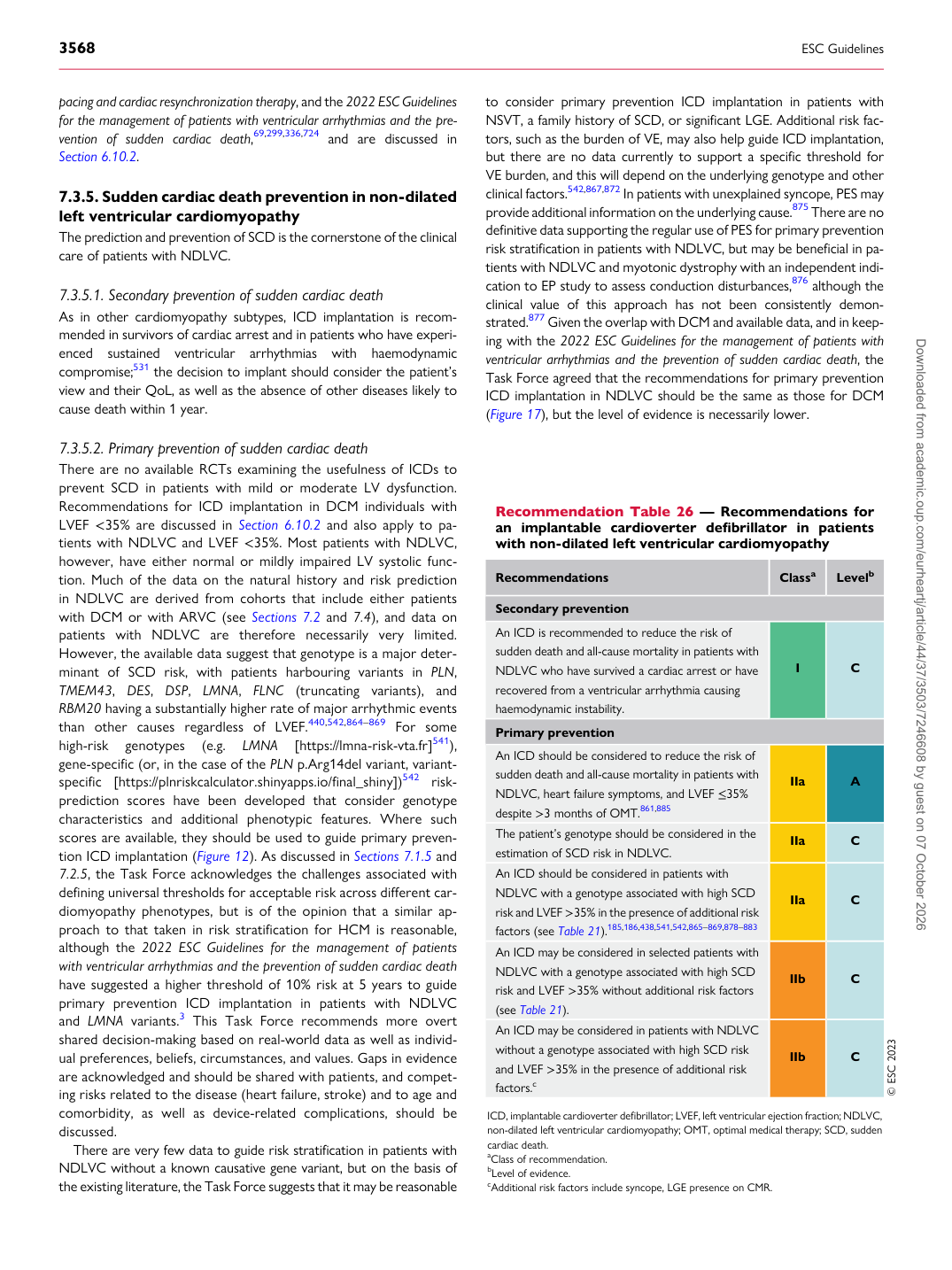
Recommendation Table 26 — Recommendations for an implantable cardioverter defibrillator in patients with non-dilated left ventricular cardiomyopathy

Recommendations Classa Levelb

Secondary prevention An ICD is recommended to reduce the risk of sudden death and all-cause mortality in patients with NDLVC who have survived a cardiac arrest or have recovered from a ventricular arrhythmia causing haemodynamic instability. I C Primary prevention An ICD should be considered to reduce the risk of sudden death and all-cause mortality in patients with NDLVC, heart failure symptoms, and LVEF ≤35% despite >3 months of OMT.861,885 IIa A The patient’s genotype should be considered in the estimation of SCD risk in NDLVC. IIa C An ICD should be considered in patients with NDLVC with a genotype associated with high SCD risk and LVEF >35% in the presence of additional risk factors (see Table 21).185,186,438,541,542,865–869,878–883 IIa C An ICD may be considered in selected patients with NDLVC with a genotype associated with high SCD risk and LVEF >35% without additional risk factors (see Table 21). IIb C An ICD may be considered in patients with NDLVC without a genotype associated with high SCD risk and LVEF >35% in the presence of additional risk factors.c IIb C © ESC 2023

ICD, implantable cardioverter defibrillator; LVEF, left ventricular ejection fraction; NDLVC, non-dilated left ventricular cardiomyopathy; OMT, optimal medical therapy; SCD, sudden cardiac death. aClass of recommendation. bLevel of evidence. cAdditional risk factors include syncope, LGE presence on CMR. Downloaded from academic.oup.com/eurheartj/article/44/37/3503/7246608 by guest on 07 October 2026