p.64 抽出テキスト
clinical factors.542,867,872 In patients with unexplained syncope, programmed electrical stimulation (PES) may provide additional information on the underlying cause.875 There are no definitive data supporting the routine use of PES for primary prevention risk stratification in patients with DCM, but this may be beneficial in patients with DCM and myotonic dystrophy with an independent indication to electrophysiological study to assess conduction disturbances,876 although the clinical value of this approach has not been consistently demonstrated.877

7.3 Non-dilated left ventricular

cardiomyopathy 7.3.1. Diagnosis 7.3.1.1. Index case The non-dilated LV cardiomyopathy phenotype is defined by the presence of non-ischaemic LV scarring or fatty replacement in the absence of LV dilatation, with or without global or regional wall motion abnormalities, or isolated global LV hypokinesia without scarring (as assessed by the presence of LGE on CMR) that is unexplained solely by abnormal loading conditions (hypertension, valve disease) or CAD. Global LV systolic dysfunction is defined by abnormal LVEF (i.e. <50%).9

7.3.1.2 Relatives

Clinical testing in relatives may reveal non-diagnostic abnormalities. In this context, the presence of LV systolic global or regional dysfunction, or additional electrocardiographic abnormalities (e.g. repolarization abnormalities, low QRS voltages, frequent ventricular extrasystoles [>500 per 24 h] or NSVT) in a first-degree relative of an individual with NDLVC (or a first-degree relative with autopsy-proven NDLVC) is highly suggestive of NDLVC and warrants close follow-up. In the absence of conclusive genetic information in the family, NDLVC should be considered familial if one or more first- or seconddegree relatives have NDLVC, or when SCD has occurred in a firstdegree relative at any age with an established diagnosis of NDLVC. Familial disease should also be suspected if a first-degree relative has sudden death at <50 years of age and autopsy findings suggestive of the NDLVC phenotype.

7.3.1.3 Diagnostic work-up

The key elements of the diagnostic work-up for all patients with NDLVC are described in Section 6 and include clinical history, laboratory tests, Holter monitoring and cardiac imaging, and genetic testing.

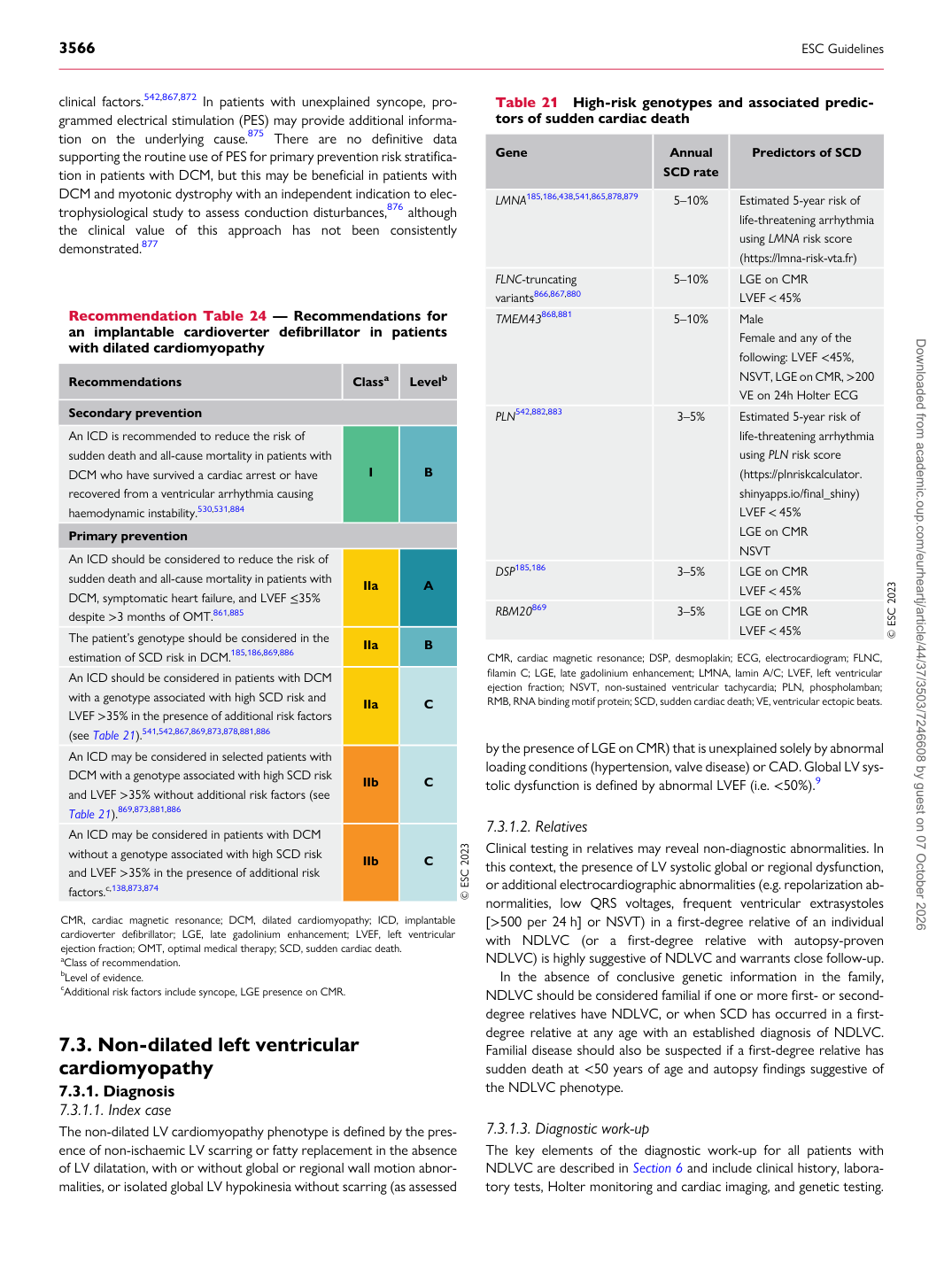
Recommendation Table 24 — Recommendations for an implantable cardioverter defibrillator in patients with dilated cardiomyopathy

Recommendations Classa Levelb

Secondary prevention An ICD is recommended to reduce the risk of sudden death and all-cause mortality in patients with DCM who have survived a cardiac arrest or have recovered from a ventricular arrhythmia causing haemodynamic instability.530,531,884 I B Primary prevention An ICD should be considered to reduce the risk of sudden death and all-cause mortality in patients with DCM, symptomatic heart failure, and LVEF ≤35% despite >3 months of OMT.861,885 IIa A The patient’s genotype should be considered in the estimation of SCD risk in DCM.185,186,869,886 IIa B An ICD should be considered in patients with DCM with a genotype associated with high SCD risk and LVEF >35% in the presence of additional risk factors (see Table 21).541,542,867,869,873,878,881,886 IIa C An ICD may be considered in selected patients with DCM with a genotype associated with high SCD risk and LVEF >35% without additional risk factors (see Table 21).869,873,881,886 IIb C An ICD may be considered in patients with DCM without a genotype associated with high SCD risk and LVEF >35% in the presence of additional risk factors.c,138,873,874 IIb C © ESC 2023

CMR, cardiac magnetic resonance; DCM, dilated cardiomyopathy; ICD, implantable cardioverter defibrillator; LGE, late gadolinium enhancement; LVEF, left ventricular ejection fraction; OMT, optimal medical therapy; SCD, sudden cardiac death. aClass of recommendation. bLevel of evidence. cAdditional risk factors include syncope, LGE presence on CMR. Table 21 High-risk genotypes and associated predictors of sudden cardiac death

Gene Annual SCD rate Predictors of SCD LMNA185,186,438,541,865,878,879 5–10% Estimated 5-year risk of life-threatening arrhythmia

using LMNA risk score (https://lmna-risk-vta.fr)

FLNC-truncating variants866,867,880 5–10% LGE on CMR

LVEF < 45%

TMEM43868,881 5–10% Male

Female and any of the following: LVEF <45%, NSVT, LGE on CMR, >200 VE on 24h Holter ECG

PLN542,882,883 3–5% Estimated 5-year risk of

life-threatening arrhythmia using PLN risk score (https://plnriskcalculator. shinyapps.io/final_shiny) LVEF < 45% LGE on CMR NSVT

DSP185,186 3–5% LGE on CMR

LVEF < 45%

RBM20869 3–5% LGE on CMR

LVEF < 45% © ESC 2023

CMR, cardiac magnetic resonance; DSP, desmoplakin; ECG, electrocardiogram; FLNC, filamin C; LGE, late gadolinium enhancement; LMNA, lamin A/C; LVEF, left ventricular ejection fraction; NSVT, non-sustained ventricular tachycardia; PLN, phospholamban; RMB, RNA binding motif protein; SCD, sudden cardiac death; VE, ventricular ectopic beats. Downloaded from academic.oup.com/eurheartj/article/44/37/3503/7246608 by guest on 07 October 2026