p.56 抽出テキスト
who had a reduction in exercise LVEDV pre-pacing (consistent with the relief of diastolic ventricular interaction). This translated into improvements in peak maximum oxygen consumption (VO2) (1.4 mL/kg/min) and QoL scores.748 Together, they suggest that symptomatic responses to CRT may occur in individual patients, but that these are not associated with consistent changes in LVEF or evidence for a reduction in progression to end-stage heart failure. The 2021 ESC Guidelines on cardiac pacing and cardiac resynchronization therapy recommend that standard criteria for CRT are used in patients with HCM.724 The Task Force considered these of limited utility in HCM, as the unique pathology of this disease means that patients with contractile impairment rarely have an LVEF ≤35%. While acknowledging this as an area of unmet research need, the Task Force suggests a more pragmatic approach in which CRT might be considered in individual symptomatic patients with LV impairment (LVEF <50%) that meet current ESC ECG criteria (LBBB, QRS 130– 149 ms). Cardiac resynchronization therapy might also be considered in patients with HCM and impaired systolic function who require permanent ventricular pacing.746 In keeping with the 2021 ESC Guidelines on cardiac pacing and cardiac resynchronization therapy, the Task Force did not include these as specific recommendations, given the limited evidence base.

7.1.5 Sudden cardiac death prevention in

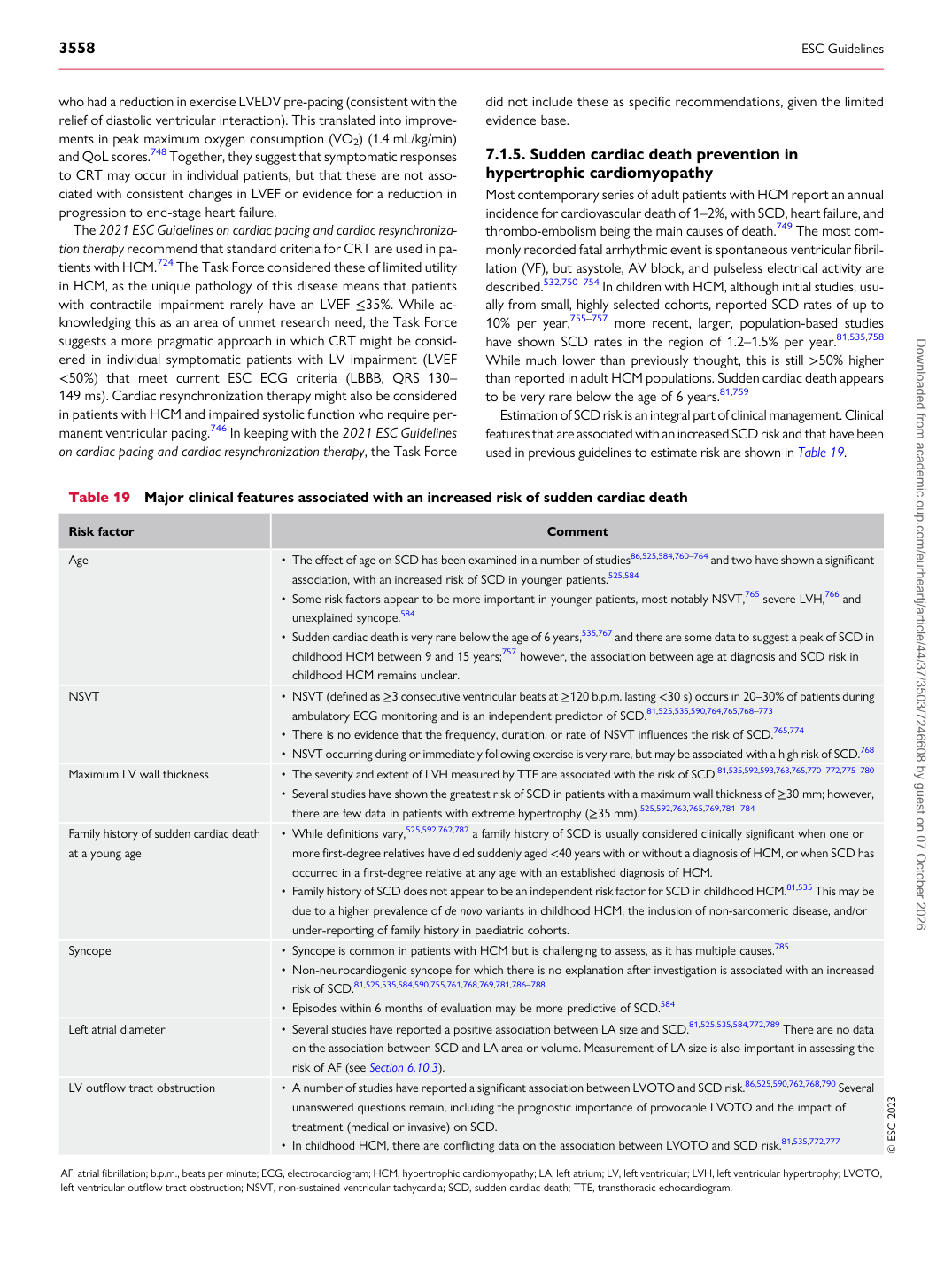
hypertrophic cardiomyopathy Most contemporary series of adult patients with HCM report an annual incidence for cardiovascular death of 1–2%, with SCD, heart failure, and thrombo-embolism being the main causes of death.749 The most commonly recorded fatal arrhythmic event is spontaneous ventricular fibrillation (VF), but asystole, AV block, and pulseless electrical activity are described.532,750–754 In children with HCM, although initial studies, usually from small, highly selected cohorts, reported SCD rates of up to 10% per year,755–757 more recent, larger, population-based studies have shown SCD rates in the region of 1.2–1.5% per year.81,535,758 While much lower than previously thought, this is still >50% higher than reported in adult HCM populations. Sudden cardiac death appears to be very rare below the age of 6 years.81,759 Estimation of SCD risk is an integral part of clinical management. Clinical features that are associated with an increased SCD risk and that have been used in previous guidelines to estimate risk are shown in Table 19.

Table 19 Major clinical features associated with an increased risk of sudden cardiac death

Risk factor Comment Age • The effect of age on SCD has been examined in a number of studies86,525,584,760–764 and two have shown a significant

association, with an increased risk of SCD in younger patients.525,584 • Some risk factors appear to be more important in younger patients, most notably NSVT,765 severe LVH,766 and unexplained syncope.584 • Sudden cardiac death is very rare below the age of 6 years,535,767 and there are some data to suggest a peak of SCD in

childhood HCM between 9 and 15 years;757 however, the association between age at diagnosis and SCD risk in childhood HCM remains unclear.

NSVT • NSVT (defined as ≥3 consecutive ventricular beats at ≥120 b.p.m. lasting <30 s) occurs in 20–30% of patients during ambulatory ECG monitoring and is an independent predictor of SCD.81,525,535,590,764,765,768–773

• There is no evidence that the frequency, duration, or rate of NSVT influences the risk of SCD.765,774 • NSVT occurring during or immediately following exercise is very rare, but may be associated with a high risk of SCD.768

Maximum LV wall thickness • The severity and extent of LVH measured by TTE are associated with the risk of SCD.81,535,592,593,763,765,770–772,775–780

• Several studies have shown the greatest risk of SCD in patients with a maximum wall thickness of ≥30 mm; however, there are few data in patients with extreme hypertrophy (≥35 mm).525,592,763,765,769,781–784

Family history of sudden cardiac death at a young age • While definitions vary,525,592,762,782 a family history of SCD is usually considered clinically significant when one or more first-degree relatives have died suddenly aged <40 years with or without a diagnosis of HCM, or when SCD has

occurred in a first-degree relative at any age with an established diagnosis of HCM. • Family history of SCD does not appear to be an independent risk factor for SCD in childhood HCM.81,535 This may be due to a higher prevalence of de novo variants in childhood HCM, the inclusion of non-sarcomeric disease, and/or

under-reporting of family history in paediatric cohorts.

Syncope • Syncope is common in patients with HCM but is challenging to assess, as it has multiple causes.785

• Non-neurocardiogenic syncope for which there is no explanation after investigation is associated with an increased

risk of SCD.81,525,535,584,590,755,761,768,769,781,786–788 • Episodes within 6 months of evaluation may be more predictive of SCD.584

Left atrial diameter • Several studies have reported a positive association between LA size and SCD.81,525,535,584,772,789 There are no data on the association between SCD and LA area or volume. Measurement of LA size is also important in assessing the

risk of AF (see Section 6.10.3).

LV outflow tract obstruction • A number of studies have reported a significant association between LVOTO and SCD risk.86,525,590,762,768,790 Several

unanswered questions remain, including the prognostic importance of provocable LVOTO and the impact of treatment (medical or invasive) on SCD. • In childhood HCM, there are conflicting data on the association between LVOTO and SCD risk.81,535,772,777 © ESC 2023

AF, atrial fibrillation; b.p.m., beats per minute; ECG, electrocardiogram; HCM, hypertrophic cardiomyopathy; LA, left atrium; LV, left ventricular; LVH, left ventricular hypertrophy; LVOTO, left ventricular outflow tract obstruction; NSVT, non-sustained ventricular tachycardia; SCD, sudden cardiac death; TTE, transthoracic echocardiogram. Downloaded from academic.oup.com/eurheartj/article/44/37/3503/7246608 by guest on 07 October 2026