p.55 抽出テキスト
Dual-chamber pacing. Three small, randomized, placebo-controlled studies of dual-chamber pacing and several long-term observational studies have reported reductions in LV outflow tract gradients and variable improvement in symptoms and QoL, including one paediatric study.719–724 A Cochrane review concluded that the data on the benefits of pacing are based on physiological measures and lack information on clinically relevant endpoints.725

Left ventricular mid-cavity obstruction and apical aneurysms. Left ventricular mid-cavity obstruction occurs in ∼10% of patients with HCM.727,728 Patients with mid-cavity obstruction tend to be very symptomatic and, in a number of studies, have shown an increased risk of progressive heart failure and SCD.727–729 Approximately 25% of patients also have an LV apical aneurysm (see Section 7.1.5).580,727,728,730 Patients with LV midcavity obstruction should be treated with high-dose beta-blockers, verapamil, or diltiazem, but the response is often suboptimal. Limited experience, mostly from single centres, suggests that mid-ventricular obstruction can be relieved by transaortic myectomy, a transapical approach, or combined transaortic and transapical incisions, with good short-term outcomes but uncertain long-term survival.731,732

Left ventricular apical aneurysms by themselves rarely need treatment. A few patients develop monomorphic ventricular tachycardia related to adjacent apical scarring, which may be amenable to mapping and ablation (see Section 7.1.5).730,733 Rarely, thrombi are present within the aneurysm and should be treated with long-term oral anticoagulation.734,735 Anticoagulation may also be considered in patients with HCM and apical aneurysms in the absence of documented thrombi.736,737

7.1.4.2 Management of symptoms in patients without left

ventricular outflow tract obstruction 7.1.4.2.1. Heart failure and chest pain. Management of heart failure in patients without LVOTO should follow the recommendations of the 2021 ESC Guidelines for the diagnosis and treatment of acute and chronic heart failure, summarized in Section 6.10.2. The aim of drug therapy is to reduce LV diastolic pressures and improve LV filling by slowing the heart rate with beta-blockers, verapamil, or diltiazem (ideally monitored by ambulatory ECG recording), and cautious use of loop diuretics. Beta-blockers or calcium antagonists should be considered in patients with exertional or prolonged episodes of anginalike pain even in the absence of resting or provocable LVOTO or obstructive CAD. In the absence of LVOTO, cautious use of oral nitrates may be considered. Ranolazine may also be considered to improve symptoms in patients with angina-like chest pain and no evidence for LVOTO.738,739

7.1.4.2.2 Cardiac resynchronization therapy. Regional heterogen-

eity of LV contraction and relaxation can be seen in patients with HCM, and LV dyssynchrony may be a marker of poor prognosis.745 Data on the impact of CRT on symptoms, LV function, and prognosis in patients with non-obstructive HCM remain limited, but new evidence has emerged since the 2014 ESC Guidelines on diagnosis and management of hypertrophic cardiomyopathy.746,747 There is one small study using a blinded crossover design of biventricular and sham pacing and a pre-specified analysis stratified by changes in LV end-diastolic volume (LVEDV) with exercise at baseline.748 Biventricular pacing was associated with significant increases in LVEDV and stroke volume in patients

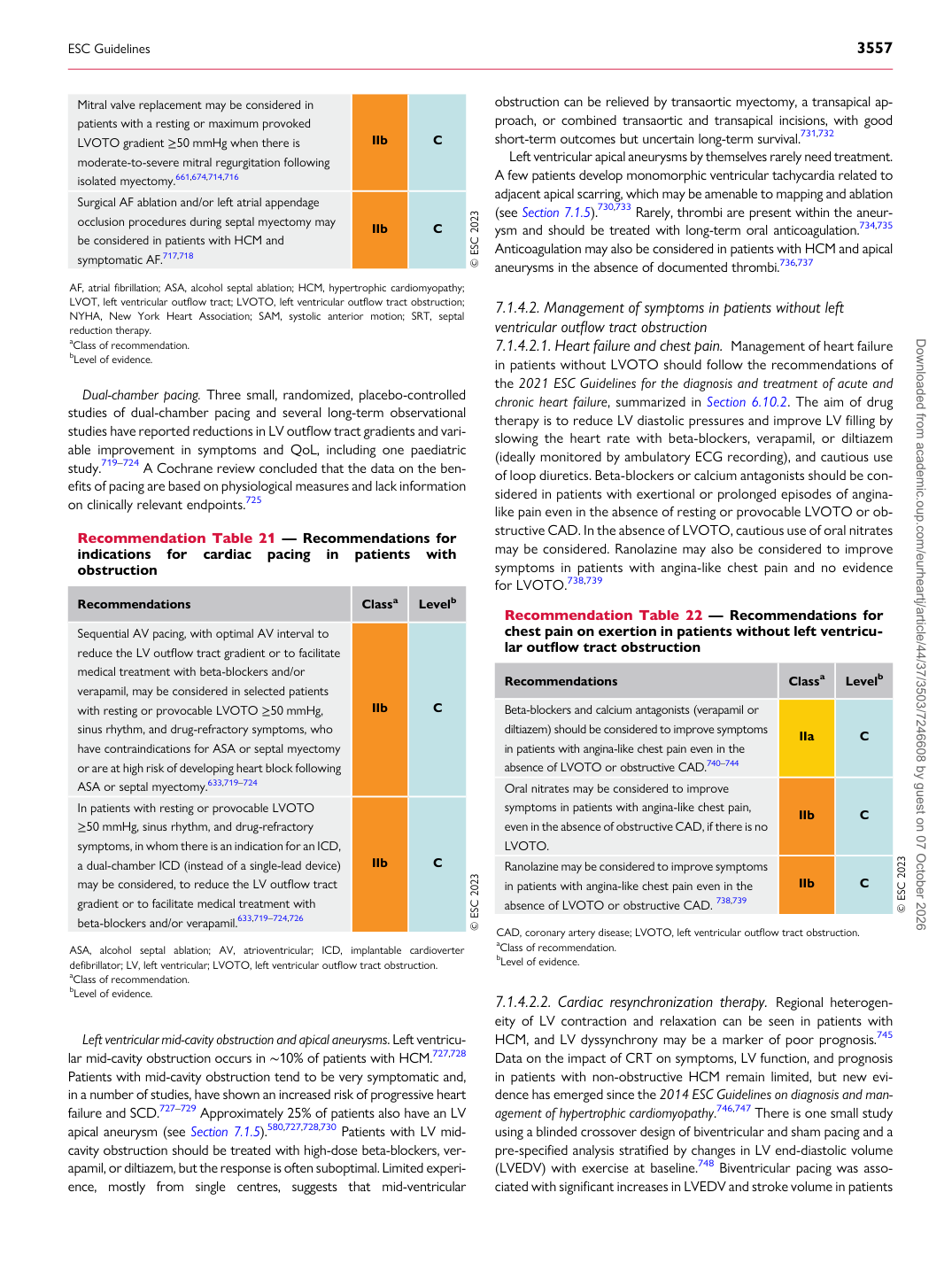
Recommendation Table 21 — Recommendations for indications for cardiac pacing in patients with obstruction

Recommendations Classa Levelb

Sequential AV pacing, with optimal AV interval to reduce the LV outflow tract gradient or to facilitate medical treatment with beta-blockers and/or verapamil, may be considered in selected patients with resting or provocable LVOTO ≥50 mmHg, sinus rhythm, and drug-refractory symptoms, who have contraindications for ASA or septal myectomy or are at high risk of developing heart block following ASA or septal myectomy.633,719–724 IIb C In patients with resting or provocable LVOTO ≥50 mmHg, sinus rhythm, and drug-refractory symptoms, in whom there is an indication for an ICD, a dual-chamber ICD (instead of a single-lead device) may be considered, to reduce the LV outflow tract gradient or to facilitate medical treatment with beta-blockers and/or verapamil.633,719–724,726 IIb C © ESC 2023

ASA, alcohol septal ablation; AV, atrioventricular; ICD, implantable cardioverter defibrillator; LV, left ventricular; LVOTO, left ventricular outflow tract obstruction. aClass of recommendation. bLevel of evidence. Recommendation Table 22 — Recommendations for chest pain on exertion in patients without left ventricular outflow tract obstruction

Recommendations Classa Levelb

Beta-blockers and calcium antagonists (verapamil or diltiazem) should be considered to improve symptoms in patients with angina-like chest pain even in the absence of LVOTO or obstructive CAD.740–744 IIa C Oral nitrates may be considered to improve symptoms in patients with angina-like chest pain, even in the absence of obstructive CAD, if there is no LVOTO. IIb C Ranolazine may be considered to improve symptoms in patients with angina-like chest pain even in the absence of LVOTO or obstructive CAD. 738,739 IIb C © ESC 2023

CAD, coronary artery disease; LVOTO, left ventricular outflow tract obstruction. aClass of recommendation. bLevel of evidence.

Mitral valve replacement may be considered in patients with a resting or maximum provoked LVOTO gradient ≥50 mmHg when there is moderate-to-severe mitral regurgitation following isolated myectomy.661,674,714,716 IIb C Surgical AF ablation and/or left atrial appendage occlusion procedures during septal myectomy may be considered in patients with HCM and symptomatic AF.717,718 IIb C © ESC 2023

AF, atrial fibrillation; ASA, alcohol septal ablation; HCM, hypertrophic cardiomyopathy; LVOT, left ventricular outflow tract; LVOTO, left ventricular outflow tract obstruction; NYHA, New York Heart Association; SAM, systolic anterior motion; SRT, septal reduction therapy. aClass of recommendation. bLevel of evidence.

ESC Guidelines                                                                                                                                                                                          3557

Downloaded from academic.oup.com/eurheartj/article/44/37/3503/7246608 by guest on 07 October 2026