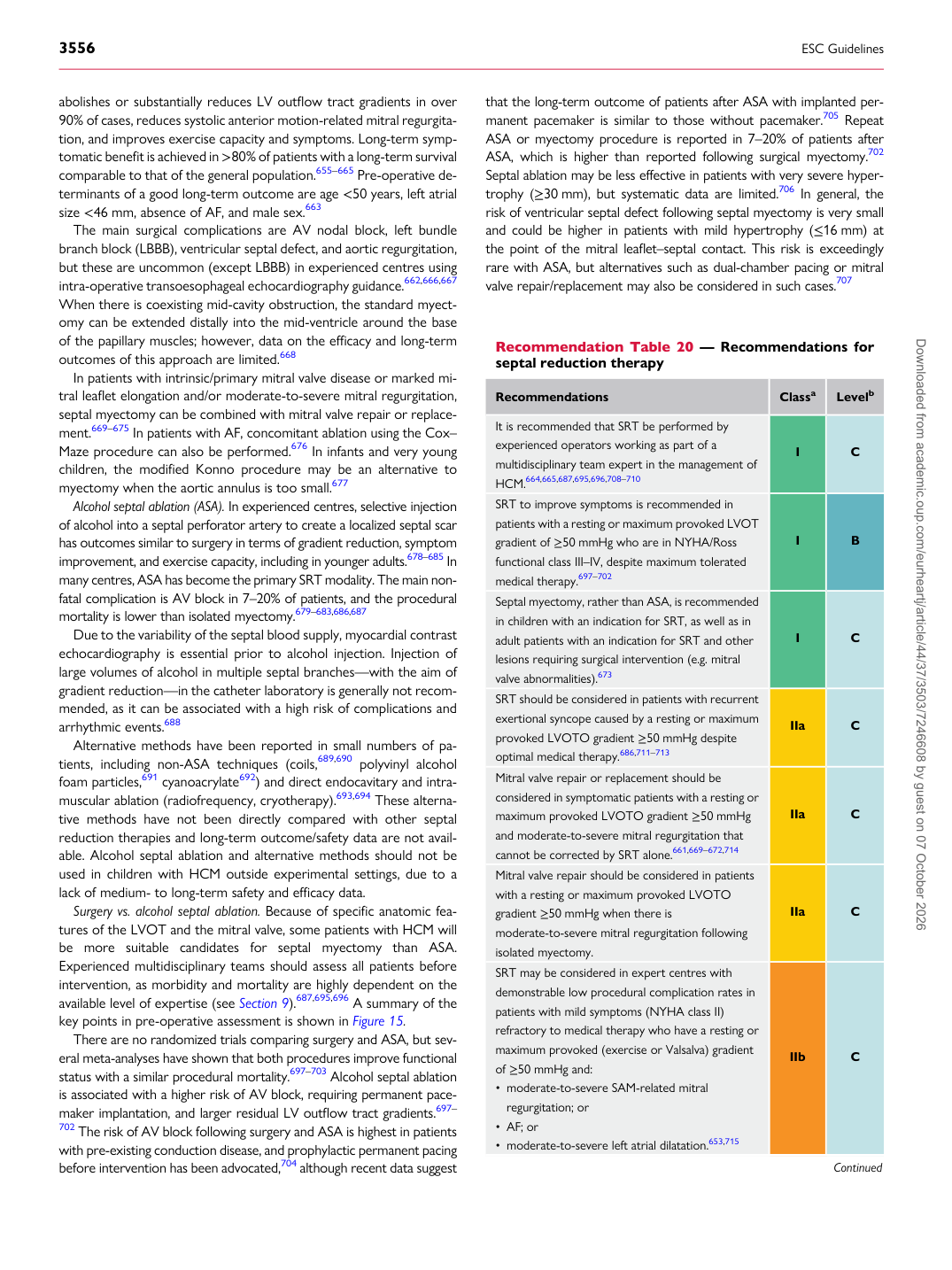
p.54 抽出テキスト
abolishes or substantially reduces LV outflow tract gradients in over 90% of cases, reduces systolic anterior motion-related mitral regurgitation, and improves exercise capacity and symptoms. Long-term symptomatic benefit is achieved in >80% of patients with a long-term survival comparable to that of the general population.655–665 Pre-operative determinants of a good long-term outcome are age <50 years, left atrial size <46 mm, absence of AF, and male sex.663 The main surgical complications are AV nodal block, left bundle branch block (LBBB), ventricular septal defect, and aortic regurgitation, but these are uncommon (except LBBB) in experienced centres using intra-operative transoesophageal echocardiography guidance.662,666,667 When there is coexisting mid-cavity obstruction, the standard myectomy can be extended distally into the mid-ventricle around the base of the papillary muscles; however, data on the efficacy and long-term outcomes of this approach are limited.668 In patients with intrinsic/primary mitral valve disease or marked mitral leaflet elongation and/or moderate-to-severe mitral regurgitation, septal myectomy can be combined with mitral valve repair or replacement.669–675 In patients with AF, concomitant ablation using the Cox– Maze procedure can also be performed.676 In infants and very young children, the modified Konno procedure may be an alternative to myectomy when the aortic annulus is too small.677 Alcohol septal ablation (ASA). In experienced centres, selective injection of alcohol into a septal perforator artery to create a localized septal scar has outcomes similar to surgery in terms of gradient reduction, symptom improvement, and exercise capacity, including in younger adults.678–685 In many centres, ASA has become the primary SRT modality. The main nonfatal complication is AV block in 7–20% of patients, and the procedural mortality is lower than isolated myectomy.679–683,686,687 Due to the variability of the septal blood supply, myocardial contrast echocardiography is essential prior to alcohol injection. Injection of large volumes of alcohol in multiple septal branches—with the aim of gradient reduction—in the catheter laboratory is generally not recommended, as it can be associated with a high risk of complications and arrhythmic events.688 Alternative methods have been reported in small numbers of patients, including non-ASA techniques (coils,689,690 polyvinyl alcohol foam particles,691 cyanoacrylate692) and direct endocavitary and intramuscular ablation (radiofrequency, cryotherapy).693,694 These alternative methods have not been directly compared with other septal reduction therapies and long-term outcome/safety data are not available. Alcohol septal ablation and alternative methods should not be used in children with HCM outside experimental settings, due to a lack of medium- to long-term safety and efficacy data. Surgery vs. alcohol septal ablation. Because of specific anatomic features of the LVOT and the mitral valve, some patients with HCM will be more suitable candidates for septal myectomy than ASA. Experienced multidisciplinary teams should assess all patients before intervention, as morbidity and mortality are highly dependent on the available level of expertise (see Section 9).687,695,696 A summary of the key points in pre-operative assessment is shown in Figure 15. There are no randomized trials comparing surgery and ASA, but several meta-analyses have shown that both procedures improve functional status with a similar procedural mortality.697–703 Alcohol septal ablation is associated with a higher risk of AV block, requiring permanent pacemaker implantation, and larger residual LV outflow tract gradients.697– 702 The risk of AV block following surgery and ASA is highest in patients with pre-existing conduction disease, and prophylactic permanent pacing before intervention has been advocated,704 although recent data suggest that the long-term outcome of patients after ASA with implanted permanent pacemaker is similar to those without pacemaker.705 Repeat ASA or myectomy procedure is reported in 7–20% of patients after ASA, which is higher than reported following surgical myectomy.702

Septal ablation may be less effective in patients with very severe hypertrophy (≥30 mm), but systematic data are limited.706 In general, the risk of ventricular septal defect following septal myectomy is very small and could be higher in patients with mild hypertrophy (≤16 mm) at the point of the mitral leaflet–septal contact. This risk is exceedingly rare with ASA, but alternatives such as dual-chamber pacing or mitral valve repair/replacement may also be considered in such cases.707

Recommendation Table 20 — Recommendations for septal reduction therapy

Recommendations Classa Levelb

It is recommended that SRT be performed by experienced operators working as part of a multidisciplinary team expert in the management of HCM.664,665,687,695,696,708–710 I C SRT to improve symptoms is recommended in patients with a resting or maximum provoked LVOT gradient of ≥50 mmHg who are in NYHA/Ross functional class III–IV, despite maximum tolerated medical therapy.697–702 I B Septal myectomy, rather than ASA, is recommended in children with an indication for SRT, as well as in adult patients with an indication for SRT and other lesions requiring surgical intervention (e.g. mitral valve abnormalities).673 I C SRT should be considered in patients with recurrent exertional syncope caused by a resting or maximum provoked LVOTO gradient ≥50 mmHg despite optimal medical therapy.686,711–713 IIa C Mitral valve repair or replacement should be considered in symptomatic patients with a resting or maximum provoked LVOTO gradient ≥50 mmHg and moderate-to-severe mitral regurgitation that cannot be corrected by SRT alone.661,669–672,714 IIa C Mitral valve repair should be considered in patients with a resting or maximum provoked LVOTO gradient ≥50 mmHg when there is moderate-to-severe mitral regurgitation following isolated myectomy. IIa C SRT may be considered in expert centres with demonstrable low procedural complication rates in patients with mild symptoms (NYHA class II) refractory to medical therapy who have a resting or maximum provoked (exercise or Valsalva) gradient of ≥50 mmHg and: • moderate-to-severe SAM-related mitral

regurgitation; or • AF; or • moderate-to-severe left atrial dilatation.653,715 IIb C

Continued Downloaded from academic.oup.com/eurheartj/article/44/37/3503/7246608 by guest on 07 October 2026