p.53 抽出テキスト
7.1.4.1.3 Invasive treatment of left ventricular outflow tract (septal

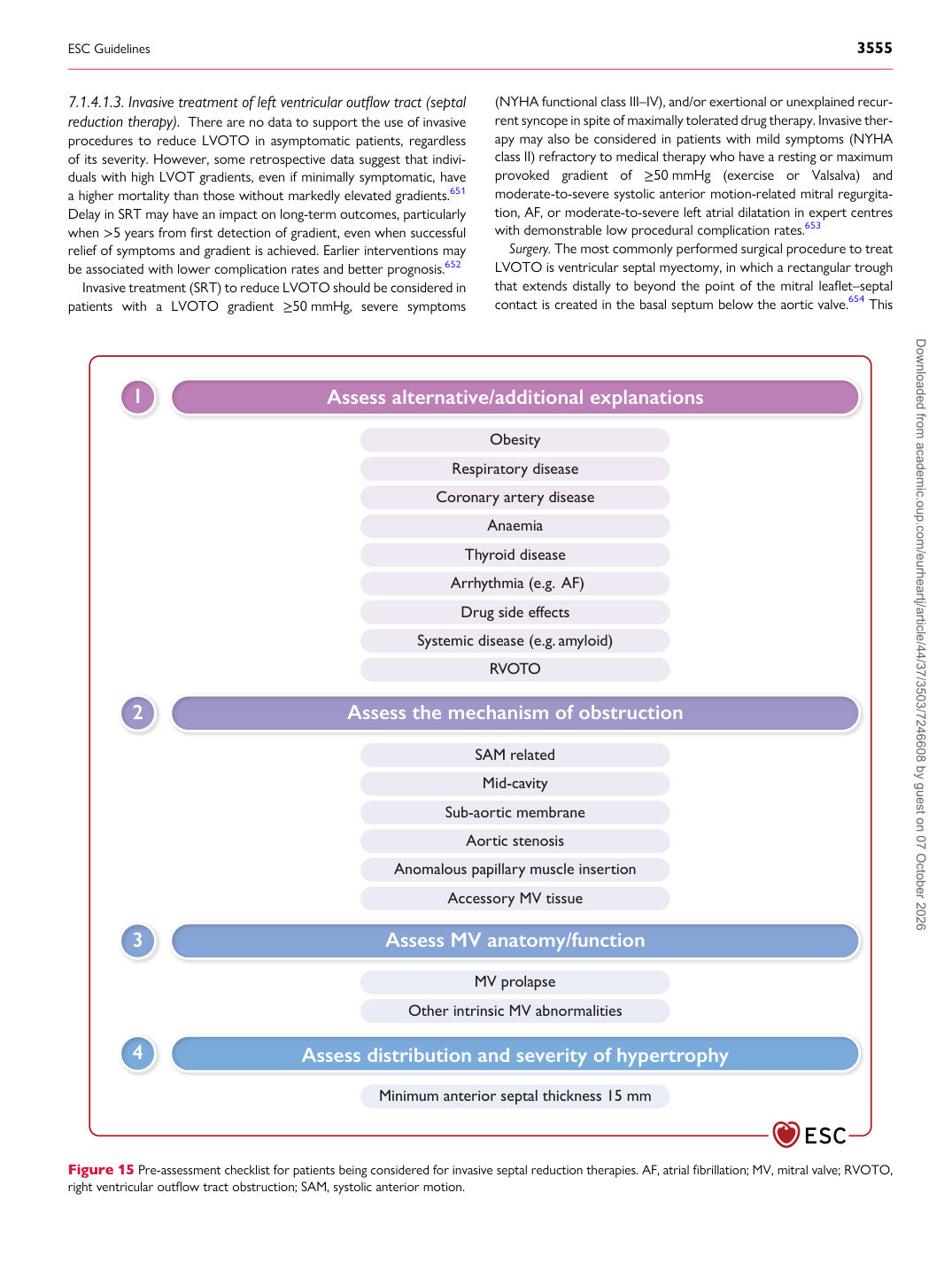
reduction therapy). There are no data to support the use of invasive procedures to reduce LVOTO in asymptomatic patients, regardless of its severity. However, some retrospective data suggest that individuals with high LVOT gradients, even if minimally symptomatic, have a higher mortality than those without markedly elevated gradients.651 Delay in SRT may have an impact on long-term outcomes, particularly when >5 years from first detection of gradient, even when successful relief of symptoms and gradient is achieved. Earlier interventions may be associated with lower complication rates and better prognosis.652 Invasive treatment (SRT) to reduce LVOTO should be considered in patients with a LVOTO gradient ≥50 mmHg, severe symptoms (NYHA functional class III–IV), and/or exertional or unexplained recurrent syncope in spite of maximally tolerated drug therapy. Invasive therapy may also be considered in patients with mild symptoms (NYHA class II) refractory to medical therapy who have a resting or maximum provoked gradient of ≥50 mmHg (exercise or Valsalva) and moderate-to-severe systolic anterior motion-related mitral regurgitation, AF, or moderate-to-severe left atrial dilatation in expert centres with demonstrable low procedural complication rates.653

Surgery. The most commonly performed surgical procedure to treat LVOTO is ventricular septal myectomy, in which a rectangular trough that extends distally to beyond the point of the mitral leaflet–septal contact is created in the basal septum below the aortic valve.654 This

Assess alternative/additional explanations

Assess the mechanism of obstruction

Assess MV anatomy/function

Assess distribution and severity of hypertrophy

Obesity Respiratory disease Coronary artery disease

Anaemia Thyroid disease Arrhythmia (e.g.  AF)

Drug side effects Systemic disease (e.g. amyloid)

RVOTO

Mid-cavity Sub-aortic membrane

Aortic stenosis

Anomalous papillary muscle insertion

Accessory MV tissue

SAM related

MV prolapse

Other intrinsic MV abnormalities

Minimum anterior septal thickness 15 mm

1

2

3

4

Figure 15 Pre-assessment checklist for patients being considered for invasive septal reduction therapies. AF, atrial fibrillation; MV, mitral valve; RVOTO, right ventricular outflow tract obstruction; SAM, systolic anterior motion.

ESC Guidelines                                                                                                                                                                                          3555

Downloaded from academic.oup.com/eurheartj/article/44/37/3503/7246608 by guest on 07 October 2026