p.52 抽出テキスト
Recommendation Table 19 — Recommendations for medical treatment of left ventricular outflow tract obstruction

Recommendations Classa Levelb

Non-vasodilating beta-blockers, titrated to maximum tolerated dose, are recommended as first-line therapy to improve symptoms in patients with resting or provokedc LVOTO.631–633,648–650 I B Verapamil or diltiazem, titrated to maximum tolerated dose, are recommended to improve symptoms in symptomatic patients with resting or provokedc LVOTO who are intolerant or have contraindications to beta-blockers.633,637–641 I B Disopyramide,d titrated to maximum tolerated dose, is recommended in addition to a beta-blocker (or, if this is not possible, with verapamil or diltiazem) to improve symptoms in patients with resting or provokedc LVOTO.632–634 I B Cardiac myosin ATPase inhibitor (mavacamten), titrated to maximum tolerated dose with echocardiographic surveillance of LVEF, should be considered in addition to a beta-blocker (or, if this is not possible, with verapamil or diltiazem) to improve symptoms in adult patients with resting or provokedc LVOTO.622,642–646 IIa A

Continued N

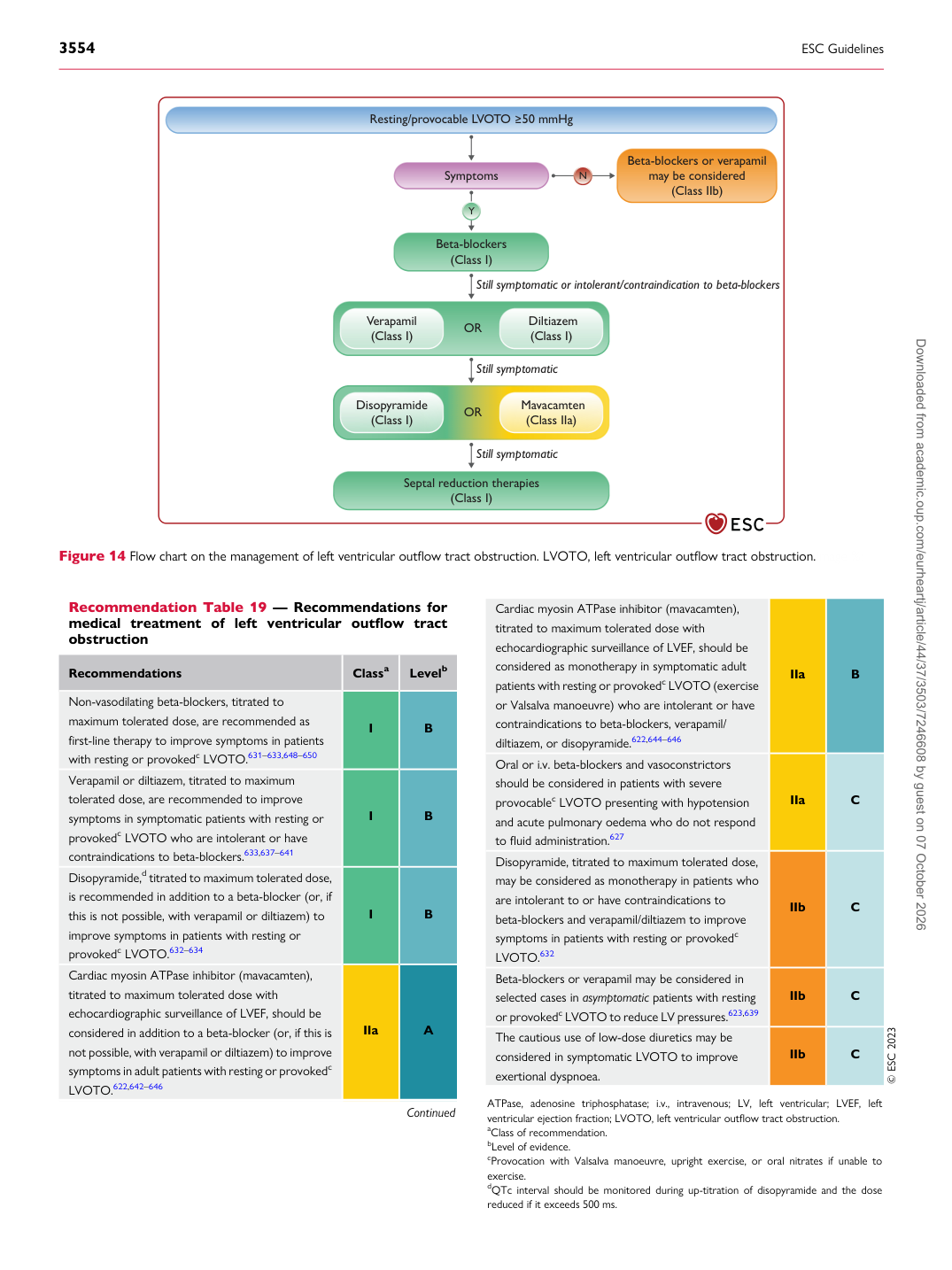
Resting/provocable LVOTO ≥50 mmHg

Symptoms Beta-blockers or verapamil

may be considered

(Class IIb)

Beta-blockers

(Class I)

Verapamil (Class I) Diltiazem

(Class I)

Septal reduction therapies

(Class I)

OR

Y

Still symptomatic or intolerant/contraindication to beta-blockers

Disopyramide

(Class I) Mavacamten

(Class IIa) OR

Still symptomatic

Still symptomatic

Figure 14 Flow chart on the management of left ventricular outflow tract obstruction. LVOTO, left ventricular outflow tract obstruction.Image %:

Cardiac myosin ATPase inhibitor (mavacamten), titrated to maximum tolerated dose with echocardiographic surveillance of LVEF, should be considered as monotherapy in symptomatic adult patients with resting or provokedc LVOTO (exercise or Valsalva manoeuvre) who are intolerant or have contraindications to beta-blockers, verapamil/ diltiazem, or disopyramide.622,644–646 IIa B Oral or i.v. beta-blockers and vasoconstrictors should be considered in patients with severe provocablec LVOTO presenting with hypotension and acute pulmonary oedema who do not respond to fluid administration.627 IIa C Disopyramide, titrated to maximum tolerated dose, may be considered as monotherapy in patients who are intolerant to or have contraindications to beta-blockers and verapamil/diltiazem to improve symptoms in patients with resting or provokedc LVOTO.632 IIb C Beta-blockers or verapamil may be considered in selected cases in asymptomatic patients with resting or provokedc LVOTO to reduce LV pressures.623,639 IIb C The cautious use of low-dose diuretics may be considered in symptomatic LVOTO to improve exertional dyspnoea. IIb C © ESC 2023

ATPase, adenosine triphosphatase; i.v., intravenous; LV, left ventricular; LVEF, left ventricular ejection fraction; LVOTO, left ventricular outflow tract obstruction. aClass of recommendation. bLevel of evidence. cProvocation with Valsalva manoeuvre, upright exercise, or oral nitrates if unable to exercise. dQTc interval should be monitored during up-titration of disopyramide and the dose reduced if it exceeds 500 ms. Downloaded from academic.oup.com/eurheartj/article/44/37/3503/7246608 by guest on 07 October 2026