p.51 抽出テキスト
7.1.4.1 Management of left ventricular outflow tract obstruction

By convention, LVOTO is defined as a peak instantaneous Doppler LV outflow tract gradient of ≥30 mmHg, but the threshold for invasive treatment is usually considered to be ≥50 mmHg (the threshold at which theoretical models examining the relationship between the gradient and stroke volume predict that this becomes haemodynamically significant).587,624,625 Most patients with a maximum resting or provoked LV outflow tract gradient <50 mmHg should be managed in accordance with the recommendations for non-obstructive HCM but, in a very small number of selected cases with LV outflow tract gradients between 30 and 50 mmHg and no other obvious cause of symptoms, invasive gradient reduction may be considered, acknowledging that data covering this group are lacking. Most asymptomatic patients with LVOTO do not require treatment but, in a very small number of selected cases, pharmacological treatment to reduced LV pressures may be considered.626,627

7.1.4.1.1 General measures. All patients with LVOTO should avoid

dehydration and excess alcohol consumption, and weight loss should be encouraged. Arterial and venous dilators, including nitrates and phosphodiesterase type 5 inhibitors, can exacerbate LVOTO and should be avoided if possible (see Section 12.2).626 New-onset or poorly controlled AF can exacerbate symptoms caused by LVOTO and should be managed by prompt restoration of sinus rhythm or ventricular rate control.628

7.1.4.1.2 Drug therapy. Figure 14 describes the management of

LVOTO in patients with HCM. By consensus, patients with symptomatic LVOTO have been treated initially with non-vasodilating betablockers titrated to the maximum tolerated dose, but there are very few studies comparing individual beta-blockers. A recent small, randomized placebo-controlled trial showed reduction of resting and exertional LVOTO, and improvement in symptoms and QoL with metoprolol therapy.631 If beta-blockers alone are ineffective, disopyramide, titrated up to a maximum tolerated dose (usually 400–600 mg/day), may be added.632–634 This class IA AAD can abolish basal LV outflow pressure gradients and improve exercise tolerance and functional capacity with a low risk of proarrhythmic effects and without an increased risk of SCD.632,633 Dose-limiting anticholinergic side effects include dry eyes and mouth, urinary hesitancy or retention, and constipation.632,633,635 The QTc interval should be monitored during dose up-titration and the dose reduced if it exceeds 500 ms. Disopyramide should be avoided in patients with glaucoma, in men with prostatism, and in patients taking other drugs that prolong the QT interval, such as amiodarone and sotalol. Disopyramide may be used in combination with verapamil.633

Verapamil (starting dose 40 mg three times daily to maximum 480 mg daily) can be used when beta-blockers are contraindicated or ineffective but, based on limited data, should be used cautiously in patients with severe obstruction (≥100 mmHg) or elevated pulmonary artery systolic pressures, as it may provoke pulmonary oedema.636 Short-term oral administration may increase exercise capacity, improve symptoms, and normalize or improve LV diastolic filling without altering systolic function.637–640 Similar findings have been demonstrated for diltiazem (starting dose 60 mg three times daily to maximum 360 mg daily),641 and it should be considered in patients who are intolerant or have contraindications to beta-blockers and verapamil. Low-dose loop or thiazide diuretics may be used cautiously to improve dyspnoea associated with LVOTO, but it is important to avoid hypovolaemia. Cardiac myosin ATPase inhibitors. Mavacamten is a first-in-class cardiac myosin adenosine triphosphatase (ATPase) inhibitor that acts by reducing actin–myosin cross-bridge formation, thereby reducing contractility and improving myocardial energetics. In the recently published Clinical Study to Evaluate Mavacamten in Adults with Symptomatic Obstructive Hypertrophic Cardiomyopathy (EXPLORER-HCM) trial, mavacamten reduced the left ventricular outflow tract (LVOT) gradient and improved exercise capacity compared with placebo in patients with HCM and symptomatic LVOTO (NYHA II–III and EF >55%); 27% of patients on mavacamten had an LVOT gradient reduction to <30 mmHg and improved to NYHA class I.622 The drug was well tolerated and has a good safety profile; only a small subset of patients developed transient LV systolic dysfunction, which resolved after temporary discontinuation of the drug. A second study (A Study to Evaluate Mavacamten in Adults With Symptomatic Obstructive HCM Who Are Eligible for Septal Reduction Therapy [VALOR-HCM]) in adult patients with obstructive HCM referred for septal reduction therapy (SRT) due to intractable symptoms showed that mavacamten significantly reduced the proportion of patients meeting criteria for SRT at 16 and 32 weeks.642,643 Small CMR and ECHO substudies suggest that mavacamten may also lead to positive myocardial remodelling, with reduction in myocardial mass, LV wall thickness, and left atrial volume.644–646 Aficamten, a next-in-class cardiac myosin inhibitor, was also recently shown in a Phase II randomized placebo-controlled study (Randomized Evaluation of Dosing With CK-3773274 in Obstructive Outflow Disease in HCM [REDWOOD-HCM]) to significantly reduce LVOT gradients and NT-proBNP levels in adult patients with symptomatic obstructive HCM.647 In the absence of a direct head-to-head comparison, the Task Force was unable to recommend the use of cardiac myosin ATPase inhibitors as first-line medical therapy, but did consider the evidence sufficiently robust to support the recommendation that their use as second-line therapy should be considered when optimal medical therapy with betablockers, calcium antagonists, and/or disopyramide is ineffective or poorly tolerated. In the absence of evidence to the contrary, cardiac myosin ATPase inhibitors should not be used with disopyramide, but may be coadministered with beta-blockers or calcium antagonists. Up-titration of medication to a maximum dose of 15 mg should be monitored in accordance with licensed recommendations using echocardiography. In patients with contraindications or known sensitivity to beta-blockers, calcium antagonists, and disopyramide, cardiac myosin ATPase inhibitors may be considered as monotherapy.

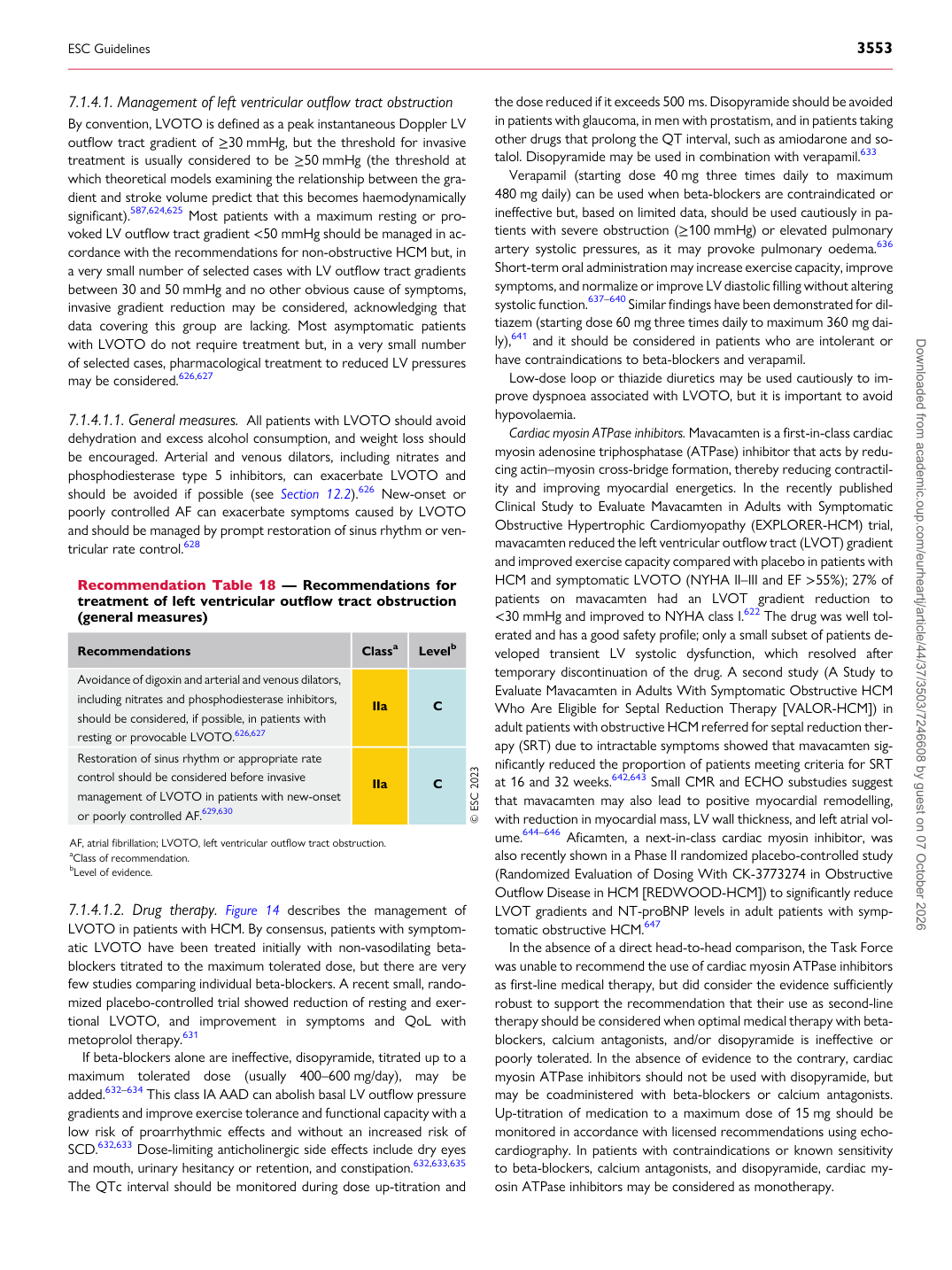
Recommendation Table 18 — Recommendations for treatment of left ventricular outflow tract obstruction (general measures)

Recommendations Classa Levelb

Avoidance of digoxin and arterial and venous dilators, including nitrates and phosphodiesterase inhibitors, should be considered, if possible, in patients with resting or provocable LVOTO.626,627 IIa C Restoration of sinus rhythm or appropriate rate control should be considered before invasive management of LVOTO in patients with new-onset or poorly controlled AF.629,630 IIa C © ESC 2023

AF, atrial fibrillation; LVOTO, left ventricular outflow tract obstruction. aClass of recommendation. bLevel of evidence.

ESC Guidelines                                                                                                                                                                                          3553

Downloaded from academic.oup.com/eurheartj/article/44/37/3503/7246608 by guest on 07 October 2026