p.50 抽出テキスト
variant inherited from a parent or due to de novo variants that were not carried by the parents or, less commonly, due to autosomal recessive inheritance. In those who undergo genetic testing, ∼40–60% will have a single variant identified as the cause of their disease, although this is influenced by the cohort studied.124 The likelihood of finding a causal variant is highest in young patients with familial disease and lowest in older patients and individuals with non-classical features. Phenotype-based scores to predict genetic yield in HCM have been developed and may be used to prioritize genetic testing where resources are limited.609,610 Genes with definitive evidence for gene–disease association with HCM are summarized in Table 10. An important subgroup characterized by no identifiable monogenic variant, no family history of disease and often being older, more likely to be male and with a history of hypertension, and less risk of major cardiovascular events is likely to be underlied by complex aetiology.238,611,612 Less than 5% of adult patients, but up to 25% of children, with HCM, will have a causative variant in a gene that is known to mimic the HCM phenotype. Such genocopies can have clinically important differences such as altered inheritance risks, and management and therapy options. The aetiology of HCM in childhood is more heterogeneous than that seen in adult populations, and includes inborn errors of metabolism, malformation syndromes, and neuromuscular disorders.613–615 Most cases of HCM in childhood, however, are caused by variants in the cardiac sarcomere protein genes, inherited as autosomal dominant traits.616,617 The relative prevalence of different HCM aetiologies varies according to age: HCM related to inborn errors of metabolism and malformation syndromes is most commonly diagnosed in the first 2 years of life, whereas HCM due to neuromuscular disorders (e.g. Friedreich ataxia) most commonly presents in adolescence.613–615 Outside of infancy, sarcomere protein gene variants account for 55–75% of cases of childhood-onset HCM,616–619 and even in infancy, sarcomeric disease is present in up to 40% of cases.616,620 Although rarer, inborn errors of metabolism and malformation syndromes can also present for the first time in older children and adolescents (see Section 7.6).614

A thorough and comprehensive diagnostic work-up is essential in the diagnosis of childhood-onset HCM in order to confirm the diagnosis, identify the underlying aetiology, and guide treatment (see Section 6). Recommendations for clinical screening, genetic counselling, and testing are described in Sections 6.8.3 and 6.11, respectively.

7.1.3 Assessment of symptoms

Most people with HCM are asymptomatic and have a normal lifespan, but some develop symptoms, often many years after the appearance of ECG or echocardiographic evidence of LVH. Assessment of symptoms in patients with cardiomyopathies is described in Section 6.4. Assessment of LVOTO, as outlined in Figure 12, should be part of the routine evaluation of all symptomatic patients.

7.1.4 Management of symptoms and complications

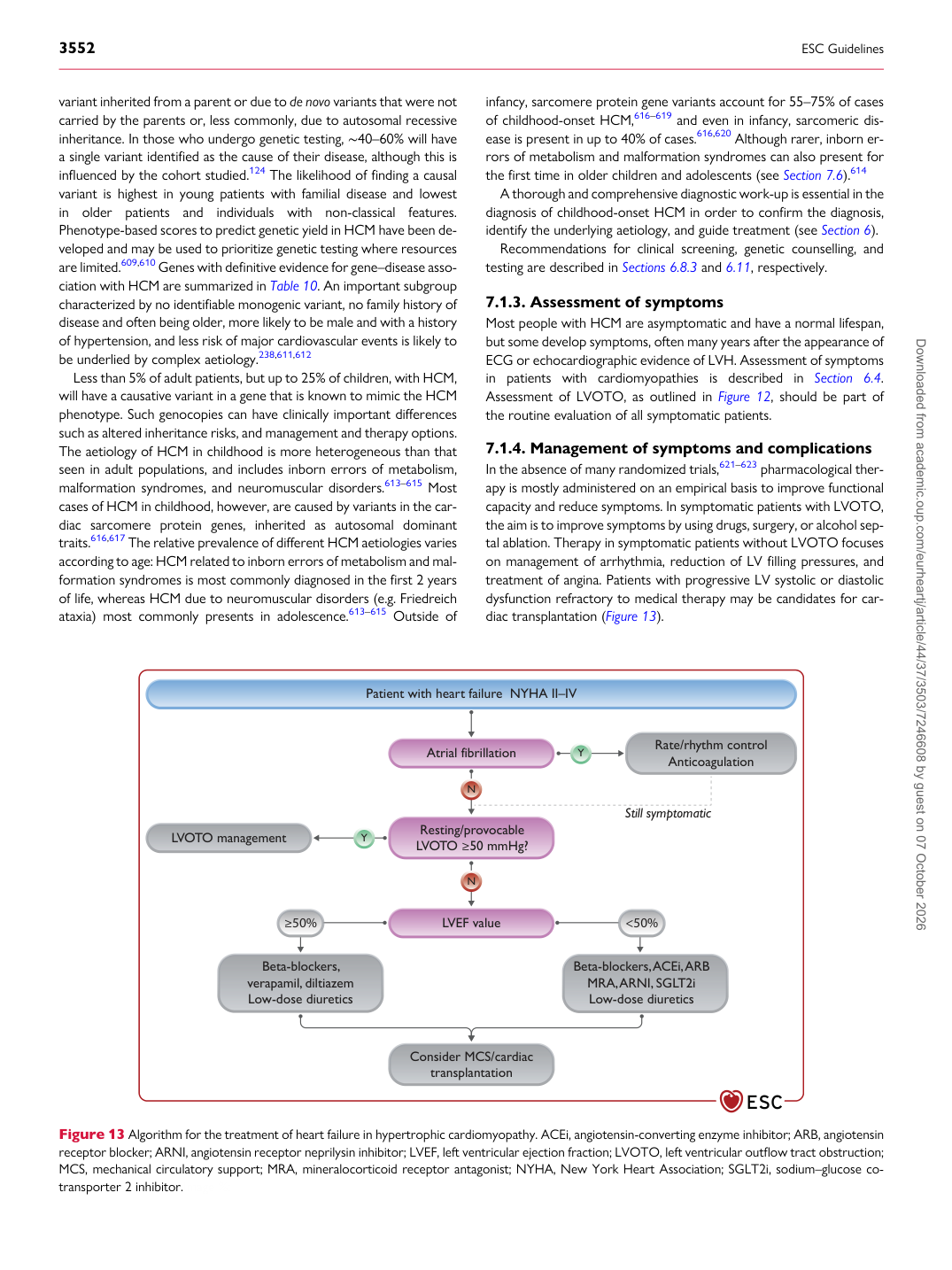
In the absence of many randomized trials,621–623 pharmacological therapy is mostly administered on an empirical basis to improve functional capacity and reduce symptoms. In symptomatic patients with LVOTO, the aim is to improve symptoms by using drugs, surgery, or alcohol septal ablation. Therapy in symptomatic patients without LVOTO focuses on management of arrhythmia, reduction of LV filling pressures, and treatment of angina. Patients with progressive LV systolic or diastolic dysfunction refractory to medical therapy may be candidates for cardiac transplantation (Figure 13).

N

N

Patient with heart failure  NYHA II–IV

Atrial fibrillation

LVEF value

LVOTO management Rate/rhythm control

Anticoagulation

Still symptomatic

Consider MCS/cardiac

transplantation Beta-blockers, ACEi, ARB

MRA, ARNI, SGLT2i Low-dose diuretics

Beta-blockers, verapamil, diltiazem Low-dose diuretics Resting/provocable LVOTO ≥50 mmHg? Y

Y

≥50% <50%

Figure 13 Algorithm for the treatment of heart failure in hypertrophic cardiomyopathy. ACEi, angiotensin-converting enzyme inhibitor; ARB, angiotensin receptor blocker; ARNI, angiotensin receptor neprilysin inhibitor; LVEF, left ventricular ejection fraction; LVOTO, left ventricular outflow tract obstruction; MCS, mechanical circulatory support; MRA, mineralocorticoid receptor antagonist; NYHA, New York Heart Association; SGLT2i, sodium–glucose cotransporter 2 inhibitor.Image %: Downloaded from academic.oup.com/eurheartj/article/44/37/3503/7246608 by guest on 07 October 2026