p.46 抽出テキスト
phenotype may express later in life; and (iii) follow-up in families with more than one likely or definitively pathogenic variant (oligopolygenicity) should be discussed in the cardiomyopathy team.

6.12 Psychological support in

cardiomyopathy patients and family members Adjusting to a diagnosis of an inherited cardiomyopathy can pose a psychosocial challenge. This includes coming to terms with a new diagnosis, exclusion from competitive sports, or living with the small risk of SCD.205 While studies show patients with inherited cardiomyopathies adjust well following an ICD, there is an important subgroup who do require additional support.552–556 The decision to have an ICD, and living with the device, can also pose psychological challenges, especially in those who are young or who have experienced multiple shocks and/or have poor baseline psychosocial functioning.553,554,557 The SCD of a young relative not only leads to profound grief, but one in two relatives report post-traumatic stress or prolonged grief on average 6 years after the death.558 Clinical psychological support for patients and their families affected by inherited cardiomyopathies is an important aspect of the multidisciplinary team’s care approach and should be available as required.559 Clinicians should be aware of the potential for poor psychological outcomes and should have a low threshold for referral.

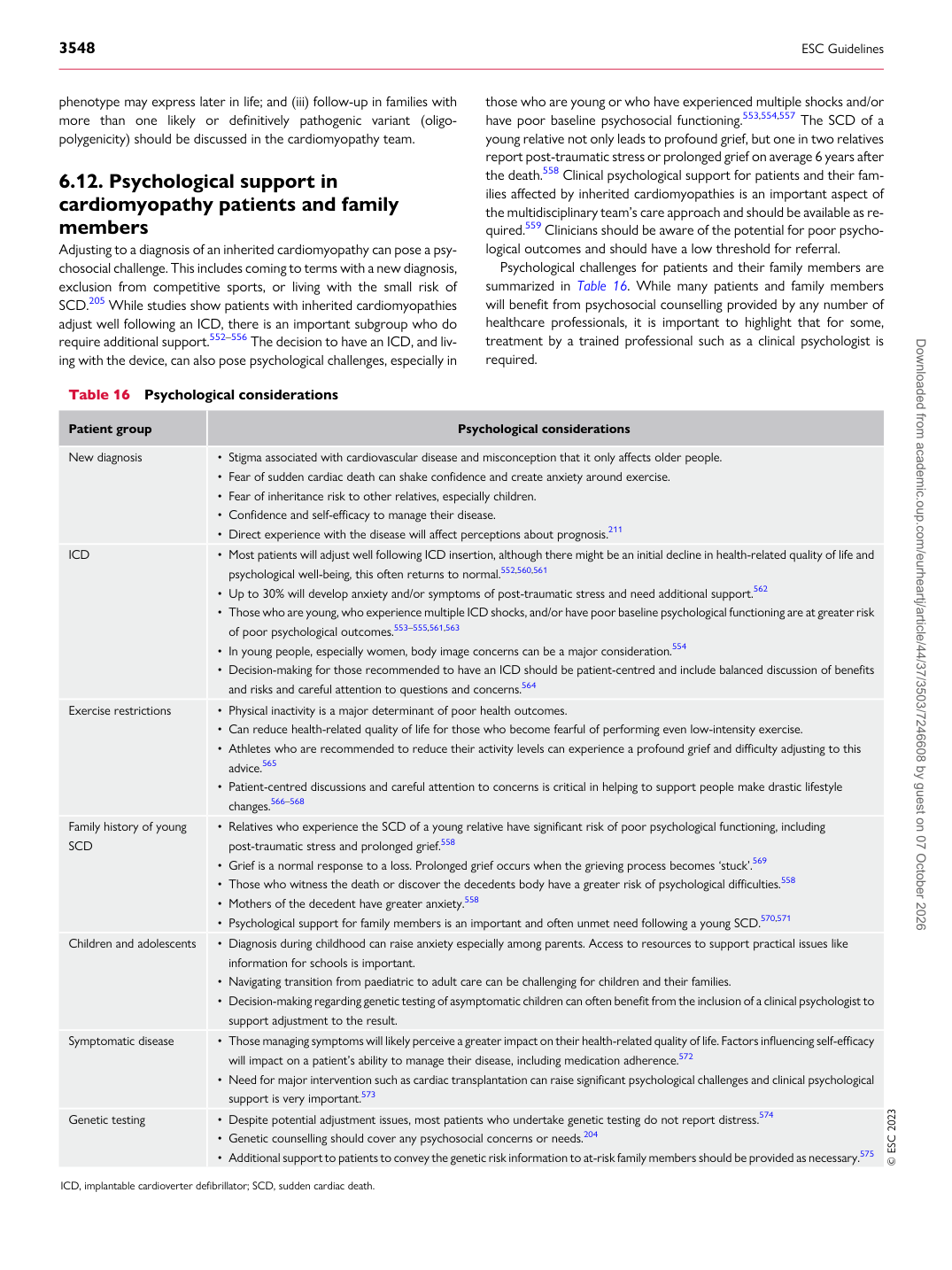
Psychological challenges for patients and their family members are summarized in Table 16. While many patients and family members will benefit from psychosocial counselling provided by any number of healthcare professionals, it is important to highlight that for some, treatment by a trained professional such as a clinical psychologist is required.

Table 16 Psychological considerations

Patient group Psychological considerations

New diagnosis • Stigma associated with cardiovascular disease and misconception that it only affects older people. • Fear of sudden cardiac death can shake confidence and create anxiety around exercise.

• Fear of inheritance risk to other relatives, especially children. • Confidence and self-efficacy to manage their disease. • Direct experience with the disease will affect perceptions about prognosis.211

ICD • Most patients will adjust well following ICD insertion, although there might be an initial decline in health-related quality of life and

psychological well-being, this often returns to normal.552,560,561 • Up to 30% will develop anxiety and/or symptoms of post-traumatic stress and need additional support.562 • Those who are young, who experience multiple ICD shocks, and/or have poor baseline psychological functioning are at greater risk

of poor psychological outcomes.553–555,561,563 • In young people, especially women, body image concerns can be a major consideration.554 • Decision-making for those recommended to have an ICD should be patient-centred and include balanced discussion of benefits

and risks and careful attention to questions and concerns.564

Exercise restrictions • Physical inactivity is a major determinant of poor health outcomes.

• Can reduce health-related quality of life for those who become fearful of performing even low-intensity exercise. • Athletes who are recommended to reduce their activity levels can experience a profound grief and difficulty adjusting to this advice.565 • Patient-centred discussions and careful attention to concerns is critical in helping to support people make drastic lifestyle

changes.566–568

Family history of young SCD • Relatives who experience the SCD of a young relative have significant risk of poor psychological functioning, including

post-traumatic stress and prolonged grief.558 • Grief is a normal response to a loss. Prolonged grief occurs when the grieving process becomes ‘stuck’.569 • Those who witness the death or discover the decedents body have a greater risk of psychological difficulties.558 • Mothers of the decedent have greater anxiety.558 • Psychological support for family members is an important and often unmet need following a young SCD.570,571

Children and adolescents • Diagnosis during childhood can raise anxiety especially among parents. Access to resources to support practical issues like information for schools is important.

• Navigating transition from paediatric to adult care can be challenging for children and their families. • Decision-making regarding genetic testing of asymptomatic children can often benefit from the inclusion of a clinical psychologist to support adjustment to the result.

Symptomatic disease • Those managing symptoms will likely perceive a greater impact on their health-related quality of life. Factors influencing self-efficacy will impact on a patient’s ability to manage their disease, including medication adherence.572

• Need for major intervention such as cardiac transplantation can raise significant psychological challenges and clinical psychological

support is very important.573

Genetic testing • Despite potential adjustment issues, most patients who undertake genetic testing do not report distress.574

• Genetic counselling should cover any psychosocial concerns or needs.204 • Additional support to patients to convey the genetic risk information to at-risk family members should be provided as necessary.575 © ESC 2023

ICD, implantable cardioverter defibrillator; SCD, sudden cardiac death. Downloaded from academic.oup.com/eurheartj/article/44/37/3503/7246608 by guest on 07 October 2026