p.44 抽出テキスト
6.10.6 Routine follow-up of patients with

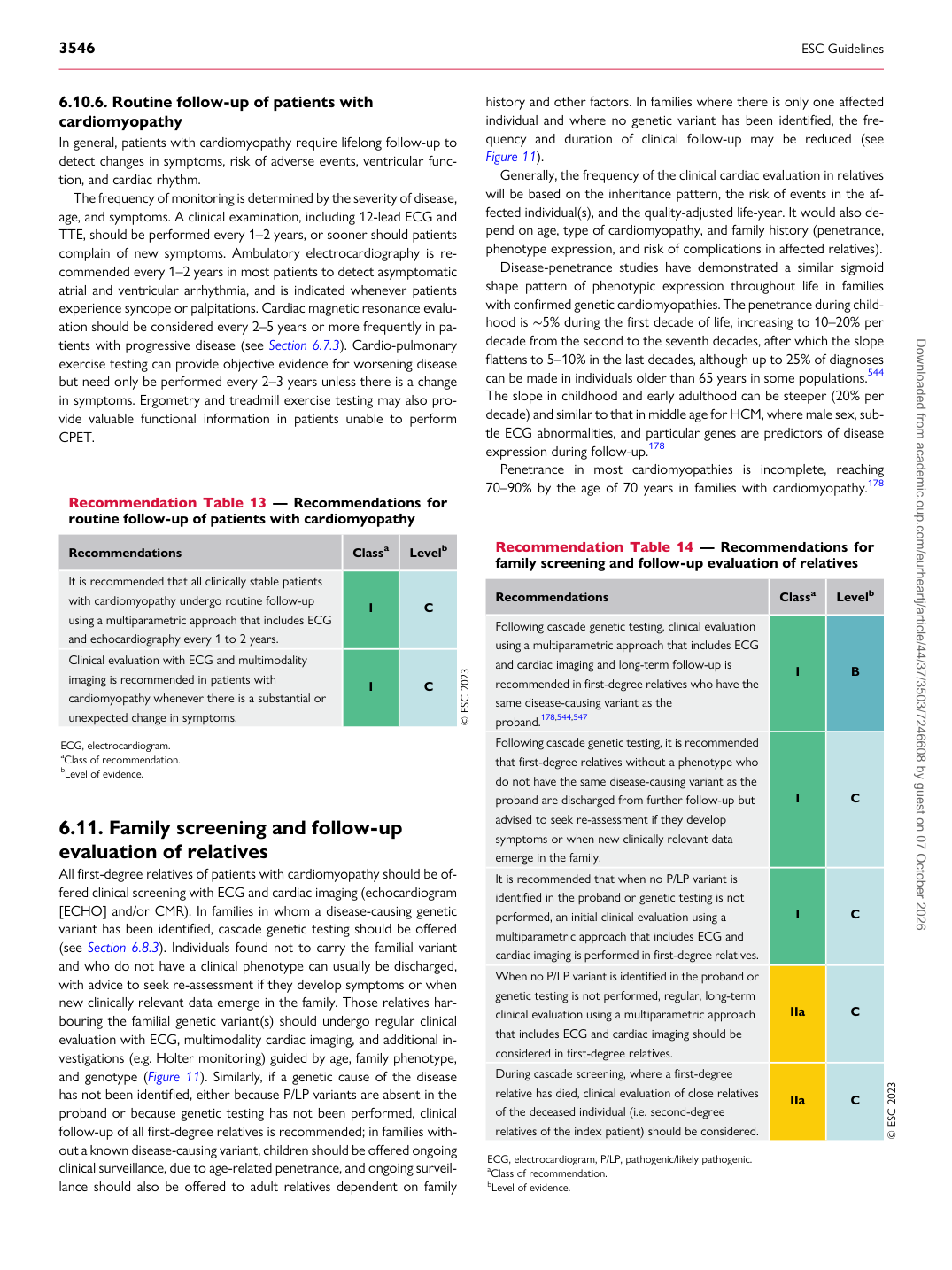
cardiomyopathy In general, patients with cardiomyopathy require lifelong follow-up to detect changes in symptoms, risk of adverse events, ventricular function, and cardiac rhythm. The frequency of monitoring is determined by the severity of disease, age, and symptoms. A clinical examination, including 12-lead ECG and TTE, should be performed every 1–2 years, or sooner should patients complain of new symptoms. Ambulatory electrocardiography is recommended every 1–2 years in most patients to detect asymptomatic atrial and ventricular arrhythmia, and is indicated whenever patients experience syncope or palpitations. Cardiac magnetic resonance evaluation should be considered every 2–5 years or more frequently in patients with progressive disease (see Section 6.7.3). Cardio-pulmonary exercise testing can provide objective evidence for worsening disease but need only be performed every 2–3 years unless there is a change in symptoms. Ergometry and treadmill exercise testing may also provide valuable functional information in patients unable to perform CPET.

6.11 Family screening and follow-up

evaluation of relatives All first-degree relatives of patients with cardiomyopathy should be offered clinical screening with ECG and cardiac imaging (echocardiogram [ECHO] and/or CMR). In families in whom a disease-causing genetic variant has been identified, cascade genetic testing should be offered (see Section 6.8.3). Individuals found not to carry the familial variant and who do not have a clinical phenotype can usually be discharged, with advice to seek re-assessment if they develop symptoms or when new clinically relevant data emerge in the family. Those relatives harbouring the familial genetic variant(s) should undergo regular clinical evaluation with ECG, multimodality cardiac imaging, and additional investigations (e.g. Holter monitoring) guided by age, family phenotype, and genotype (Figure 11). Similarly, if a genetic cause of the disease has not been identified, either because P/LP variants are absent in the proband or because genetic testing has not been performed, clinical follow-up of all first-degree relatives is recommended; in families without a known disease-causing variant, children should be offered ongoing clinical surveillance, due to age-related penetrance, and ongoing surveillance should also be offered to adult relatives dependent on family history and other factors. In families where there is only one affected individual and where no genetic variant has been identified, the frequency and duration of clinical follow-up may be reduced (see Figure 11).

Generally, the frequency of the clinical cardiac evaluation in relatives will be based on the inheritance pattern, the risk of events in the affected individual(s), and the quality-adjusted life-year. It would also depend on age, type of cardiomyopathy, and family history (penetrance, phenotype expression, and risk of complications in affected relatives). Disease-penetrance studies have demonstrated a similar sigmoid shape pattern of phenotypic expression throughout life in families with confirmed genetic cardiomyopathies. The penetrance during childhood is ∼5% during the first decade of life, increasing to 10–20% per decade from the second to the seventh decades, after which the slope flattens to 5–10% in the last decades, although up to 25% of diagnoses can be made in individuals older than 65 years in some populations.544 The slope in childhood and early adulthood can be steeper (20% per decade) and similar to that in middle age for HCM, where male sex, subtle ECG abnormalities, and particular genes are predictors of disease expression during follow-up.178

Penetrance in most cardiomyopathies is incomplete, reaching 70–90% by the age of 70 years in families with cardiomyopathy.178 Recommendation Table 13 — Recommendations for routine follow-up of patients with cardiomyopathy

Recommendations Classa Levelb

It is recommended that all clinically stable patients with cardiomyopathy undergo routine follow-up using a multiparametric approach that includes ECG and echocardiography every 1 to 2 years. I C Clinical evaluation with ECG and multimodality imaging is recommended in patients with cardiomyopathy whenever there is a substantial or unexpected change in symptoms. I C © ESC 2023

ECG, electrocardiogram. aClass of recommendation. bLevel of evidence. Recommendation Table 14 — Recommendations for family screening and follow-up evaluation of relatives

Recommendations Classa Levelb

Following cascade genetic testing, clinical evaluation using a multiparametric approach that includes ECG and cardiac imaging and long-term follow-up is recommended in first-degree relatives who have the same disease-causing variant as the proband.178,544,547 I B Following cascade genetic testing, it is recommended that first-degree relatives without a phenotype who do not have the same disease-causing variant as the proband are discharged from further follow-up but advised to seek re-assessment if they develop symptoms or when new clinically relevant data emerge in the family. I C It is recommended that when no P/LP variant is identified in the proband or genetic testing is not performed, an initial clinical evaluation using a multiparametric approach that includes ECG and cardiac imaging is performed in first-degree relatives. I C When no P/LP variant is identified in the proband or genetic testing is not performed, regular, long-term clinical evaluation using a multiparametric approach that includes ECG and cardiac imaging should be considered in first-degree relatives. IIa C During cascade screening, where a first-degree relative has died, clinical evaluation of close relatives of the deceased individual (i.e. second-degree relatives of the index patient) should be considered. IIa C © ESC 2023

ECG, electrocardiogram, P/LP, pathogenic/likely pathogenic. aClass of recommendation. bLevel of evidence. Downloaded from academic.oup.com/eurheartj/article/44/37/3503/7246608 by guest on 07 October 2026