p.43 抽出テキスト
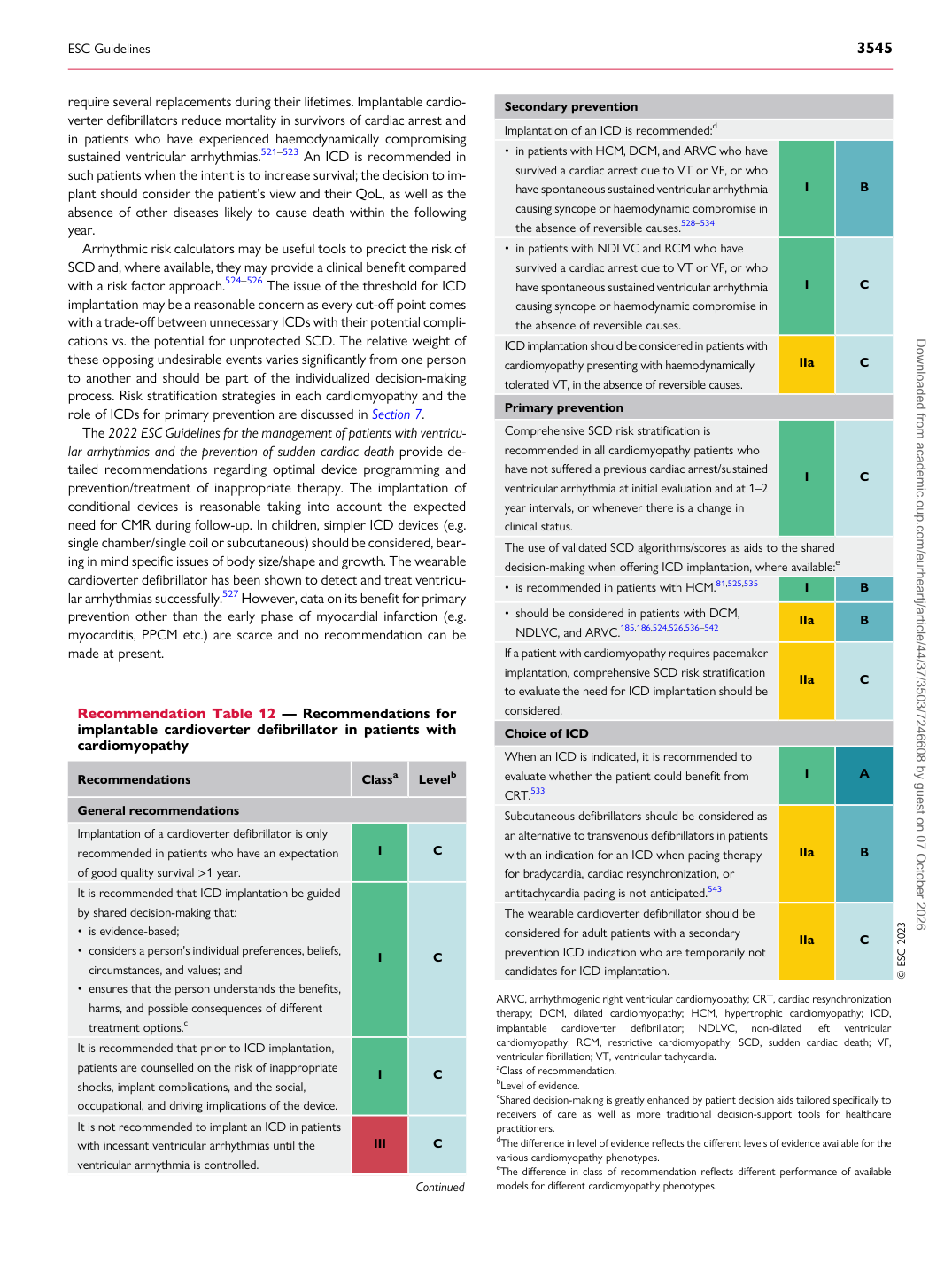
require several replacements during their lifetimes. Implantable cardioverter defibrillators reduce mortality in survivors of cardiac arrest and in patients who have experienced haemodynamically compromising sustained ventricular arrhythmias.521–523 An ICD is recommended in such patients when the intent is to increase survival; the decision to implant should consider the patient’s view and their QoL, as well as the absence of other diseases likely to cause death within the following year. Arrhythmic risk calculators may be useful tools to predict the risk of SCD and, where available, they may provide a clinical benefit compared with a risk factor approach.524–526 The issue of the threshold for ICD implantation may be a reasonable concern as every cut-off point comes with a trade-off between unnecessary ICDs with their potential complications vs. the potential for unprotected SCD. The relative weight of these opposing undesirable events varies significantly from one person to another and should be part of the individualized decision-making process. Risk stratification strategies in each cardiomyopathy and the role of ICDs for primary prevention are discussed in Section 7. The 2022 ESC Guidelines for the management of patients with ventricular arrhythmias and the prevention of sudden cardiac death provide detailed recommendations regarding optimal device programming and prevention/treatment of inappropriate therapy. The implantation of conditional devices is reasonable taking into account the expected need for CMR during follow-up. In children, simpler ICD devices (e.g. single chamber/single coil or subcutaneous) should be considered, bearing in mind specific issues of body size/shape and growth. The wearable cardioverter defibrillator has been shown to detect and treat ventricular arrhythmias successfully.527 However, data on its benefit for primary prevention other than the early phase of myocardial infarction (e.g. myocarditis, PPCM etc.) are scarce and no recommendation can be made at present.

Recommendation Table 12 — Recommendations for implantable cardioverter defibrillator in patients with cardiomyopathy

Recommendations Classa Levelb

General recommendations Implantation of a cardioverter defibrillator is only recommended in patients who have an expectation of good quality survival >1 year. I C It is recommended that ICD implantation be guided by shared decision-making that: • is evidence-based; • considers a person’s individual preferences, beliefs,

circumstances, and values; and • ensures that the person understands the benefits, harms, and possible consequences of different

treatment options.c I C It is recommended that prior to ICD implantation, patients are counselled on the risk of inappropriate shocks, implant complications, and the social, occupational, and driving implications of the device. I C It is not recommended to implant an ICD in patients with incessant ventricular arrhythmias until the ventricular arrhythmia is controlled. III C

Continued Secondary prevention

Implantation of an ICD is recommended:d • in patients with HCM, DCM, and ARVC who have

survived a cardiac arrest due to VT or VF, or who have spontaneous sustained ventricular arrhythmia causing syncope or haemodynamic compromise in the absence of reversible causes.528–534 I B • in patients with NDLVC and RCM who have

survived a cardiac arrest due to VT or VF, or who have spontaneous sustained ventricular arrhythmia causing syncope or haemodynamic compromise in the absence of reversible causes. I C ICD implantation should be considered in patients with cardiomyopathy presenting with haemodynamically tolerated VT, in the absence of reversible causes. IIa C Primary prevention Comprehensive SCD risk stratification is recommended in all cardiomyopathy patients who have not suffered a previous cardiac arrest/sustained ventricular arrhythmia at initial evaluation and at 1–2 year intervals, or whenever there is a change in clinical status. I C The use of validated SCD algorithms/scores as aids to the shared decision-making when offering ICD implantation, where available:e • is recommended in patients with HCM.81,525,535 I B • should be considered in patients with DCM, NDLVC, and ARVC.185,186,524,526,536–542 IIa B If a patient with cardiomyopathy requires pacemaker implantation, comprehensive SCD risk stratification to evaluate the need for ICD implantation should be considered. IIa C Choice of ICD When an ICD is indicated, it is recommended to evaluate whether the patient could benefit from CRT.533 I A Subcutaneous defibrillators should be considered as an alternative to transvenous defibrillators in patients with an indication for an ICD when pacing therapy for bradycardia, cardiac resynchronization, or antitachycardia pacing is not anticipated.543 IIa B The wearable cardioverter defibrillator should be considered for adult patients with a secondary prevention ICD indication who are temporarily not candidates for ICD implantation. IIa C © ESC 2023

ARVC, arrhythmogenic right ventricular cardiomyopathy; CRT, cardiac resynchronization therapy; DCM, dilated cardiomyopathy; HCM, hypertrophic cardiomyopathy; ICD, implantable cardioverter defibrillator; NDLVC, non-dilated left ventricular cardiomyopathy; RCM, restrictive cardiomyopathy; SCD, sudden cardiac death; VF, ventricular fibrillation; VT, ventricular tachycardia. aClass of recommendation. bLevel of evidence. cShared decision-making is greatly enhanced by patient decision aids tailored specifically to receivers of care as well as more traditional decision-support tools for healthcare practitioners. dThe difference in level of evidence reflects the different levels of evidence available for the various cardiomyopathy phenotypes. eThe difference in class of recommendation reflects different performance of available models for different cardiomyopathy phenotypes.

ESC Guidelines                                                                                                                                                                                          3545

Downloaded from academic.oup.com/eurheartj/article/44/37/3503/7246608 by guest on 07 October 2026