p.42 抽出テキスト
6.10.4 Management of ventricular arrhythmias

Ventricular arrhythmias, particularly in the form of electrical storm and/ or repetitive appropriate ICD interventions, contribute to a significantly increased risk of morbidity and mortality in patients with cardiomyopathies.299 The 2022 ESC Guidelines for the management of patients with ventricular arrhythmias and the prevention of sudden cardiac death provide detailed recommendations on acute and long-term management of ventricular arrhythmias in patients with cardiomyopathies.299 Limited data exist addressing ventricular arrhythmia management in patients with specific genetic cardiomyopathies. Nonetheless, some general concepts can be highlighted:

• Any reversible cause and/or precipitating factor, such as electrolyte imbalances, ischaemia, hypoxaemia, or drugs, should be identified and corrected when possible. • Extensive efforts should be made in the attempt to understand the aetiology (i.e. underlying mechanism and substrate, and their relationship with the underlying cardiomyopathy) as this will influence the choice of treatment. • Acute termination of sustained ventricular arrhythmias can be achieved with electrical cardioversion, AADs, or pacing. The initial choice of treatment will depend on the haemodynamic tolerance, the underlying aetiology, and the patient profile. • In patients presenting with electrical storm, mild-to-moderate sedation is recommended to alleviate psychological distress and reduce sympathetic tone. If the electrical storm remains intractable despite antiarrhythmic therapies, deep sedation/intubation should be considered. • In case of incessant ventricular arrhythmias and electrical storm not responding to antiarrhythmic medication, catheter ablation is recommended. In refractory cases or whenever VT ablation is either not indicated or not immediately available, autonomic modulation (i.e. stellate ganglion block or cardiac sympathetic denervation, depending on the setting) and/or MCS may be considered. • In patients with cardiomyopathies and scar-related ventricular arrhythmias, the therapeutic arsenal for long-term prevention of recurrent ventricular arrhythmias includes antiarrhythmic medications (mostly limited to beta-blockers, sotalol, and amiodarone) and catheter ablation (particularly in the case of sustained monomorphic VT or in the case of polymorphic VT triggered by a premature ventricular complex of similar morphology). Additional strategies, performed by experienced centres, may be considered, depending on the characteristics of the patient and the ventricular arrhythmia, including acute neuromodulation strategies (stellate ganglion block and thoracic epidural anaesthesia), chronic neuromodulation strategies (cardiac sympathetic denervation), and stereotactic non-invasive VT ablation.514–520 Limited data are available at present concerning the long-term cardiac and extracardiac safety of stereotactic non-invasive VT ablation, as well as the dose–response relationship, therefore its usage should be limited to compassionate cases or within prospective clinical studies. • The acute as well as the chronic management of patients with cardiomyopathies and refractory ventricular arrhythmias, particularly in case of concomitant moderate-to-severe ventricular dysfunction, should involve an integrated evaluation by a heart team including cardiomyopathy specialists, electrophysiologists with specific experience in catheter ablation of ventricular arrhythmias and neuromodulation, anaesthesiologists, and cardiac surgeons.

6.10.5 Device therapy: implantable cardioverter

defibrillator Implantable cardioverter defibrillators are effective at correcting potentially lethal ventricular arrhythmias and preventing SCD, but are also associated with complications, particularly in young patients who will

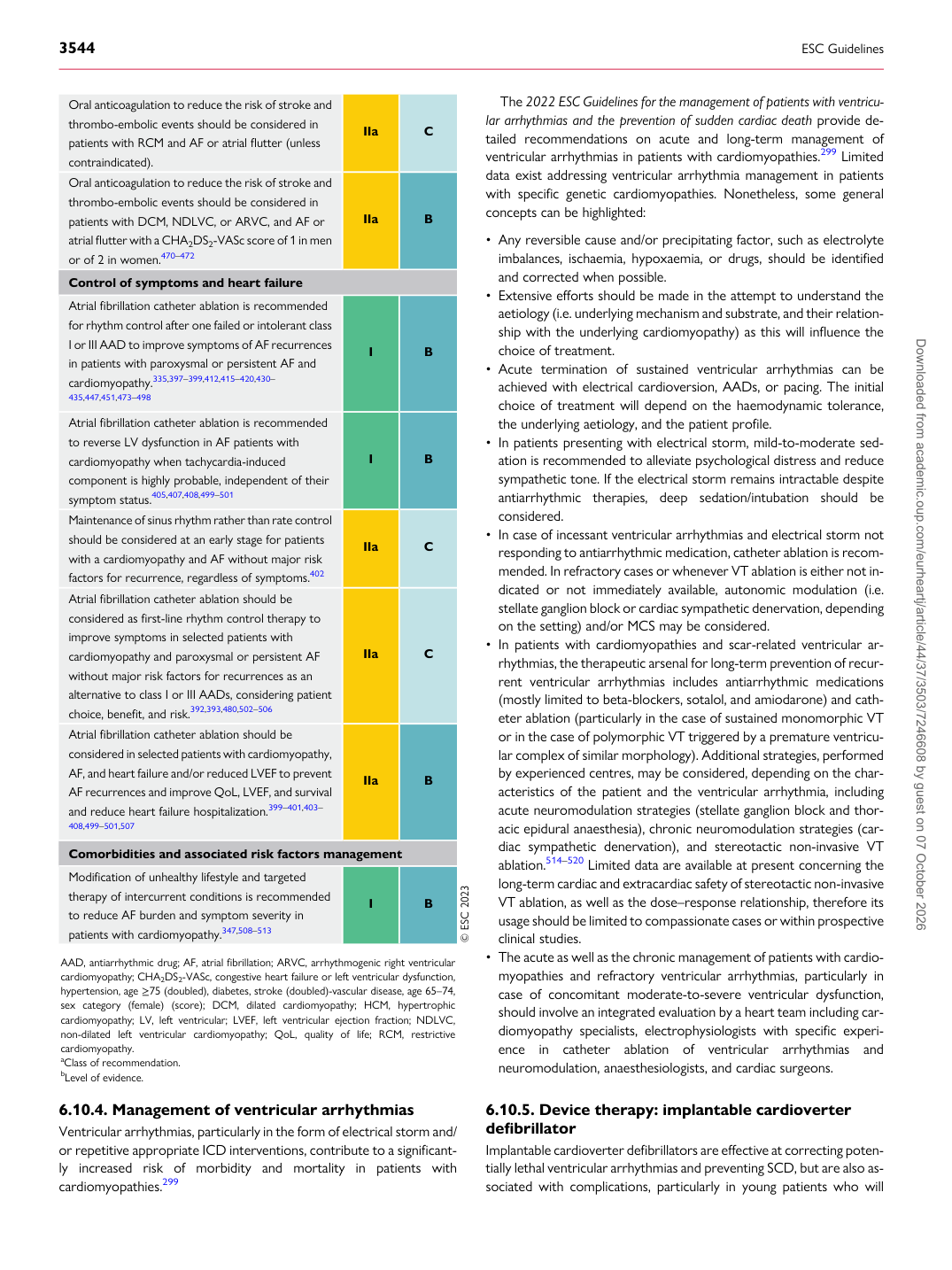
Oral anticoagulation to reduce the risk of stroke and thrombo-embolic events should be considered in patients with RCM and AF or atrial flutter (unless contraindicated). IIa C Oral anticoagulation to reduce the risk of stroke and thrombo-embolic events should be considered in patients with DCM, NDLVC, or ARVC, and AF or atrial flutter with a CHA2DS2-VASc score of 1 in men or of 2 in women.470–472 IIa B Control of symptoms and heart failure Atrial fibrillation catheter ablation is recommended for rhythm control after one failed or intolerant class I or III AAD to improve symptoms of AF recurrences in patients with paroxysmal or persistent AF and cardiomyopathy.335,397–399,412,415–420,430– 435,447,451,473–498 I B

Atrial fibrillation catheter ablation is recommended to reverse LV dysfunction in AF patients with cardiomyopathy when tachycardia-induced component is highly probable, independent of their symptom status.405,407,408,499–501 I B Maintenance of sinus rhythm rather than rate control should be considered at an early stage for patients with a cardiomyopathy and AF without major risk factors for recurrence, regardless of symptoms.402 IIa C Atrial fibrillation catheter ablation should be considered as first-line rhythm control therapy to improve symptoms in selected patients with cardiomyopathy and paroxysmal or persistent AF without major risk factors for recurrences as an alternative to class I or III AADs, considering patient choice, benefit, and risk.392,393,480,502–506 IIa C Atrial fibrillation catheter ablation should be considered in selected patients with cardiomyopathy, AF, and heart failure and/or reduced LVEF to prevent AF recurrences and improve QoL, LVEF, and survival and reduce heart failure hospitalization.399–401,403– 408,499–501,507 IIa B

Comorbidities and associated risk factors management Modification of unhealthy lifestyle and targeted therapy of intercurrent conditions is recommended to reduce AF burden and symptom severity in patients with cardiomyopathy.347,508–513 I B © ESC 2023

AAD, antiarrhythmic drug; AF, atrial fibrillation; ARVC, arrhythmogenic right ventricular cardiomyopathy; CHA2DS2-VASc, congestive heart failure or left ventricular dysfunction, hypertension, age ≥75 (doubled), diabetes, stroke (doubled)-vascular disease, age 65–74, sex category (female) (score); DCM, dilated cardiomyopathy; HCM, hypertrophic cardiomyopathy; LV, left ventricular; LVEF, left ventricular ejection fraction; NDLVC, non-dilated left ventricular cardiomyopathy; QoL, quality of life; RCM, restrictive cardiomyopathy. aClass of recommendation. bLevel of evidence. Downloaded from academic.oup.com/eurheartj/article/44/37/3503/7246608 by guest on 07 October 2026