p.41 抽出テキスト
levels is needed, as observational data suggest higher mortality in patients with AF, regardless of heart failure; the risk of death was related to serum digoxin concentration and was highest in patients with concentrations ≥1.2 ng/mL. On the contrary, a lower mortality with betablocker therapy in AF patients with concomitant heart failure has been observed. Non-dihydropyridine calcium channel blockers (CCBs) (verapamil or diltiazem) may only be used in patients with LVEF ≥40%.336 Atrioventricular node ablation is also an alternative in patients with poor ventricular rate control despite medical treatment not eligible for rhythm control by catheter ablation or in patients with biventricular pacing.336 In patients with symptomatic persistent AF (>6 months) unsuitable for AF ablation or in which AF ablation had failed, narrow QRS and at least one admission for heart failure, AV node ablation in association with CRT has been shown to be superior to rate control with pharmacological therapy, reducing the composite outcome of death due to heart failure, or hospitalization due to heart failure, or worsening heart failure,388 and all-cause mortality,389 irrespective of baseline EF (APAF-CRT Trial). Whether conduction system-pacing is a (better) alternative to CRT needs to be further explored with only one small crossover trial (ALTERNATIVE-AF) comparing His-Bundle pacing (HBP) and biventricular pacing in 50 patients with LVEF ≤40% with persistent AF undergoing AV node ablation.390 In this study, both arms significantly improved LVEF at 9 months, with a small, but statistically significant superiority with HBP.69,336

6.10.3.3 Rhythm control

Atrial fibrillation can result in haemodynamic and clinical decompensation due to shortening of the diastolic filling time with rapid heart rates and dependence on atrial contraction for LV filling. Therefore, maintenance of sinus rhythm is highly desirable and a rhythm control strategy is preferred, particularly in the presence of symptoms. Regarding long-term pharmacological treatment,336 antiarrhythmic drugs (AADs) have shown limited success in maintaining sinus rhythm over time both in the general population and in patients with cardiomyopathies,391–393 show high rates of withdrawal due to intolerance,394 and, most importantly, are associated with significant side effects, including proarrhythmia and extracardiac side effects, and, in some cases (sotalol and class IA drugs, such as quinidine and disopyramide), increased mortality.394 As a consequence, a degree of caution is recommended when using antiarrhythmic drugs in this population. Data on antiarrhythmic therapy for the specific management of AF in the context of genetic cardiomyopathies other than HCM are scarce. It is important to note the potential for proarrhythmia of class I antiarrhythmics, particularly in the presence of significant structural heart disease; these should therefore be used with caution. Antiarrhythmic drug–drug treatment has mostly been limited to amiodarone or sotalol, as there are no available data regarding other antiarrhythmics such as dofetilide or dronedarone. Importantly, sotalol should not be used in patients with HFrEF, significant LVH, prolonged QT, asthma, hypokalaemia, or creatinine clearance (CrCl) <30 ml/min. Likewise, dronedarone should be avoided in patients with recent decompensated heart failure or permanent AF as it has been shown to increase mortality.395,396 Catheter ablation of AF is a safe and superior alternative to AAD therapy for maintenance of sinus rhythm, reducing AF-related symptoms, and improving QoL, and can be considered an alternative to AAD therapy in practically any type and context of AF.336,397 In patients with AF and normal LVEF, catheter ablation has not been shown to reduce total mortality or stroke.398 In selected patients with HFrEF,399–401 ablation has shown a reduction in all-cause mortality and hospitalizations, and should be considered as a first-line option. In the general AF population, the Early Treatment of Atrial Fibrillation for Stroke Prevention Trial (EAST-AFNET 4) randomized 2789 patients with early AF and associated cardiovascular comorbidities to an early rhythm control strategy or usual care (28.6% with heart failure).402 The trial was stopped early after a median follow-up of 5.1 years for a lower occurrence of the primary outcome of death, stroke, or hospitalization for worsening heart failure or acute coronary syndrome in the patients in the early rhythm control group vs. those assigned to usual care. A pre-specified analysis evaluated the effects in patients with heart failure, showing the benefit of early rhythm control in this subgroup of patients,403 findings which corroborated those of the CABANA trial.400 In patients with AF and heart failure, several RCTs have demonstrated an improvement in outcomes with catheter ablation when compared with medical therapy.399–401,404–409

Some observational studies in patients with HFpEF have also suggested better results in terms of freedom from AF and all-cause mortality,410 but proper RCTs are warranted. The role of catheter ablation in patients with cardiomyopathies has been reported in several registries, mainly in HCM patients.397,411–420 Overall, maintenance is achieved in up to two-thirds of patients, although repeat procedures or continuation of antiarrhythmic medications are often necessary.397,411,415–419 Patients with cardiomyopathies may have a higher risk of AF recurrence, particularly in the presence of atrial remodelling/dilatation.397

6.10.3.4 Comorbidities and risk factor management

Cardiovascular risk factors and comorbidities are also more frequent in patients with cardiomyopathies and AF. These include smoking, alcohol consumption, hypertension, diabetes mellitus type 2, hyperlipidaemia, renal impairment, chronic obstructive pulmonary disease, valvular and ischaemic heart disease, and anaemia.332,334 Furthermore, these patients have a larger body mass index and report less physical activity than those without AF.332,334 These risk factors and comorbidities are associated with the risk of AF and its complications and should therefore be appropriately identified and managed to prevent AF progression and the occurrence of adverse outcomes.336

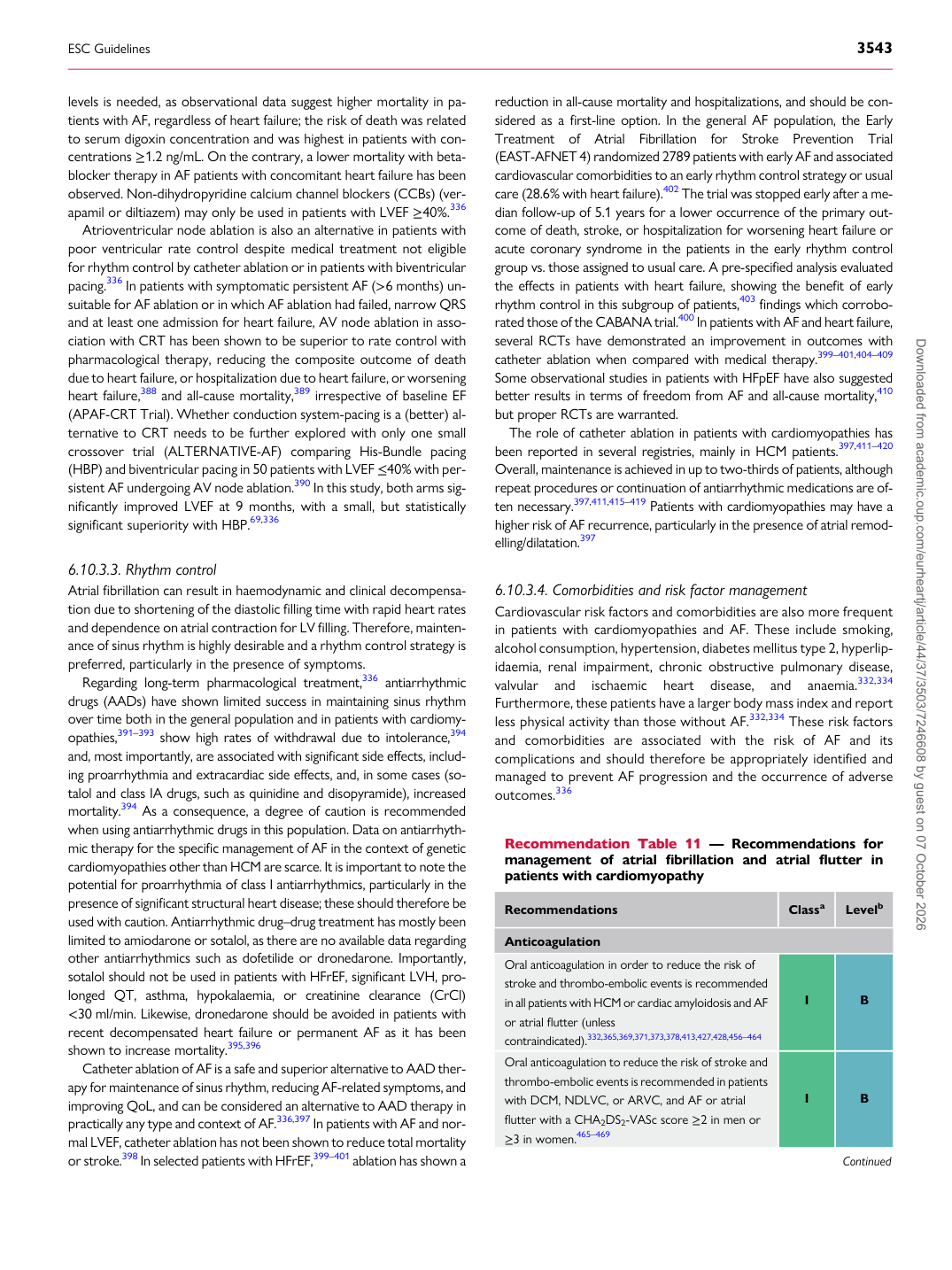
Recommendation Table 11 — Recommendations for management of atrial fibrillation and atrial flutter in patients with cardiomyopathy

Recommendations Classa Levelb

Anticoagulation Oral anticoagulation in order to reduce the risk of stroke and thrombo-embolic events is recommended in all patients with HCM or cardiac amyloidosis and AF or atrial flutter (unless contraindicated).332,365,369,371,373,378,413,427,428,456–464 I B Oral anticoagulation to reduce the risk of stroke and thrombo-embolic events is recommended in patients with DCM, NDLVC, or ARVC, and AF or atrial flutter with a CHA2DS2-VASc score ≥2 in men or ≥3 in women.465–469 I B

Continued

ESC Guidelines                                                                                                                                                                                          3543

Downloaded from academic.oup.com/eurheartj/article/44/37/3503/7246608 by guest on 07 October 2026