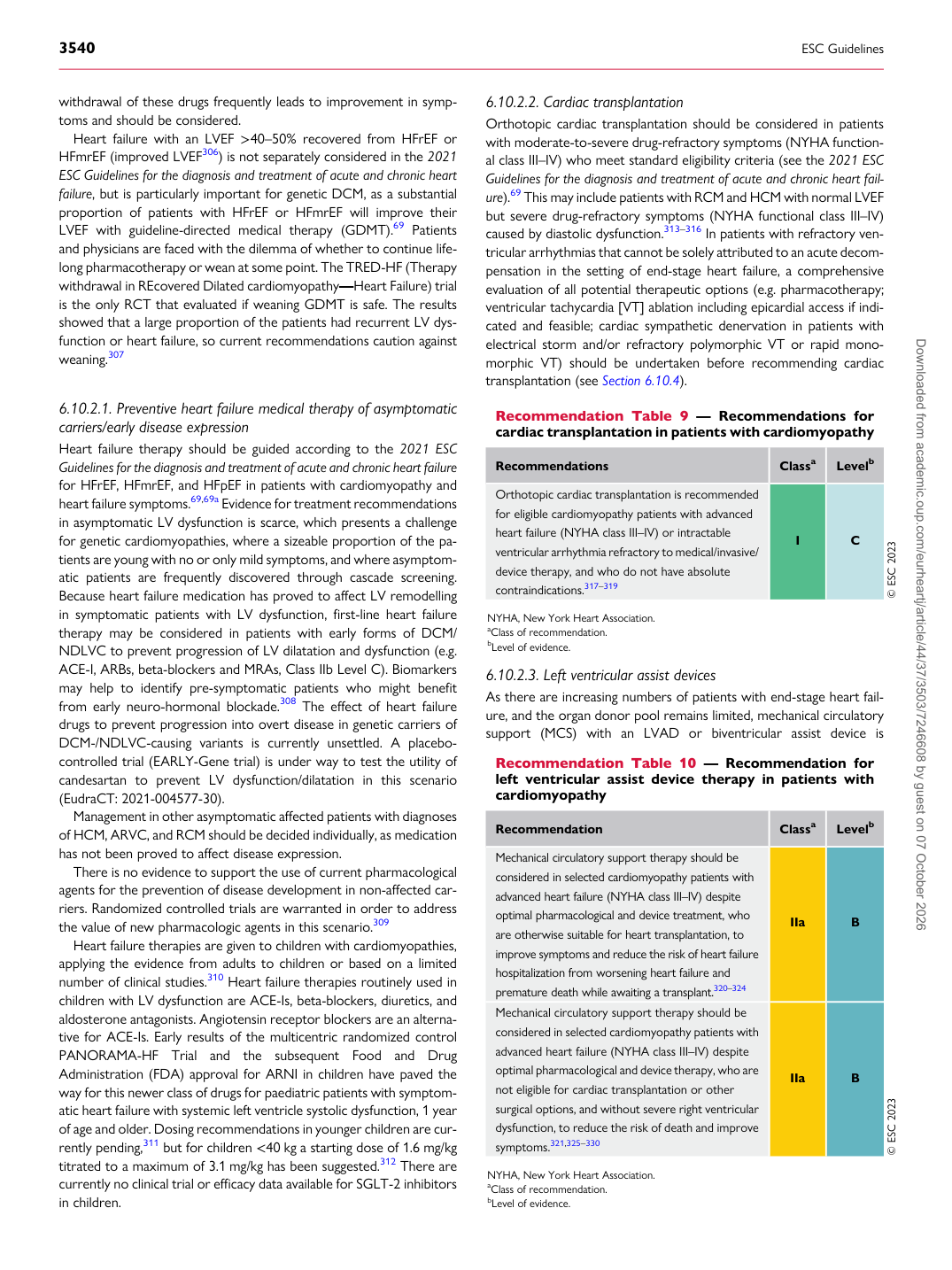
p.38 抽出テキスト
withdrawal of these drugs frequently leads to improvement in symptoms and should be considered. Heart failure with an LVEF >40–50% recovered from HFrEF or HFmrEF (improved LVEF306) is not separately considered in the 2021 ESC Guidelines for the diagnosis and treatment of acute and chronic heart failure, but is particularly important for genetic DCM, as a substantial proportion of patients with HFrEF or HFmrEF will improve their LVEF with guideline-directed medical therapy (GDMT).69 Patients and physicians are faced with the dilemma of whether to continue lifelong pharmacotherapy or wean at some point. The TRED-HF (Therapy withdrawal in REcovered Dilated cardiomyopathy—Heart Failure) trial is the only RCT that evaluated if weaning GDMT is safe. The results showed that a large proportion of the patients had recurrent LV dysfunction or heart failure, so current recommendations caution against weaning.307

6.10.2.1 Preventive heart failure medical therapy of asymptomatic

carriers/early disease expression Heart failure therapy should be guided according to the 2021 ESC Guidelines for the diagnosis and treatment of acute and chronic heart failure for HFrEF, HFmrEF, and HFpEF in patients with cardiomyopathy and heart failure symptoms.69,69a Evidence for treatment recommendations in asymptomatic LV dysfunction is scarce, which presents a challenge for genetic cardiomyopathies, where a sizeable proportion of the patients are young with no or only mild symptoms, and where asymptomatic patients are frequently discovered through cascade screening. Because heart failure medication has proved to affect LV remodelling in symptomatic patients with LV dysfunction, first-line heart failure therapy may be considered in patients with early forms of DCM/ NDLVC to prevent progression of LV dilatation and dysfunction (e.g. ACE-I, ARBs, beta-blockers and MRAs, Class IIb Level C). Biomarkers may help to identify pre-symptomatic patients who might benefit from early neuro-hormonal blockade.308 The effect of heart failure drugs to prevent progression into overt disease in genetic carriers of DCM-/NDLVC-causing variants is currently unsettled. A placebocontrolled trial (EARLY-Gene trial) is under way to test the utility of candesartan to prevent LV dysfunction/dilatation in this scenario (EudraCT: 2021-004577-30). Management in other asymptomatic affected patients with diagnoses of HCM, ARVC, and RCM should be decided individually, as medication has not been proved to affect disease expression. There is no evidence to support the use of current pharmacological agents for the prevention of disease development in non-affected carriers. Randomized controlled trials are warranted in order to address the value of new pharmacologic agents in this scenario.309 Heart failure therapies are given to children with cardiomyopathies, applying the evidence from adults to children or based on a limited number of clinical studies.310 Heart failure therapies routinely used in children with LV dysfunction are ACE-Is, beta-blockers, diuretics, and aldosterone antagonists. Angiotensin receptor blockers are an alternative for ACE-Is. Early results of the multicentric randomized control PANORAMA-HF Trial and the subsequent Food and Drug Administration (FDA) approval for ARNI in children have paved the way for this newer class of drugs for paediatric patients with symptomatic heart failure with systemic left ventricle systolic dysfunction, 1 year of age and older. Dosing recommendations in younger children are currently pending,311 but for children <40 kg a starting dose of 1.6 mg/kg titrated to a maximum of 3.1 mg/kg has been suggested.312 There are currently no clinical trial or efficacy data available for SGLT-2 inhibitors in children. 6.10.2.2 Cardiac transplantation

Orthotopic cardiac transplantation should be considered in patients with moderate-to-severe drug-refractory symptoms (NYHA functional class III–IV) who meet standard eligibility criteria (see the 2021 ESC Guidelines for the diagnosis and treatment of acute and chronic heart failure).69 This may include patients with RCM and HCM with normal LVEF but severe drug-refractory symptoms (NYHA functional class III–IV) caused by diastolic dysfunction.313–316 In patients with refractory ventricular arrhythmias that cannot be solely attributed to an acute decompensation in the setting of end-stage heart failure, a comprehensive evaluation of all potential therapeutic options (e.g. pharmacotherapy; ventricular tachycardia [VT] ablation including epicardial access if indicated and feasible; cardiac sympathetic denervation in patients with electrical storm and/or refractory polymorphic VT or rapid monomorphic VT) should be undertaken before recommending cardiac transplantation (see Section 6.10.4).

6.10.2.3 Left ventricular assist devices

As there are increasing numbers of patients with end-stage heart failure, and the organ donor pool remains limited, mechanical circulatory support (MCS) with an LVAD or biventricular assist device is

Recommendation Table 9 — Recommendations for cardiac transplantation in patients with cardiomyopathy

Recommendations Classa Levelb

Orthotopic cardiac transplantation is recommended for eligible cardiomyopathy patients with advanced heart failure (NYHA class III–IV) or intractable ventricular arrhythmia refractory to medical/invasive/ device therapy, and who do not have absolute contraindications.317–319 I C © ESC 2023

NYHA, New York Heart Association. aClass of recommendation. bLevel of evidence.

Recommendation Table 10 — Recommendation for left ventricular assist device therapy in patients with cardiomyopathy

Recommendation Classa Levelb

Mechanical circulatory support therapy should be considered in selected cardiomyopathy patients with advanced heart failure (NYHA class III–IV) despite optimal pharmacological and device treatment, who are otherwise suitable for heart transplantation, to improve symptoms and reduce the risk of heart failure hospitalization from worsening heart failure and premature death while awaiting a transplant.320–324 IIa B Mechanical circulatory support therapy should be considered in selected cardiomyopathy patients with advanced heart failure (NYHA class III–IV) despite optimal pharmacological and device therapy, who are not eligible for cardiac transplantation or other surgical options, and without severe right ventricular dysfunction, to reduce the risk of death and improve symptoms.321,325–330 IIa B © ESC 2023

NYHA, New York Heart Association. aClass of recommendation. bLevel of evidence. Downloaded from academic.oup.com/eurheartj/article/44/37/3503/7246608 by guest on 07 October 2026