p.35 抽出テキスト
6.9 Diagnostic approach to paediatric

patients Traditionally, cardiomyopathies in children have been considered to be distinct entities from adolescent and adult cardiomyopathies, with different aetiologies, natural history, and management. Although substantially rarer than in adults, contemporary data have shown that, beyond the first year of life, in most cases, paediatric cardiomyopathies represent part of the spectrum of the same diseases that are seen in adolescents and adults.245 Given their rarity, data on clinical management and outcomes are more limited than in adults, but large populationbased or international consortium data have provided important information on clinical presentation, natural history, and outcomes of cardiomyopathies in children.245 Paediatric-onset cardiomyopathies often represent two opposite ends of the spectrum of heart muscle disease: (i) severe, early-onset disease, with rapid disease progression and poor prognosis, in keeping with the most severe presentations in adults; or (ii) early phenotypic expression of adult cardiomyopathy phenotypes, increasingly identified as a result of family screening. For this reason, the Task Force highlights the principle of considering cardiomyopathies in all age groups as single disease entities, with recommendations applicable to paediatric and adult populations throughout this guideline, accepting that the evidence base for many of the recommendations is significantly more limited for children. Where there are age-related differences, these are specifically highlighted.

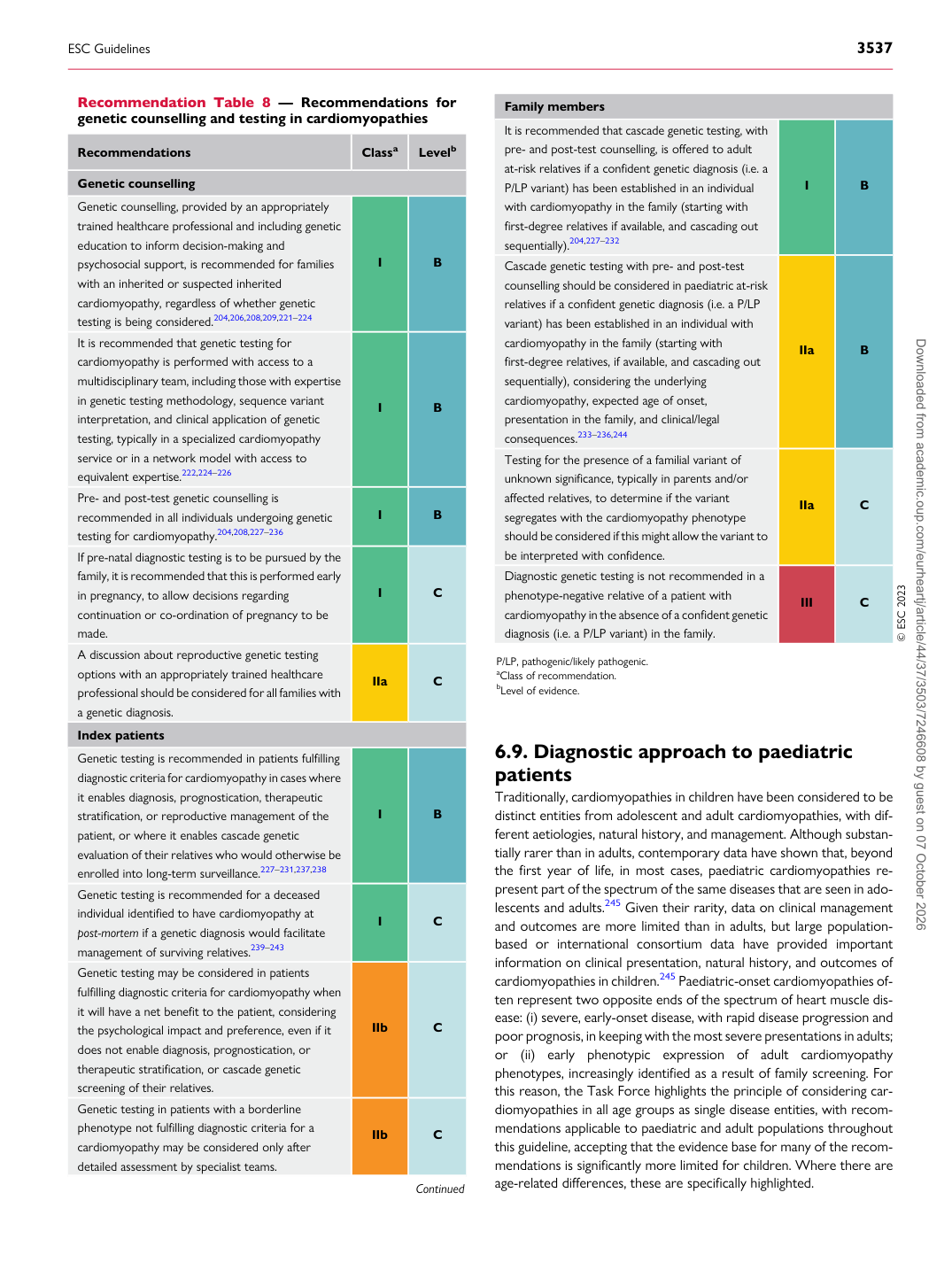
Recommendation Table 8 — Recommendations for genetic counselling and testing in cardiomyopathies

Recommendations Classa Levelb

Genetic counselling Genetic counselling, provided by an appropriately trained healthcare professional and including genetic education to inform decision-making and psychosocial support, is recommended for families with an inherited or suspected inherited cardiomyopathy, regardless of whether genetic testing is being considered.204,206,208,209,221–224 I B It is recommended that genetic testing for cardiomyopathy is performed with access to a multidisciplinary team, including those with expertise in genetic testing methodology, sequence variant interpretation, and clinical application of genetic testing, typically in a specialized cardiomyopathy service or in a network model with access to equivalent expertise.222,224–226 I B Pre- and post-test genetic counselling is recommended in all individuals undergoing genetic testing for cardiomyopathy.204,208,227–236 I B If pre-natal diagnostic testing is to be pursued by the family, it is recommended that this is performed early in pregnancy, to allow decisions regarding continuation or co-ordination of pregnancy to be made. I C A discussion about reproductive genetic testing options with an appropriately trained healthcare professional should be considered for all families with a genetic diagnosis. IIa C Index patients Genetic testing is recommended in patients fulfilling diagnostic criteria for cardiomyopathy in cases where it enables diagnosis, prognostication, therapeutic stratification, or reproductive management of the patient, or where it enables cascade genetic evaluation of their relatives who would otherwise be enrolled into long-term surveillance.227–231,237,238 I B Genetic testing is recommended for a deceased individual identified to have cardiomyopathy at post-mortem if a genetic diagnosis would facilitate management of surviving relatives.239–243 I C Genetic testing may be considered in patients fulfilling diagnostic criteria for cardiomyopathy when it will have a net benefit to the patient, considering the psychological impact and preference, even if it does not enable diagnosis, prognostication, or therapeutic stratification, or cascade genetic screening of their relatives. IIb C Genetic testing in patients with a borderline phenotype not fulfilling diagnostic criteria for a cardiomyopathy may be considered only after detailed assessment by specialist teams. IIb C

Continued Family members

It is recommended that cascade genetic testing, with pre- and post-test counselling, is offered to adult at-risk relatives if a confident genetic diagnosis (i.e. a P/LP variant) has been established in an individual with cardiomyopathy in the family (starting with first-degree relatives if available, and cascading out sequentially).204,227–232 I B Cascade genetic testing with pre- and post-test counselling should be considered in paediatric at-risk relatives if a confident genetic diagnosis (i.e. a P/LP variant) has been established in an individual with cardiomyopathy in the family (starting with first-degree relatives, if available, and cascading out sequentially), considering the underlying cardiomyopathy, expected age of onset, presentation in the family, and clinical/legal consequences.233–236,244 IIa B Testing for the presence of a familial variant of unknown significance, typically in parents and/or affected relatives, to determine if the variant segregates with the cardiomyopathy phenotype should be considered if this might allow the variant to be interpreted with confidence. IIa C Diagnostic genetic testing is not recommended in a phenotype-negative relative of a patient with cardiomyopathy in the absence of a confident genetic diagnosis (i.e. a P/LP variant) in the family. III C © ESC 2023

P/LP, pathogenic/likely pathogenic. aClass of recommendation. bLevel of evidence.

ESC Guidelines                                                                                                                                                                                          3537

Downloaded from academic.oup.com/eurheartj/article/44/37/3503/7246608 by guest on 07 October 2026