p.32 抽出テキスト
6.8.2.1 Non-Mendelian cardiomyopathies and implications for

genetic testing The preceding discussion has focused on genetic testing to identify monogenic forms of cardiomyopathy. The recognition that an important proportion of cardiomyopathies have a more complex genetic architecture has important implications for the use of genetic tests. The absence of a monogenic disease-causing variant on conventional genetic testing (i.e. sequencing for rare variants of large effect) leaves three possibilities: (i) either there is a monogenic cause that has not been identified (i.e. not detected or recognized as causative by current testing); (ii) the cardiomyopathy does not have a genetic aetiology; or (iii) the cardiomyopathy is attributable to the effects of multiple variants of individually smaller effect (Figure 8). Recent data suggest that for many cardiomyopathies, the absence of a rare causative variant on comprehensive testing indicates that the disease is unlikely to have a monogenic aetiology.182,183,194 This, in turn, implies a different inheritance pattern, with a lower risk to first-degree relatives, such that ongoing surveillance may not be indicated if an initial clinical evaluation is reassuring. The use of genetic testing to identify families in whom the disease is unlikely to be monogenic represents a likely new application of conventional testing, which is gathering evidence but not yet established. Polygenic risk scores (PRS) (sometimes known as genomic risk scores) are another form of genetic test that may, in the future, have relevance in the management of cardiomyopathies. Instead of trying to identify a single genetic variant that is responsible for disease, many variants across the genome are evaluated, each associated with a small effect on disease risk, and a score representing the aggregate risk is calculated.182,183,195–197 To date, the value of a PRS in the clinical management of cardiomyopathies has not yet been demonstrated, and access to genetic counselling will be even more important in conveying risks and uncertainties to patients and families.

6.8.2.2 Genetic test reports and variant interpretation

Many genetic diagnostic laboratories use a standardized framework to interpret and report diagnostic genetic test results.3,198–200 A negative genetic test result in a proband indicates that no causative variant has been found in a known disease-associated gene. This does not necessarily mean the patient does not have a genetic disease, but reflects our limited knowledge of the genetic architecture of inherited cardiomyopathies at this point in time. Aspects concerning the genetic testing approach, genetic testing methods, and variant interpretation are further elaborated in the Supplementary data online, Section 2, and in the European Heart Rhythm Association (EHRA)/Heart Rhythm Society (HRS)/Asia Pacific Heart Rhythm Society (APHRS)/Latin American Heart Rhythm Society (LAHRS) Expert Consensus Statement on the state of genetic testing for cardiac diseases.3

6.8.3 Genetic counselling

Genetic counselling is a process that aims to support patients and their families to understand and adapt to the medical, psychosocial, and familial impact of genetic diseases.201,202 It should be performed by healthcare professionals with specific training, such as genetic counsellors, genetic nurses, or clinical/medical geneticists, regardless of whether genetic testing is being considered. Genetic counselling can include a discussion of inheritance risks, provide education including the need for clinical evaluation, perform pre- and post-genetic test counselling, review variant classifications, obtain a three-generation family history, and provide psychosocial support.203–205 For patients with a new diagnosis of cardiomyopathy, there can be difficulty adjusting to life with an inherited cardiomyopathy, challenges living with an implantable cardioverter defibrillator (ICD), and ongoing trauma and grief for those who have experienced a young SCD in their family. Attention to the psychological support needs of patients is therefore critical (see Section 6.12). Indeed, in the general setting, genetic counselling can improve knowledge, recall, and patient empowerment; increase satisfaction with decision-making; and reduce anxiety.206–209

6.8.3.1 Genetic counselling in children

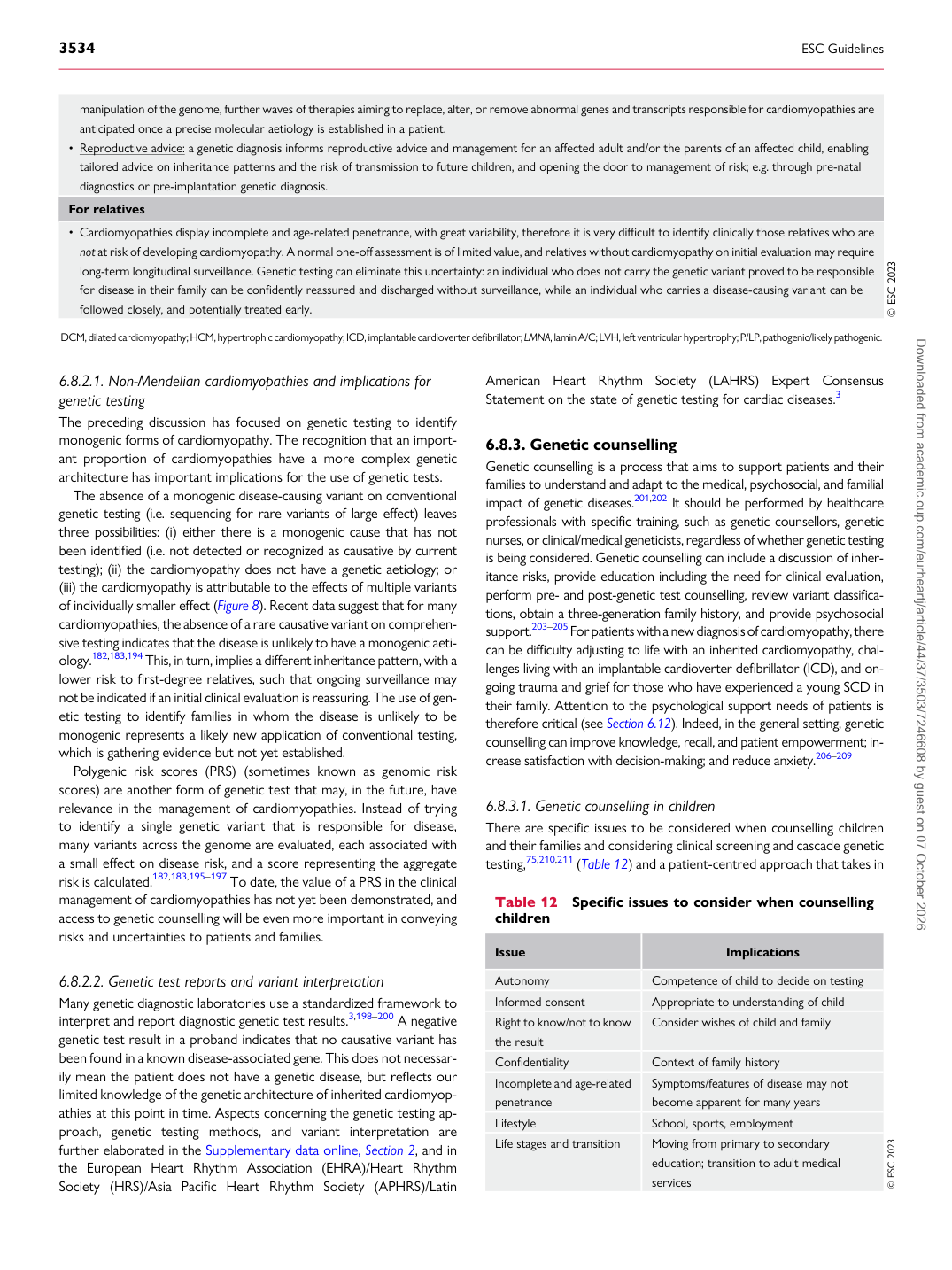
There are specific issues to be considered when counselling children and their families and considering clinical screening and cascade genetic testing,75,210,211 (Table 12) and a patient-centred approach that takes in

manipulation of the genome, further waves of therapies aiming to replace, alter, or remove abnormal genes and transcripts responsible for cardiomyopathies are anticipated once a precise molecular aetiology is established in a patient. • Reproductive advice: a genetic diagnosis informs reproductive advice and management for an affected adult and/or the parents of an affected child, enabling tailored advice on inheritance patterns and the risk of transmission to future children, and opening the door to management of risk; e.g. through pre-natal

diagnostics or pre-implantation genetic diagnosis. For relatives • Cardiomyopathies display incomplete and age-related penetrance, with great variability, therefore it is very difficult to identify clinically those relatives who are not at risk of developing cardiomyopathy. A normal one-off assessment is of limited value, and relatives without cardiomyopathy on initial evaluation may require

long-term longitudinal surveillance. Genetic testing can eliminate this uncertainty: an individual who does not carry the genetic variant proved to be responsible for disease in their family can be confidently reassured and discharged without surveillance, while an individual who carries a disease-causing variant can be followed closely, and potentially treated early. © ESC 2023

DCM, dilated cardiomyopathy; HCM, hypertrophic cardiomyopathy; ICD, implantable cardioverter defibrillator; LMNA, lamin A/C; LVH, left ventricular hypertrophy; P/LP, pathogenic/likely pathogenic.

Table 12 Specific issues to consider when counselling children

Issue Implications

Autonomy Competence of child to decide on testing Informed consent Appropriate to understanding of child Right to know/not to know the result Consider wishes of child and family Confidentiality Context of family history Incomplete and age-related penetrance Symptoms/features of disease may not

become apparent for many years

Lifestyle School, sports, employment Life stages and transition Moving from primary to secondary

education; transition to adult medical services © ESC 2023 Downloaded from academic.oup.com/eurheartj/article/44/37/3503/7246608 by guest on 07 October 2026