p.31 抽出テキスト
+ + +

- - + - - + +

+ - + +

- + +

- +

+ +

+ - + -

+

Severity

Disease susceptibility

Disease threshold Severity

Disease susceptibility

Disease threshold

Rare pathogenic variant Intermediate effect variant Small effect common variant Non-genetic factors

Panel A Panel B Panel C

Severity

Disease susceptibility

Disease threshold Low familial

aggregation

Autosomal dominant with incomplete penetrance and variable severity/expressivity

Sporadic presentation (negative family history) Autosomal dominant with

complete penetrance

Rare Mendelian variant Population MAF <0.01% Intermediate effect variant

Population MAF <1–2% Common variants (GWAS)

Population MAF >1–5%

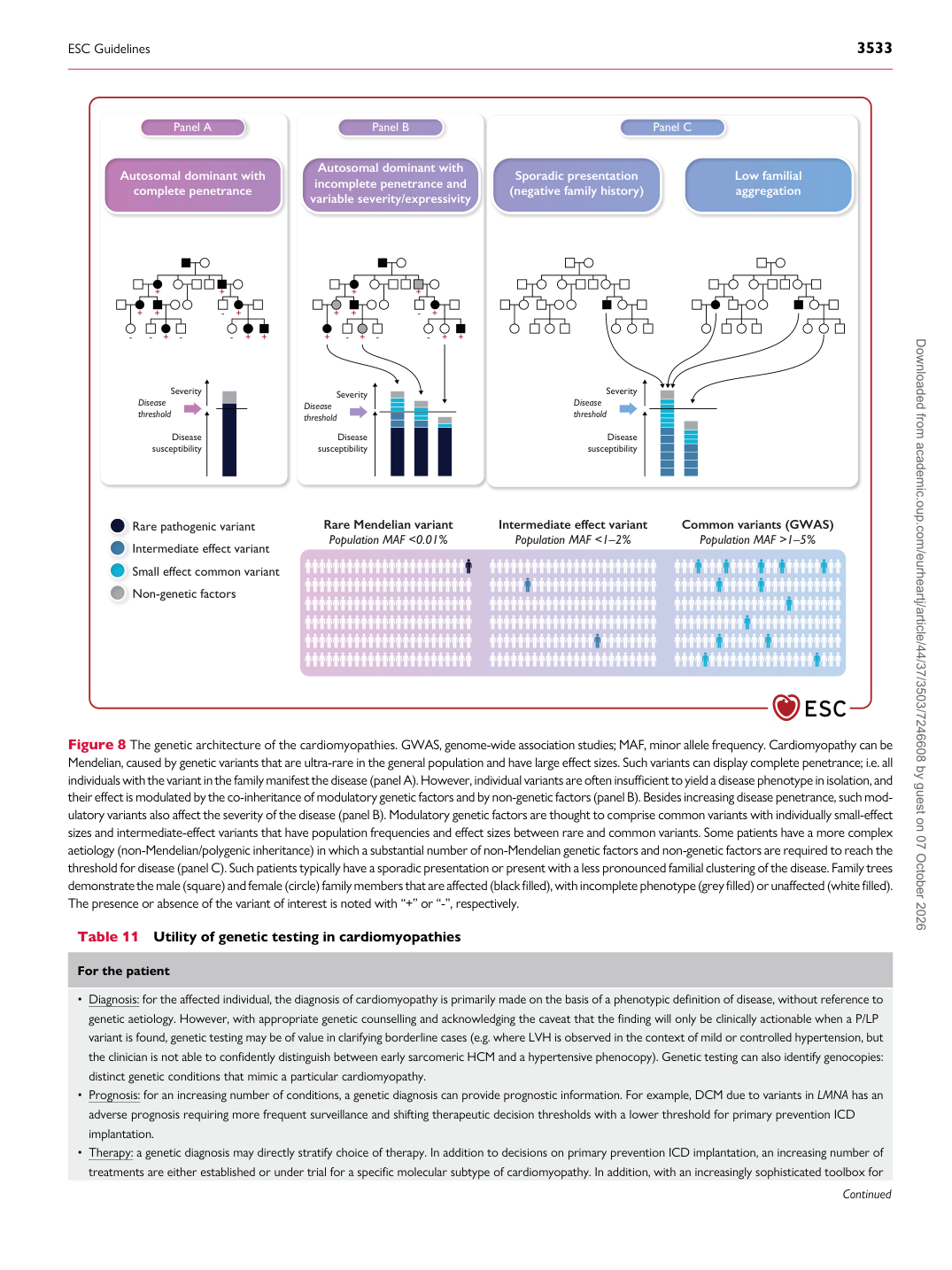
Figure 8 The genetic architecture of the cardiomyopathies. GWAS, genome-wide association studies; MAF, minor allele frequency. Cardiomyopathy can be Mendelian, caused by genetic variants that are ultra-rare in the general population and have large effect sizes. Such variants can display complete penetrance; i.e. all individuals with the variant in the family manifest the disease (panel A). However, individual variants are often insufficient to yield a disease phenotype in isolation, and their effect is modulated by the co-inheritance of modulatory genetic factors and by non-genetic factors (panel B). Besides increasing disease penetrance, such modulatory variants also affect the severity of the disease (panel B). Modulatory genetic factors are thought to comprise common variants with individually small-effect sizes and intermediate-effect variants that have population frequencies and effect sizes between rare and common variants. Some patients have a more complex aetiology (non-Mendelian/polygenic inheritance) in which a substantial number of non-Mendelian genetic factors and non-genetic factors are required to reach the threshold for disease (panel C). Such patients typically have a sporadic presentation or present with a less pronounced familial clustering of the disease. Family trees demonstrate the male (square) and female (circle) family members that are affected (black filled), with incomplete phenotype (grey filled) or unaffected (white filled). The presence or absence of the variant of interest is noted with “+” or “-”, respectively.

Table 11 Utility of genetic testing in cardiomyopathies

For the patient

• Diagnosis: for the affected individual, the diagnosis of cardiomyopathy is primarily made on the basis of a phenotypic definition of disease, without reference to genetic aetiology. However, with appropriate genetic counselling and acknowledging the caveat that the finding will only be clinically actionable when a P/LP

variant is found, genetic testing may be of value in clarifying borderline cases (e.g. where LVH is observed in the context of mild or controlled hypertension, but the clinician is not able to confidently distinguish between early sarcomeric HCM and a hypertensive phenocopy). Genetic testing can also identify genocopies: distinct genetic conditions that mimic a particular cardiomyopathy. • Prognosis: for an increasing number of conditions, a genetic diagnosis can provide prognostic information. For example, DCM due to variants in LMNA has an adverse prognosis requiring more frequent surveillance and shifting therapeutic decision thresholds with a lower threshold for primary prevention ICD

implantation. • Therapy: a genetic diagnosis may directly stratify choice of therapy. In addition to decisions on primary prevention ICD implantation, an increasing number of treatments are either established or under trial for a specific molecular subtype of cardiomyopathy. In addition, with an increasingly sophisticated toolbox for

Continued

ESC Guidelines                                                                                                                                                                                          3533

Downloaded from academic.oup.com/eurheartj/article/44/37/3503/7246608 by guest on 07 October 2026