p.24 抽出テキスト
severe renal disease.114 However, gadolinium-based contrast agents can be safely administered for patients with an estimated glomerular filtration rate >30 mL/min/1.73 m2, and nephrogenic systemic fibrosis is virtually unreported with the use of newer linear or macrocyclic gadolinium contrasts. For patients with severe renal impairment, new CMR modalities and mapping procedures, which are very informative and do not require the use of contrast, are particularly valuable when assessing Anderson–Fabry disease and cardiac amyloidosis.115–117 • The use of gadolinium contrast is generally not advised in pregnancy due to the potential for adverse outcomes in the foetus and neonate.118

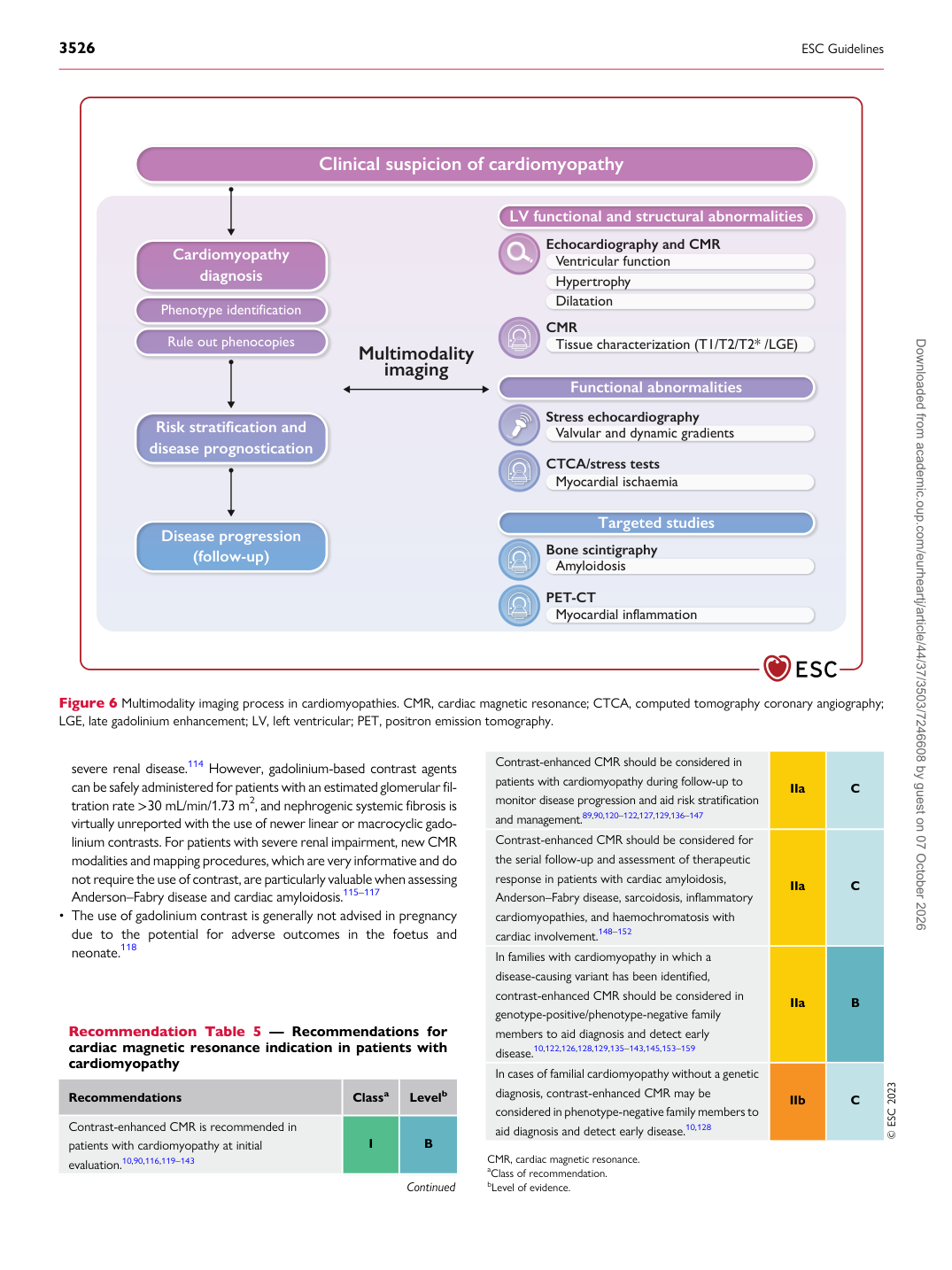
Multimodality

imaging LV functional and structural abnormalities

Ventricular function Hypertrophy Dilatation

Echocardiography and CMR

Tissue characterization (T1/T2/T2* /LGE) CMR

Amyloidosis Bone scintigraphy Myocardial inflammation PET-CT

Targeted studies

Valvular and dynamic gradients Stress echocardiography Myocardial ischaemia CTCA/stress tests

Functional abnormalities

Clinical suspicion of cardiomyopathy

Risk stratification and disease prognostication

Disease progression

(follow-up)

Cardiomyopathy

diagnosis Phenotype identification Rule out phenocopies

Figure 6 Multimodality imaging process in cardiomyopathies. CMR, cardiac magnetic resonance; CTCA, computed tomography coronary angiography; LGE, late gadolinium enhancement; LV, left ventricular; PET, positron emission tomography.

Recommendation Table 5 — Recommendations for cardiac magnetic resonance indication in patients with cardiomyopathy

Recommendations Classa Levelb

Contrast-enhanced CMR is recommended in patients with cardiomyopathy at initial evaluation.10,90,116,119–143 I B

Continued Contrast-enhanced CMR should be considered in

patients with cardiomyopathy during follow-up to monitor disease progression and aid risk stratification and management.89,90,120–122,127,129,136–147 IIa C Contrast-enhanced CMR should be considered for the serial follow-up and assessment of therapeutic response in patients with cardiac amyloidosis, Anderson–Fabry disease, sarcoidosis, inflammatory cardiomyopathies, and haemochromatosis with cardiac involvement.148–152 IIa C In families with cardiomyopathy in which a disease-causing variant has been identified, contrast-enhanced CMR should be considered in genotype-positive/phenotype-negative family members to aid diagnosis and detect early disease.10,122,126,128,129,135–143,145,153–159 IIa B In cases of familial cardiomyopathy without a genetic diagnosis, contrast-enhanced CMR may be considered in phenotype-negative family members to aid diagnosis and detect early disease.10,128 IIb C © ESC 2023

CMR, cardiac magnetic resonance. aClass of recommendation. bLevel of evidence. Downloaded from academic.oup.com/eurheartj/article/44/37/3503/7246608 by guest on 07 October 2026